PRODUCT COMPARISON · UPDATED OCTOBER 4, 2026
BioMedAna vs InvertBio: From Bioprocess Data to Modality-Native Intelligence
Compare BioMedAna and InvertBio for bioprocess data, scientific models, agents, modalities, implementation and price. See where each platform fits.
BioMedAna prepared this editorial comparison from the vendors’ public materials and its own product positioning. It is not endorsed by InvertBio. Confirm scope, availability and performance in a live evaluation.
A process team sees a change in product quality after a run that otherwise looked familiar. To understand what happened, the team needs to connect process conditions, analytical results, materials, events, batch history and the reasoning behind earlier decisions. It may also need to compare runs, investigate likely causes, design an experiment or model a scenario, and prepare findings for review.
Both BioMedAna and InvertBio address important parts of this work. InvertBio has a strong public proposition around bioprocess connectivity, data lineage, monitoring, analytics and reporting. BioMedAna’s proposition connects those needs to a broader operating model: Bio Hub contextualizes evidence, Bio Twin supports simulation and prediction, Bio Agents coordinate specialist work, and Bio OS provides governance and oversight.
The practical question for teams seeking an InvertBio alternative is how far the platform carries a process question—from finding evidence to modeling the process and organizing the next action. This is a BioMedAna-authored comparison, based on public vendor materials and BioMedAna’s stated product scope, not an independent performance benchmark.
At a glance
| Evaluation area | BioMedAna | InvertBio |
|---|---|---|
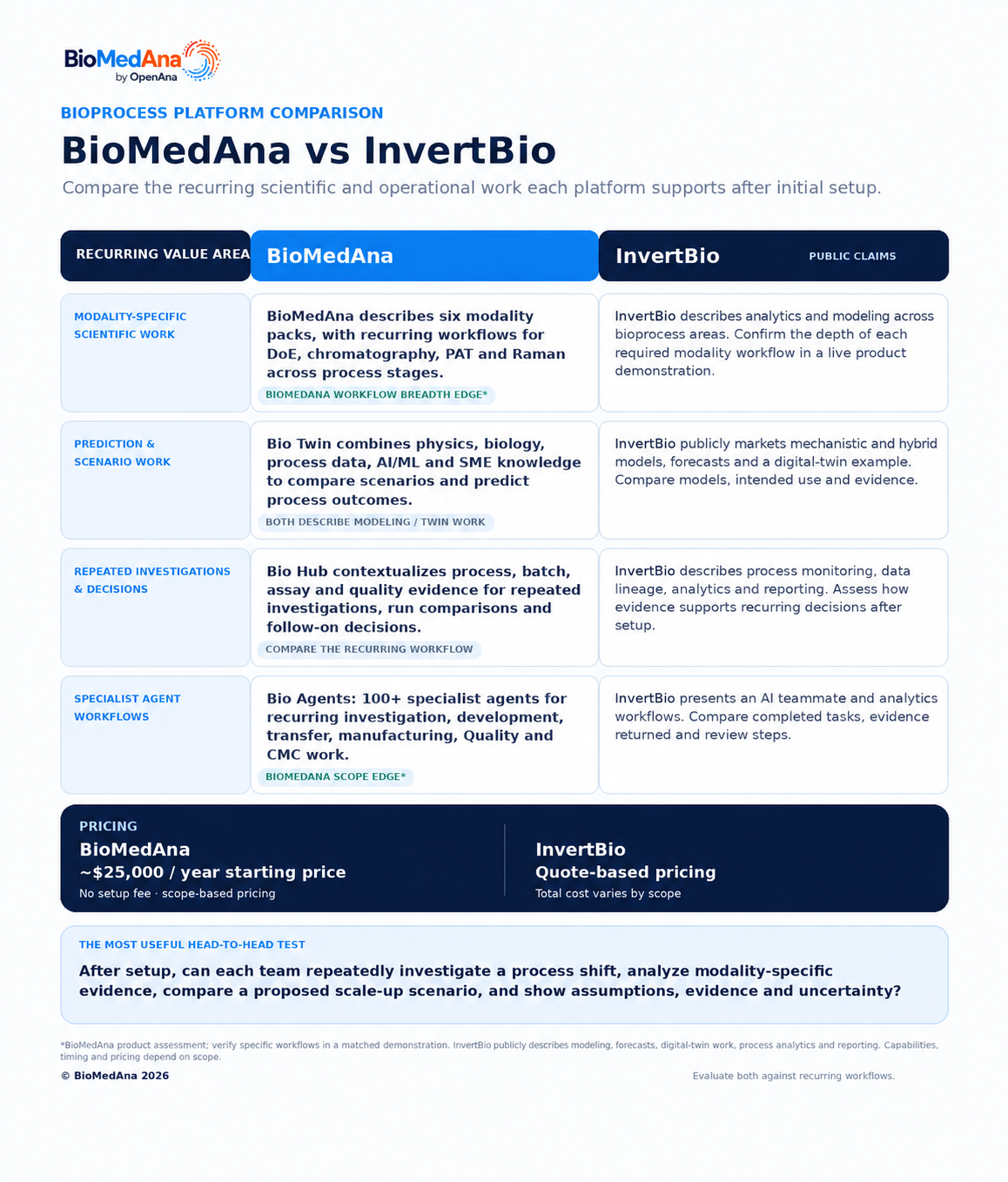
| Prebuilt connectivity | BioMedAna reports more than 100 connectors and positions Bio Hub as a connected process foundation. Compare the exact sources and configuration work in scope. | InvertBio advertises prebuilt integrations for bioreactors, historians, ELN, LIMS, analytical instruments and enterprise stores, with some connections described as going live in hours. |
| Data lineage and process context | Bio Hub adds process, batch, sample, assay, material and quality context, with six modality packs as a BioMedAna product claim. Test the exact scientific relationships needed. | InvertBio Foundation describes a unified namespace, transformations and end-to-end lineage across instruments and scales. |
| Monitoring, analysis and reports | BioMedAna connects run comparison and reporting to Hub evidence, Twin scenarios and coordinated Agents so a finding can become a reviewable next step. | InvertBio describes live-run monitoring, cross-run analysis, automated reports and traceable answers; it publishes quantified customer stories for reduced data work. |
| Mechanistic, hybrid and predictive models | Bio Twin combines physics, biology, process data, AI/ML and SME knowledge for scenario comparison, prediction and uncertainty-aware decisions. Neither vendor has a proven accuracy edge here. | InvertBio Models explicitly lists soft sensors, forecasts, mechanistic and hybrid models, optimization, simulation and monitoring; it publishes an executable CHO twin showcase using simulated data. |
| DoE and virtual experimentation | BioMedAna describes DoE analysis and virtual scenario exploration as recurring scientific workflows. This is a claimed product edge to demonstrate on the same experiment-planning task. | InvertBio describes experimental design and modeling. Its public materials do not establish the depth of every productized DoE workflow a buyer may need. |
| Chromatography, PAT and Raman | BioMedAna describes chromatography, PAT and Raman analysis linked to process stages, quality outcomes and scientific decision workflows. Verify each required method live. | InvertBio connects downstream and analytical sources and documents downstream lineage. Specific model and workflow depth should be shown in the proposed product. |
| Modality-native workflow depth | BioMedAna describes six modality packs configured around biology, process stages and intended use. A modality list alone does not prove equivalent native depth. | InvertBio markets biologics, microbial fermentation, cell therapy, gene therapy and other areas; its pricing questionnaire lists further modalities. |
| Cross-functional specialist agents | Bio Agents is positioned as 100+ ready agents coordinated across development, transfer, manufacturing, Quality and CMC, with evidence-linked drafts and human ownership. | InvertBio Assist can analyze, report, prepare imports and use reusable Skills with review steps. It is more than a simple chat interface. |
| Initial time to value | BioMedAna says a focused Bio Hub and Bio Agents workflow can start in days; its broader initial-value target is 8–12 weeks. Compare the same outcome, data readiness and validation scope. | InvertBio advertises fast integrations and AI workflows and reports rapid customer deployments. Scope varies by case. |
| Soft sensors and scale-up decisions | BioMedAna’s claimed distinction is a connected process-to-quality workflow: context, model-supported scale-up scenarios, uncertainty and expert review before intervention. | InvertBio demonstrates a predictive iPSC soft sensor on simulated lots and markets modeling and forecasts. Compare the output’s intended use and review path. |
| Commercial fit | BioMedAna states a starting price of approximately $25,000 per year with no setup fee. Compare written proposals for the same integrations, services and validation work. | InvertBio’s public pricing page requests equipment, facility and modality details for a tailored quote; it does not publish a rate card or first-year TCO. |
| Public business references | BioMedAna’s scope claims should be tested in a matched workflow and supported by customer references appropriate to the buyer’s use case. | InvertBio publishes vendor-reported cases covering manual data-effort reduction, hours recovered, costs avoided and a digital-twin data integration. |
| Governance and regulated deployment | Bio OS is positioned for permissions, traceability, model lifecycle and human oversight. BioMedAna says it supports 21 CFR Part 11; confirm the exact controls and intended use. | InvertBio publicly lists SOC 2, ISO 27001, audit trails and 21 CFR Part 11-related controls. Verify the exact product and validation responsibilities. |
What InvertBio does well
InvertBio positions itself as infrastructure and intelligence for bioprocess development and manufacturing. Its Integrations and Foundation pages describe prebuilt connectivity, a unified namespace, bioprocess-aware transformations and end-to-end lineage. Enablement describes live-run monitoring against historical baselines and quick access to a run’s design, intent and outcome. These are meaningful capabilities for reducing manual data preparation and improving process visibility.
InvertBio’s Intelligence layer and Assist support natural-language analysis, code-backed traceability and reporting. The Process Development page describes upstream-to-downstream linkage, automated reporting and prompt-to-model work. Its Models page expressly lists mechanistic and hybrid models, forecasts, soft sensors, classifiers, optimization and simulation. InvertBio also publishes an executable CHO digital-twin showcase made with simulated data. These capabilities belong in a direct evaluation of both platforms.
InvertBio publishes vendor-reported customer outcomes, including roughly 98% less manual data work and 3,046 hours recovered per CMC program, a digital-twin data integration in under one month, and costs avoided in a cell-therapy deployment. These are InvertBio case claims rather than independently audited, matched comparisons with BioMedAna. They nevertheless give buyers concrete references to examine.
InvertBio Foundation ↗InvertBio Enablement ↗InvertBio Models ↗InvertBio case studies ↗
BioMedAna’s connected operating model
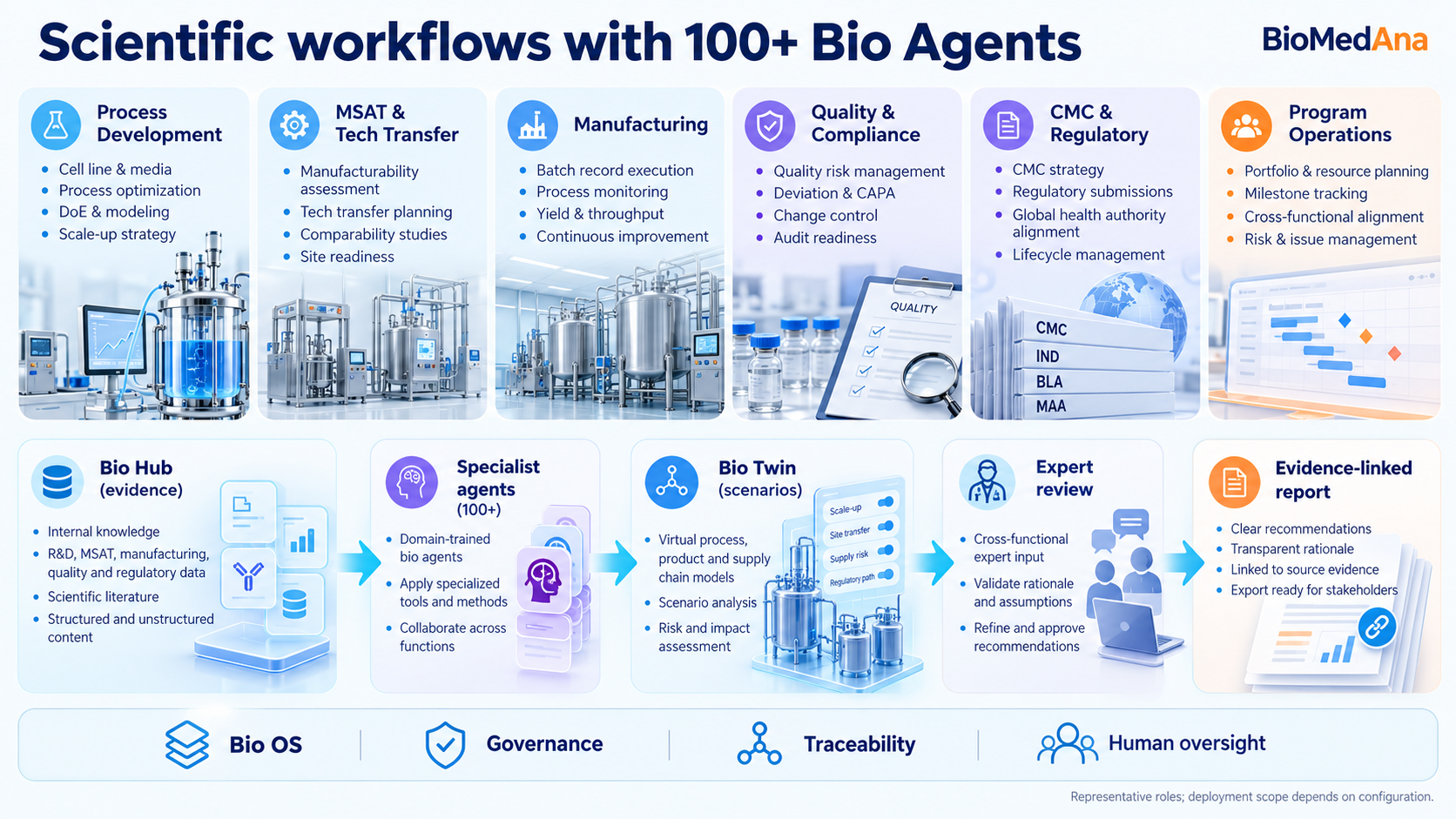
BioMedAna brings four capabilities together. Bio Hub connects process, analytical and enterprise sources and gives the records batch, sample, material, phase and quality context. Bio Twin combines physics, biology, process data, AI/ML and human expertise to compare scenarios and predict outcomes. Bio Agents coordinate specialist work around connected evidence and models. Bio OS supplies shared integration, permissions, governance, security and traceability.
The relationship between these capabilities is the BioMedAna proposition. Hub provides reusable context for investigation before a predictive model exists. Twin can support prediction and simulation when a scientific question warrants it. Agents can organize analysis, evidence mapping, investigation and documentation, including tasks that do not begin with a simulation. OS keeps source lineage, model version and review ownership visible throughout the workflow.
BioMedAna currently describes six modality packs, more than 100 ready agents, and workflows spanning development, scale-up, transfer, manufacturing, Quality and CMC. Its product materials describe DoE, hybrid simulation, chromatography, PAT and Raman analysis. These are BioMedAna product claims to test against a customer’s own modality, data and intended use.
Explore Bio Hub ↗Explore Bio Twin ↗Explore Bio Agents ↗Explore Bio OS ↗
What BioMedAna means by a digital twin
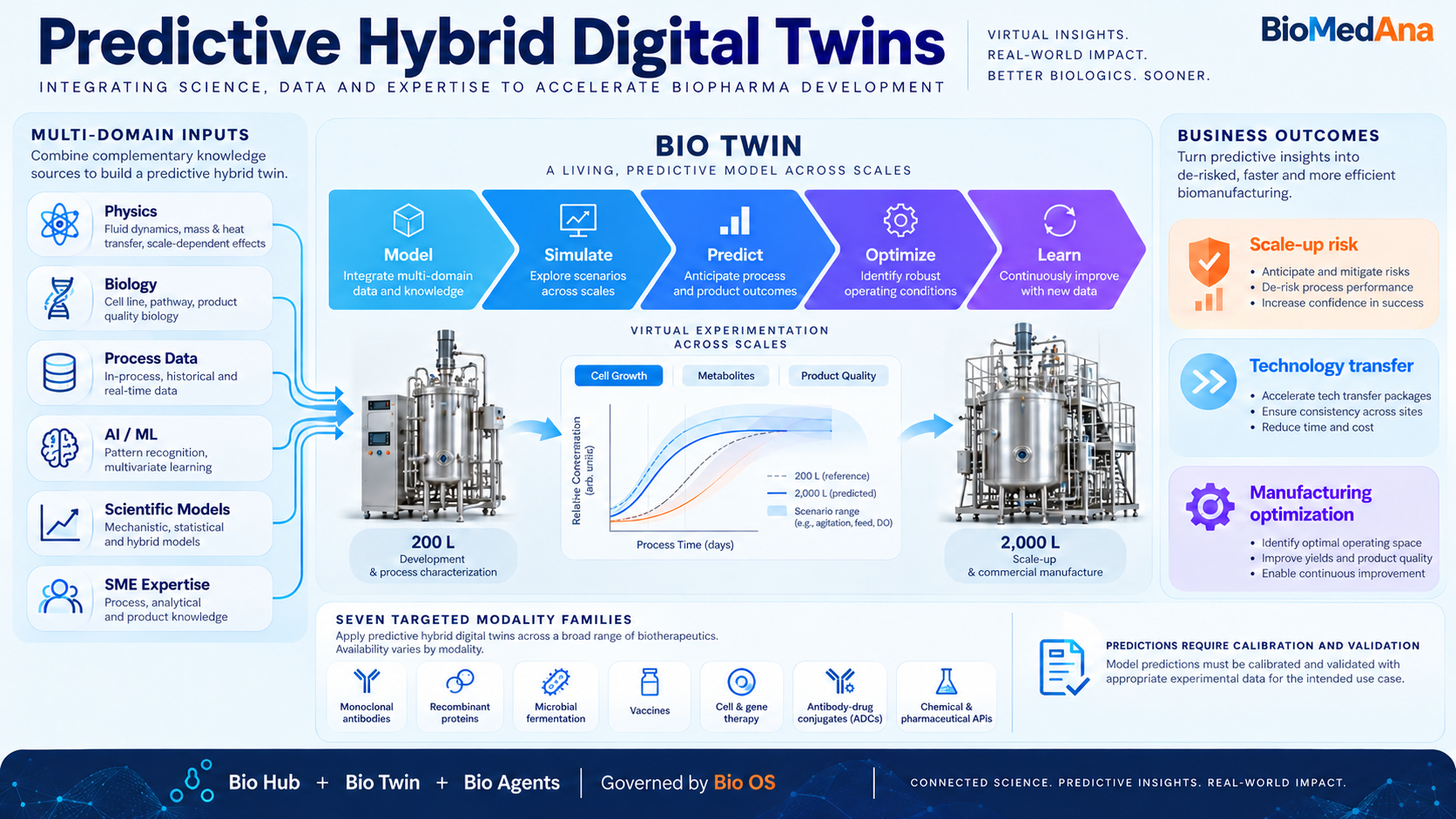
A BioMedAna digital twin is positioned as a connected decision system, beyond a dashboard or a one-time simulation. It links process evidence and context to mechanistic and engineering knowledge, biological response, AI/ML and subject-matter expertise. A scientifically appropriate Twin can compare conditions, forecast yield or quality outcomes, surface uncertainty and help identify risks early enough for a team to consider preventive action. Earlier risk visibility does not guarantee that every deviation can be prevented.
For scale-up, the question is not only what a PAT sensor reads. It is how changes in mixing, oxygen transfer, shear or other physical conditions may affect biology and product outcomes at the next scale. In downstream processing, a signal is more useful when tied to run context, chromatography conditions, quality results and a model that can compare operating or pooling strategies. This is the full loop BioMedAna aims to support: detect, contextualize, investigate, predict, compare and review.
What is a bioprocess digital twin? ↗AI in bioprocess scale-up ↗
Connectivity is shared; scientific context is the test
Both vendors connect bioprocess data. InvertBio emphasizes prebuilt integrations and fast connections. BioMedAna reports more than 100 connectors and positions Bio Hub as a scientific foundation for process, batch, modality and analytical context. A connector count is only a starting point: buyers should validate the actual instruments and systems, how much is prebuilt, what needs configuration, and whether data from different stages can be used together.
For an unexpected quality shift, ask both products to show where an assay result came from, which run and process version it belongs to, which material entered the process, and what happened before it changed. The stronger data layer is the one that retains the context needed for the next scientific decision, not simply the one that ingests more files.
InvertBio Integrations ↗What is bioprocess data contextualization? ↗
Reporting and process intelligence are different jobs
InvertBio has a strong public proposition in data exploration, automated analysis and report generation. Its Assist documentation describes reproducible Python-backed answers, root-cause analysis, experiment summaries, reports, staged data changes and reusable Skills. BioMedAna’s product assessment is that its combined Hub and Agents scope can carry more cross-functional work through evidence preparation, modeling, investigation and review. That claimed breadth should be demonstrated rather than inferred from the number of agents or a label on either website.
A useful test starts with a cross-run comparison, then asks each system to investigate a finding, identify the evidence gap, propose a next experiment or model scenario, and prepare a brief for a named process or Quality owner. Compare the records used, calculations performed, evidence links, reviewer corrections and what remains reusable after the decision.
InvertBio Assist user guide ↗How to investigate a bioreactor deviation ↗
Compare scientific model workflows, not model labels
InvertBio’s current Models page explicitly markets mechanistic and hybrid models, forecasts, optimization, simulation and soft sensors. BioMedAna positions Bio Twin around hybrid modeling, process-to-quality prediction and scenario analysis. Public materials do not establish which is more accurate or better validated for any customer’s intended use. A fair comparison asks each vendor to run the same representative data and show model assumptions, fit, uncertainty, versioning and deployment boundary.
BioMedAna’s claimed differentiation lies in implemented, modality-aware decision workflows: DoE and virtual experimentation; chromatography, PAT and Raman analysis; process-to-quality relationships; and how modeled results flow into investigations and specialist agent work. BioMedAna’s product assessment favors its breadth here, while InvertBio’s broad modeling claims warrant a direct demonstration. Ask which workflows exist in the proposed product, which require custom development, and which are showcase examples.
InvertBio Models ↗InvertBio CHO twin showcase ↗How to validate a bioprocess digital twin ↗
A modality list is not modality-native depth
InvertBio’s site markets biologics, microbial fermentation, cell therapy and gene therapy, and its pricing questionnaire lists still more modalities. That is meaningful market coverage, but a list does not by itself prove the same data structures, models or workflows are delivered for each modality. BioMedAna describes six packs configured around biology, measurements, process stages and intended use.
A monoclonal-antibody quality investigation, a microbial scale-up question and a cell-therapy manufacturing review should not be forced into identical scientific interpretations. BioMedAna’s strongest proposed fit is one operating foundation that retains those differences while connecting data, Twin scenarios and agent workflows. Buyers should verify the exact pack and the deployed workflow for their modality.
InvertBio pricing questionnaire ↗BioMedAna modality-specific Twin ↗
Deployment speed must describe the same outcome
BioMedAna says a focused Bio Hub and Bio Agents starting workflow can go live in days. The website separately targets initial measurable value in 8–12 weeks for broader implementation; Bio Twin work is scoped around the process and model validation needs. InvertBio publicly says prebuilt integrations can go live in hours and that certain AI workflows can be delivered in days. Its customer stories describe rapid defined deployments, including digital-twin data integration in less than a month.
These timelines are not directly comparable until the deliverable is defined. Connector setup, a first investigation, an operational digital twin and a multi-site regulated rollout are different projects. Ask both vendors for the same sources, sites, users, controls, acceptance tests and definition of live use before assigning a time advantage.
InvertBio Integrations ↗InvertBio R&D Digital ↗BioMedAna OS ↗
Pricing and first-year commercial fit
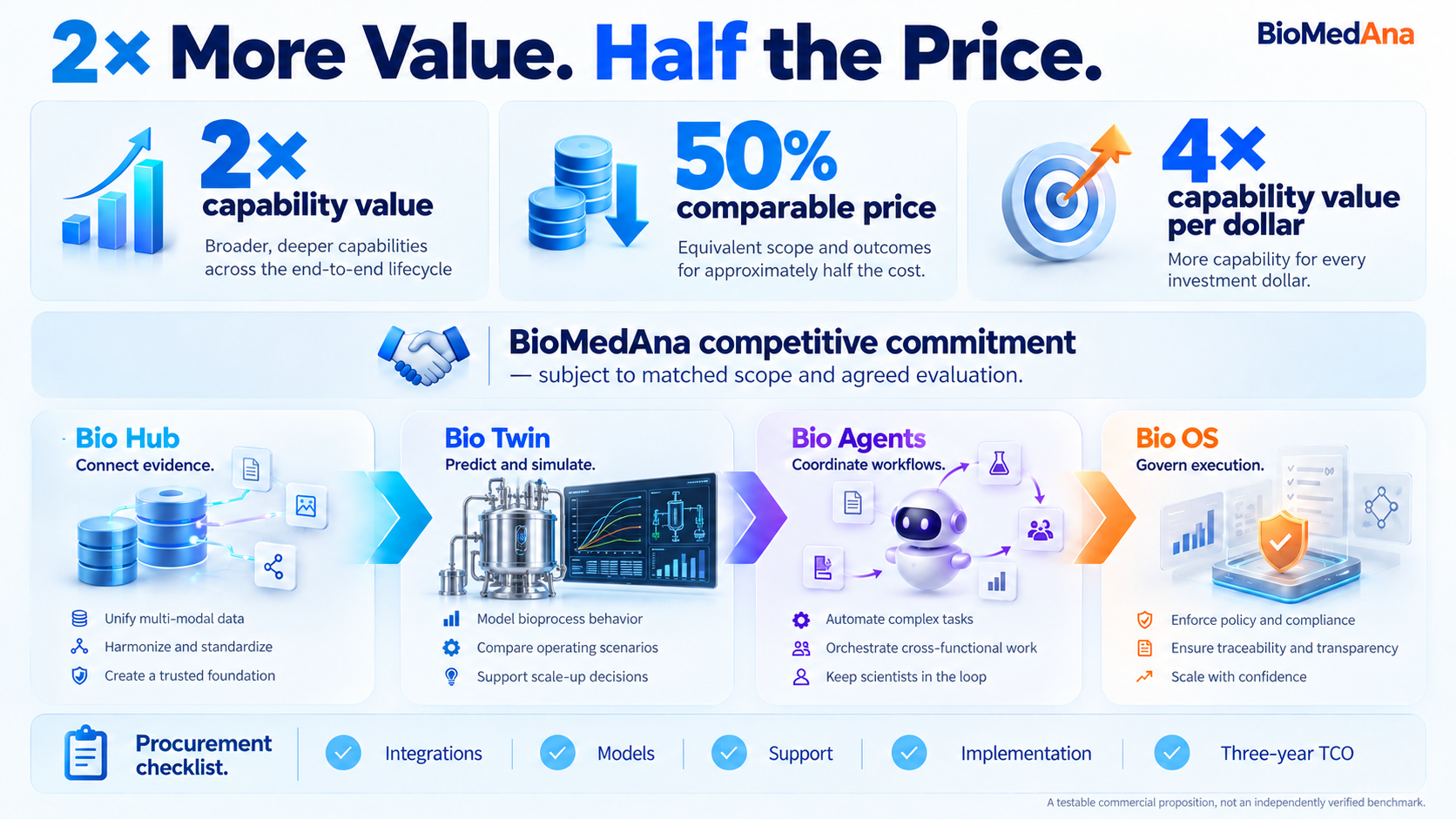
BioMedAna’s company-supplied starting price is approximately $25,000 per year, with no setup fee for that starting offer. The exact offer, included workflows and services should be confirmed in writing. InvertBio’s public pricing page does not publish a rate card: it asks for equipment, facilities and modalities before offering a tailored estimate. The comparison graphic reflects these different published starting points.
BioMedAna’s supplied market intelligence suggests that InvertBio may charge a one-time setup fee and estimates first-year total cost at roughly four to seven times BioMedAna’s starting price—about $100,000–$175,000 when $25,000 is used as the arithmetic baseline. This is an unverified BioMedAna estimate, not an InvertBio quote, and no matched-scope evidence establishes that ratio. InvertBio’s actual first-year total cost is unknown from public information.
Buyers should compare written proposals for the same first workflow, integrations, facilities, modalities, users, validation requirements, services, recurring fees, support and acceptance criteria. The price of a connector or starter package is not the cost of a full decision workflow.
Sensor readings and predictive decisions answer different questions
A sensor or soft sensor can produce a valuable measurement or estimate. InvertBio’s current site goes further than reporting readings: it markets predictive models and publishes an illustrative iPSC soft-sensor analysis using simulated lots. Both platforms should therefore be tested for the prediction, evidence and intervention path each supports.
BioMedAna’s claimed distinction is the integrated decision workflow. It connects a signal to run, biological and quality context; examines how a process may respond to a proposed change or scale transition; compares outcomes and uncertainty; and sends the evidence to an expert for review. Ask both vendors to show the same project-level scale-up or process-change scenario and the action the output actually supports.
InvertBio simulated soft-sensor example ↗AI, PAT and downstream processing ↗
InvertBio has more visible public customer references
InvertBio currently publishes quantified customer stories about manual data effort, hours recovered, costs avoided and a digital-twin data integration. This gives a buyer more public examples to inspect today. Their measures are vendor-reported and were not produced in a head-to-head comparison with BioMedAna.
BioMedAna’s proposed advantages in agent breadth, modality-specific workflows, speed and commercial fit should be supported with similarly clear customer outcomes as deployments mature. Until then, a buyer should use the same process question and a referenceable acceptance test to judge both products.
Who should evaluate each platform?
InvertBio is worth evaluating when the immediate priority is connecting bioprocess sources, monitoring runs, reducing manual analysis and reporting work, and making data more accessible. Its integration proposition and public cases provide concrete starting points.
BioMedAna is worth evaluating when the requirement extends from connected evidence into modality-specific scientific work: DoE and scenario analysis, hybrid process models, specialized downstream and PAT workflows, investigations, transfer readiness, and Quality or CMC evidence preparation. Bio Hub and Bio Agents can be a focused start, with Bio Twin added when prediction or simulation informs a defined decision and Bio OS governing the connected workflow.
Some organizations may combine existing data or modeling tools with another intelligence layer. In that case, evaluate interoperability, model portability, data ownership, traceability and the operating cost of the combined architecture before choosing a design.
See your workflow in BioMedAna ↗Bioprocess AI platform evaluation guide ↗
The decision is about the next workflow and the platform beyond it
InvertBio is a serious bioprocess platform with strengths in connectivity, lineage, monitoring, analytics, reporting and visible customer evidence. Its public materials also describe hybrid models, AI Assist and digital-twin work. Those capabilities should be tested in the actual product, not dismissed.
BioMedAna’s strongest case is breadth around the process decision: Bio Hub for contextualized evidence, Bio Twin for scientific modeling and prediction, Bio Agents for coordinated specialist work, and Bio OS for governance. Its product assessment favors modality-specific workflows, agent scope and a faster, lower-cost focused starting path. The strength of that case depends on demonstrating the exact required workflow with the buyer’s data and reviewers.
Prepare a comparison using your own evidence
Use the bioprocess AI platform evaluation guide to agree on the question, inputs and review criteria. The connected-platform comparison explains how data, models and agents support the same scientific workflow.
Before the demonstration, check bioprocess data readiness, define digital twin validation criteria, and select a representative bioreactor deviation investigation to test evidence traceability.
Questions to ask in a live demo
- Use the same process question, source data, intended user and reviewable output for both vendors.
- Show which instruments, historians, ELN, LIMS and analytical sources connect directly versus through custom configuration.
- Trace runs, process versions, events, materials, samples, analytical results and quality attributes to their original records.
- Compare runs, identify candidate drivers and gaps, then show a DoE or next-experiment method where appropriate.
- Test predictive and hybrid models on held-out data, including error, uncertainty, model version and intended use.
- Demonstrate chromatography, PAT or Raman analysis and its connection to process and quality outcomes if those are in scope.
- Show which AI or agent tasks execute, what method or code is used, what evidence is returned and who approves the next action.
- Inspect audit trails, permissions, model versions, human review records and validation responsibilities.
- Compare implementation and total first-year cost using identical systems, modalities, sites, users, services and acceptance criteria.
Frequently asked questions
Does InvertBio offer process models or digital-twin capabilities?
Yes. InvertBio’s current Models page lists mechanistic and hybrid models, forecasts, soft sensors, optimization and simulation. It also publishes a CHO digital-twin showcase built from simulated data. Confirm the product and validation scope for your process.
Does InvertBio support multiple modalities?
InvertBio publicly markets several bioprocess areas and lists more in its pricing questionnaire. Compare the actual data model, scientific workflow and implementation depth for your modality.
How is BioMedAna different from InvertBio Assist?
InvertBio Assist offers traceable AI analysis and reusable Skills. BioMedAna positions 100+ ready specialist agents coordinated with Hub context, Twin scenarios and Bio OS review across development, transfer, manufacturing, Quality and CMC. Compare completed tasks on the same data.
Is BioMedAna faster to implement?
BioMedAna says focused Hub and Agents workflows can begin in days, while its broader initial-value target is 8–12 weeks. InvertBio also publishes fast integration and deployment claims. A meaningful comparison requires the same deliverable, data readiness and validation scope.
How does pricing compare?
BioMedAna states an approximately $25,000 annual starting price and no setup fee for that starting offer. InvertBio publishes tailored estimates, not a rate card. BioMedAna’s 4–7× first-year InvertBio estimate is unverified market intelligence, not an InvertBio quote; compare matched written proposals.
How does BioMedAna use sensor and PAT data differently?
BioMedAna aims to connect a signal to run, quality and model context so a team can evaluate a proposed process change and review uncertainty. InvertBio also publicly demonstrates predictive soft-sensor work. Test both products on the same process scenario.
Which platform has stronger public customer evidence?
InvertBio currently publishes more quantified case stories. These are vendor-reported outcomes, not independent comparisons. Ask for references and results relevant to your own workflow.
Can a team start with Bio Hub and Bio Agents before Bio Twin?
Yes. A focused starting path can connect evidence in Bio Hub and use Bio Agents for a reviewable investigation; add Bio Twin when a prediction or simulation question warrants modeling and validation.
Sources and scope
- InvertBio platform and customer cases
- InvertBio Foundation
- InvertBio Integrations
- InvertBio Enablement
- InvertBio Intelligence
- InvertBio Models
- InvertBio Process Development
- InvertBio CHO digital-twin showcase
- InvertBio Assist documentation
- InvertBio simulated soft-sensor example
- InvertBio pricing questionnaire
- InvertBio customer stories
- BioMedAna Hub
- BioMedAna Twin
- BioMedAna Agents
- BioMedAna OS
Vendor descriptions reflect public materials reviewed September 30, 2026. Feature availability may change. BioMedAna capabilities are its product positioning; no matched head-to-head benchmark or independently validated implementation advantage is claimed.
Explore the BioMedAna platform · Explore BioHub · Explore Bio Twin · Explore BioAgents · Request an evaluation · All resources
More platform comparisons: BioMedAna vs DataHowBioMedAna vs Basetwo