PLATFORM & TECHNOLOGY
Bioprocess Data Platforms, Digital Twins and AI Tools: How BioMedAna Compares
BioMedAna brings contextualized process data, hybrid modeling and intelligent agents together under shared governance and orchestration. Its differentiation is the connection between these capabilities, with scientific context specific to each modality.
For Process, MSAT and CMC teams, choosing technology means choosing how scientific work will get done. Who assembles the evidence? How does it reach the model? What turns a model output into a justified next step? How will another team review and reuse that reasoning?
A data platform can address the data foundation. A simulation tool can address process modeling. An AI/ML platform can support predictive analytics. Automation can coordinate tasks. Scientific services can bring expertise to a defined problem. The comparison becomes meaningful when we examine how these capabilities work together around the same process question.
BioMedAna's approach connects them through BioMedAna Hub, BioMedAna Hybrid Twin and BioMedAna Agents, with BioMedAna OS governing and coordinating their interaction.
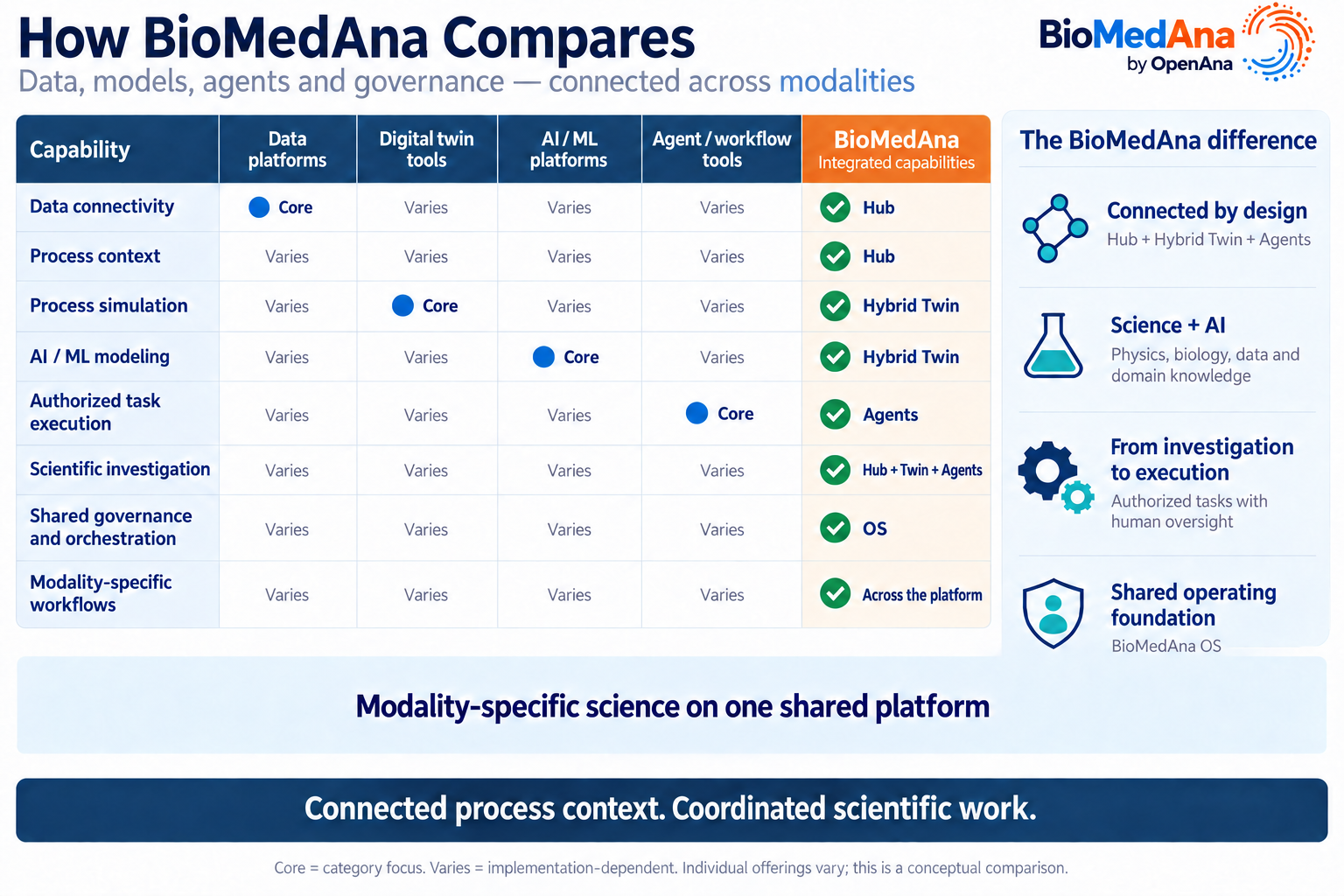
The comparison at a glance
The central choice is between assembling and maintaining connections across separate capabilities and using a platform in which those interactions are part of the operating foundation.
The table compares two implementation approaches. It does not assign universal limitations to product categories: specialized tools can be integrated effectively, and individual offerings vary.
| Dimension | Separately assembled tools | BioMedAna's integrated approach |
|---|---|---|
| Process data and context | The implementation must carry batch, material, equipment and process meaning across tool boundaries. | Hub connects and contextualizes process data as a reusable foundation for analysis, modeling, investigations and reporting. |
| Scientific modeling | Mechanistic models, AI/ML pipelines and supporting data must be connected within the chosen toolchain. | Hybrid Twin combines physics, biology, process data, AI/ML and domain knowledge to represent process behavior. |
| Investigation to next step | The team must connect data retrieval, analysis, model outputs and downstream tasks. | Agents use contextualized data and model outputs to investigate, recommend and execute authorized tasks. |
| Governance and orchestration | Cross-tool permissions, traceability, workflow coordination and review must be designed and maintained. | OS provides shared governance, security, traceability, human oversight and coordination across Hub, Hybrid Twin and Agents. |
| Modality-specific science | Relevant scientific context must be represented consistently across the selected systems and models. | Modality-native data interpretation, models and workflows operate within the shared platform. |
| Scale-up and technology transfer | The implementation must preserve the relationship between source evidence, assumptions, scenarios and decisions across handoffs. | Hub, Hybrid Twin and Agents connect process evidence with scenario evaluation and evidence-linked recommendations. |
| Reusable process knowledge | Reuse depends on how data, models and investigation outputs are retained and connected across systems. | Contextualized data and traceable work provide a foundation for subsequent investigations, modeling and reporting. |
| Adoption responsibilities | The team selects tools and owns or commissions the connections between them. | The platform supplies the shared interaction model; source integration, process configuration and intended-use assessment remain part of deployment. |
The practical difference is where responsibility for connecting the scientific workflow sits—and how much of that connection the team must establish for each use case.
BioMedAna compared with a bioprocess data platform
The defining responsibility of a data platform is to make data available and usable. For a bioprocess team, the next question is how those data support process understanding and a decision.
Consider an investigation into different batch outcomes. Access to measurements is the starting point. The team still needs to select comparable runs, evaluate possible explanations, explore scenarios and prepare a defensible recommendation.
BioMedAna Hub supplies connected, contextualized process data. Hybrid Twin uses that context to simulate, predict and optimize. Agents use the data and model outputs to investigate and carry out authorized tasks. OS coordinates and governs the interaction.
What this changes for the team: The data foundation is directly connected to the modeling and investigation workflow. When comparing solutions, ask to see that entire sequence using the same batch evidence.
BioMedAna compared with a standalone digital twin tool
A digital twin evaluation naturally focuses on what a model represents and how well it performs. A platform evaluation must also examine how evidence reaches the model and how results are used afterward.
BioMedAna Hybrid Twin combines mechanistic models grounded in physics and biology with process data, AI/ML and domain knowledge. Its role includes scenario exploration, outcome prediction, experiment prioritization and evaluation of operating conditions.
Within BioMedAna, Hub provides the process context, Agents use the model outputs in investigations and workflows, and OS provides shared governance and orchestration. The comparison therefore extends to the work before and after simulation.
What this changes for the team: A scenario comparison can become part of a traceable investigation and a reviewed next step. Scientific applicability, model performance and uncertainty still need assessment for the intended use.
New to digital twins? Read how connected, hybrid twins work across development, scale-up and manufacturing.
Read the digital twin guide ↗BioMedAna compared with a general-purpose AI/ML platform
An AI/ML platform provides an environment for developing and operating models. In a bioprocess application, the implementation must also establish what the variables mean, which scientific constraints matter and where the model is applicable.
BioMedAna makes modality-specific process context part of the platform approach. Hybrid Twin brings together mechanistic understanding and AI/ML. Hub organizes the supporting evidence around batches, materials, process conditions and results. Agents use that context in scientific workflows.
What this changes for the team: Process knowledge is represented alongside the data and predictive methods, with a shared path into investigation and execution. The evaluation should test whether that context is useful for the team's actual organism, product, equipment and process stage.
BioMedAna compared with standalone automation or agent tools
Automating a task and coordinating a scientific investigation place different demands on the system. An investigation requires relevant evidence, process knowledge, appropriate analysis and a clear boundary between a recommendation and an authorized action.
BioMedAna Agents use contextualized data, process knowledge and model outputs to investigate issues, recommend next steps and execute authorized tasks. They support analysis, experiment planning, workflow execution and reporting with traceability and human oversight.
Their relationship with Hub and Hybrid Twin is central to the comparison. OS governs and coordinates that relationship across data, models and workflows.
What this changes for the team: Agent activity can be grounded in the same process context and model outputs used by the scientist. Review and execution permissions remain explicit parts of the workflow.
BioMedAna compared with a services-led implementation
Scientific and engineering services can bring expertise to a specific process challenge and can build a highly integrated solution. The relevant comparison concerns what the team can operate and reuse after the initial work.
With a bespoke implementation, ownership of the connections, maintenance and reusable assets depends on the agreed scope. BioMedAna provides a shared platform foundation for the data, models and workflows involved in ongoing work. Domain expertise remains important in choosing the question, assessing evidence and interpreting results.
What this changes for the team: The evaluation can focus on repeatability: how a subsequent investigation, batch or scale uses the established process context and workflow, and what additional configuration it needs.
Why modality-native intelligence changes the comparison
Supporting several datasets is only one part of supporting several modalities. A useful scientific platform must accommodate differences in biological behavior, product objectives, measurements, constraints and decisions.
BioMedAna supports mAbs/biologics, fermentation/microbial processes, recombinant proteins, vaccines, cell and gene therapy, and antibody-drug conjugates. Three illustrative workflows show how the scientific question changes while Hub, Hybrid Twin, Agents and OS work together.
| Illustrative workflow | Scientific question | BioMedAna interaction |
|---|---|---|
| mAb scale-up | Which process or equipment differences could explain changed performance at a larger scale, and what should be evaluated next? | Hub organizes relevant batch and equipment context; Hybrid Twin evaluates supported scenarios; Agents prepare evidence-linked next steps; OS governs and coordinates the work. |
| Fermentation investigation | Could oxygen demand, oxygen transfer and feeding explain a productivity decline? | Hub connects relevant operating and analytical evidence; Hybrid Twin evaluates the hypothesis within its supported scope; Agents organize comparisons and an investigation plan; OS maintains oversight and traceability. |
| Recombinant protein development | Which induction, temperature and feeding conditions should be tested for an E. coli process targeting soluble protein? | Hub connects cultivation and expression results; Hybrid Twin evaluates supported candidate conditions; Agents prepare proposed experiments and their rationale; OS governs review and authorized execution. |
These examples describe potential workflows, not measured customer outcomes. Fermentation and recombinant protein production can overlap; the expression system, product objective and process stage determine the scientific configuration. A shared platform does not imply that one model transfers unchanged across modalities.
What should a comparison demonstration prove?
For Process, MSAT and CMC teams, a useful demonstration should follow one scientific question all the way through:
- Evidence: Show the relevant source data and how batches, materials and process conditions are contextualized.
- Analysis: Show how that context supports model selection and scenario evaluation, including assumptions and applicability.
- Recommendation: Show an Agent using the evidence and model outputs to propose the next step.
- Oversight: Show where authorization and human review apply, and how the work remains traceable.
- Reuse: Show how the reviewed investigation supports a subsequent experiment, transfer discussion or report.
This tests the connection between capabilities as well as the quality of each individual capability. For Process teams, the immediate output may be a better-supported experiment plan. For MSAT, it may be a scale-up or transfer recommendation. For CMC, it may be a clearer evidence trail for technical review.
Value can then be assessed using a documented baseline: evidence preparation effort, time to a reviewed recommendation and reporting effort. Claims about yield, avoided experiments or manufacturing savings require experimental or operational evidence.
Frequently asked questions
What is BioMedAna?
BioMedAna is a modality-native, AI-native intelligence platform that connects process data, hybrid modeling and intelligent agents to help biologics and pharmaceutical teams accelerate development, improve scale-up and technology transfer, and optimize manufacturing. BioMedAna OS provides governance, security, traceability and human oversight across the platform.
What is BioMedAna’s main difference from separate data, modeling and AI tools?
BioMedAna connects those responsibilities through a shared platform. Hub supplies process context; Hybrid Twin uses it to simulate, predict and optimize; Agents investigate, recommend and execute authorized tasks; OS governs and coordinates their interaction. Separate tools can also be integrated, with the integration approach and ongoing responsibilities determined by the implementation.
Is BioMedAna OS only a security layer?
BioMedAna OS is the shared operating foundation that coordinates Hub, Hybrid Twin and Agents. It provides governance, security, traceability and human oversight across data, models and workflows.
Does an integrated platform remove the need for process-specific work?
No. Source integration, scientific configuration, model assessment and workflow setup depend on the process and intended use. BioMedAna provides the shared foundation and component interactions on which that work is built.
Can BioMedAna work with existing laboratory and manufacturing systems?
BioMedAna Hub connects and contextualizes data from equipment, laboratory and manufacturing systems, and files. It organizes that data around batches, materials, process conditions and results, creating a reusable data foundation for analysis, modeling, investigations and reporting.
Compare the workflow using your scientific question
Bring a scale-up decision, an investigation or an experiment-planning challenge. Follow the evidence through BioMedAna Hub, Hybrid Twin and Agents, with OS providing shared governance and orchestration. Evaluate how the connections support the work your team needs to complete.
CONNECTED PROCESS CONTEXT
See the platform through the scientific question that matters to your team.
We'll trace the evidence, models, recommendations and review path together.