PRODUCT COMPARISON · OCTOBER 13, 2026
BioMedAna vs. Invert Bio: 2× More Value. Half the Price.
Why biopharma leaders should evaluate scientific capabilities, operational outcomes, and total cost of ownership before choosing their next bioprocess intelligence platform.
By BioMedAna Scientific & Engineering Team · Published and updated October 13, 2026. This BioMedAna-authored comparison uses public vendor documentation and BioMedAna’s stated product capabilities. Validate scope and outcomes with representative process data.
Full BioMedAna vs InvertBio comparison ↗Bio Agents ↗Hybrid Digital Twins ↗
Biopharmaceutical manufacturers face a growing challenge.
The amount of process data generated across development, scale-up, technology transfer, and manufacturing continues to increase. Yet converting that information into better scientific decisions remains difficult.
Organizations are investing in data platforms, advanced analytics, artificial intelligence, and digital twins to improve efficiency and accelerate decision-making.
But for CIOs, CTOs, MSAT leaders, and manufacturing executives, technology investment must ultimately answer two fundamental questions:
How much business value will the platform deliver? And what will it cost to achieve that value?
These questions are central to the decision between BioMedAna, Invert Bio, and other bioprocess intelligence platforms.
BioMedAna's competitive proposition is straightforward:
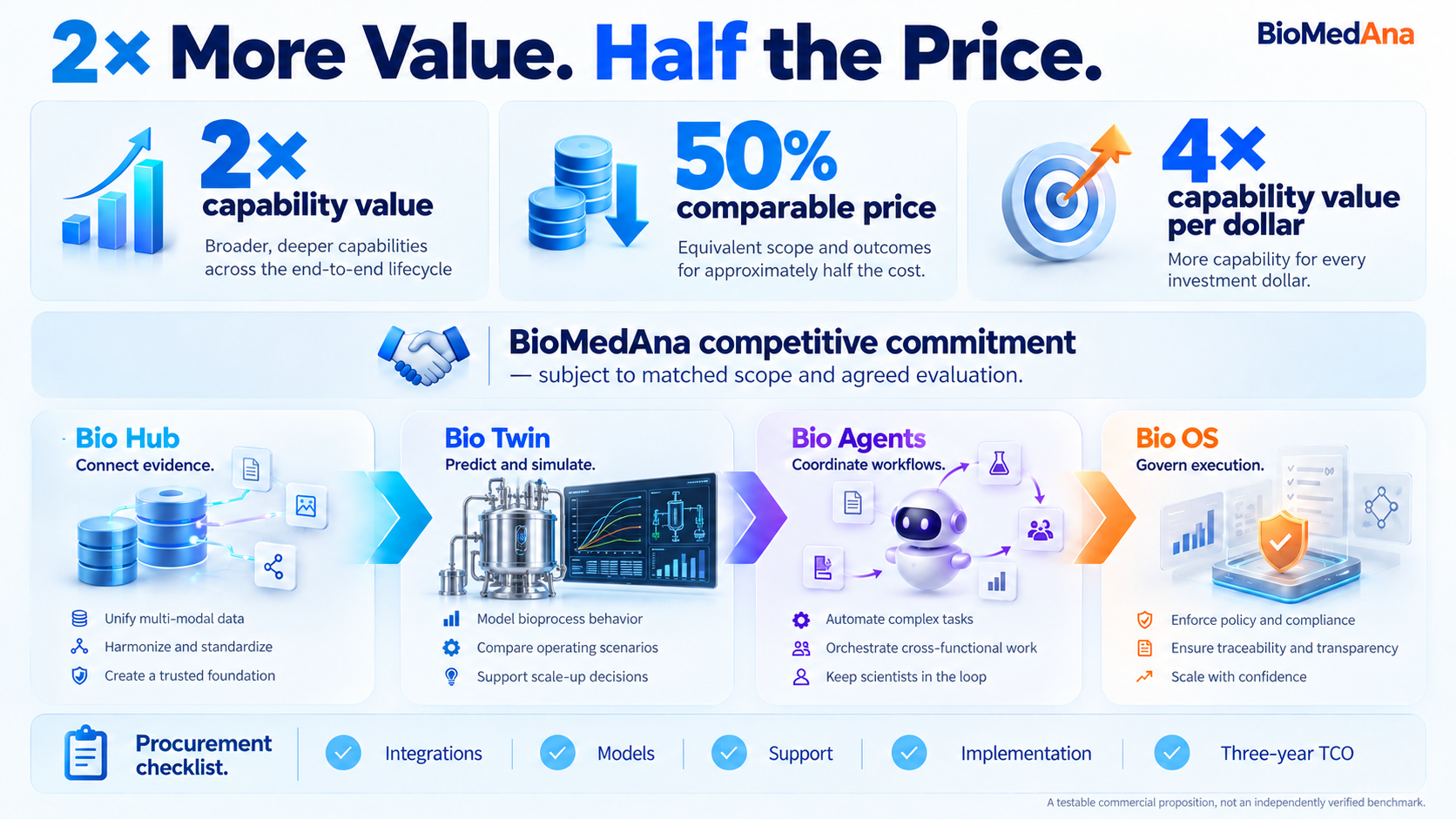
2× More Value.
Half the Price.
4× capability value per dollar — BioMedAna's competitive commitment
A commercial and capability-value target, assessed against a comparable vendor proposal and agreed evaluation criteria.
This is more than a pricing message. It reflects BioMedAna's strategy of combining broad scientific capabilities, predictive modeling, specialist AI agents, and an efficient deployment model.
The economics of bioprocess intelligence are changing
Historically, pharmaceutical companies have often assembled their digital environments through multiple specialized systems.
One system collects process data. Another provides analytics and visualization. A separate environment may support advanced modeling. Additional tools handle AI workflows, reporting, and operational coordination.
Each component may deliver value independently.
However, the combined environment can introduce integration effort, licensing costs, implementation delays, fragmented scientific context, and ongoing maintenance obligations.
The real cost of a platform therefore extends well beyond its software subscription.
For executives evaluating Invert Bio or other vendors, total cost of ownership should include software, implementation, data connectivity, scientific model deployment, specialized workflows, engineering support, and recurring operations.
More importantly, the investment should be evaluated against the scientific and operational decisions it enables.
What does Invert Bio cost?
Invert Bio does not publish a standard subscription rate on its public pricing page.
Instead, the company provides customized estimates based on a customer's equipment, facilities, modalities, and system requirements.
This makes a direct public price comparison difficult.
BioMedAna is taking a different commercial approach.
BioMedAna's competitive commitment is to offer a comparable solution at 50% lower pricing than an eligible, like-for-like Invert proposal.
The final comparison should account for deployment scope, contract duration, users, integrations, models, support, and any one-time fees.
For prospective customers, this creates a clear reason to include BioMedAna in their vendor evaluation before making a purchasing decision.
Where does the additional value come from?
BioMedAna combines four complementary capabilities within one intelligence architecture.
Bio Hub
Connect and contextualize process evidence
Bio Twin
Predict, simulate and optimize process conditions
Bio Agents
Coordinate specialized scientific and operational work
Bio OS
Govern data, models, users and agent execution
Together, these capabilities support a broader set of bioprocess intelligence use cases.
1. Deeper scientific intelligence
BioMedAna's architecture incorporates physics, biology, scientific models, process data, and AI/ML.
This enables process understanding to extend beyond correlation and historical comparisons into scientifically informed predictive analysis.
2. More powerful agentic workflows
More than 100 specialized Bio Agents support activities across Process Development, MSAT, scale-up, technology transfer, manufacturing, quality, and CMC.
The value is not simply automation of repetitive tasks. It is the ability to coordinate complex workflows involving multiple sources of evidence, specialized knowledge, and scientific models.
3. Predictive Hybrid Digital Twins
BioMedAna Twin is designed to support forward-looking simulation, operating-window evaluation, process optimization, and scale-up risk assessment.
These capabilities are particularly relevant where physical experimentation is expensive, time-consuming, or constrained by manufacturing capacity.
4. Broad modality coverage
BioMedAna targets seven modality families, including mAbs, recombinant proteins, fermentation, vaccines, cell and gene therapy, ADCs, and APIs.
The common platform architecture is designed to provide consistency while preserving modality-specific scientific requirements.
5. Faster time to value
BioMedAna emphasizes focused, engineering-led deployments that begin with high-value business decisions rather than lengthy platform transformation programs.
Bio Hub and selected Bio Agent workflows can provide a starting point, while Bio Twin can be introduced for use cases where predictive modeling provides measurable value.
BioMedAna vs. Invert Bio: An executive comparison
| Executive consideration | Invert Bio | BioMedAna |
|---|---|---|
| Primary platform strengths | Process data connectivity, analytics, AI-assisted analysis and reporting | Connected data, scientific intelligence, predictive twins and specialized agents |
| AI capabilities | Assist, reusable Skills and Automations | 100+ purpose-built Bio Agents and coordinated workflows |
| Advanced modeling | Digital twin and modeling capabilities; scope to be evaluated | 400+ scientific models and hybrid modeling architecture |
| Predictive simulation | Evaluate against customer-specific use cases | Core Bio Twin proposition |
| Modality strategy | Supports multiple bioprocess modalities | Seven targeted modality-native families |
| Deployment approach | Tailored to customer needs | Focused, engineering-led implementation |
| Public pricing | Customized quotation | Competitive price commitment |
| Commercial differentiation | Quote-dependent | Target of 50% lower comparable pricing |
| Overall value | Assess using common criteria | 2× capability-value commitment |
The 2× capability-value claim represents BioMedAna's competitive proposition, not a conclusion established by this table. A buyer should use an agreed, weighted scorecard and product demonstrations to assess it.
What does 2× more value actually mean?
Value should not be measured by counting menu items or software features.
For a biopharmaceutical organization, greater value should mean better outcomes across the scientific and manufacturing lifecycle.
Consider three high-impact areas.
Scale-up and technology transfer
A platform that helps teams compare historical batches is useful.
A platform that also supports predictive modeling, what-if simulations, and evaluation of alternative operating conditions may create additional value by improving decision quality and narrowing experimental requirements.
Deviation investigation and process optimization
Automated reports and historical analysis reduce manual effort.
An integrated scientific intelligence platform can go further by bringing together evidence, model-based hypotheses, specialist agents, and proposed experimental next steps.
CMC and manufacturing readiness
Connected process data and reporting provide a valuable foundation.
Integrating scientific models, process knowledge, traceability, and coordinated workflows can improve consistency and reduce the effort required to prepare and review technical evidence.
These benefits should ultimately be assessed using measurable KPIs, including cycle time, engineering effort, experiment consumption, investigation effort, quality outcomes, and total operating cost.
Understanding the 4× value-per-dollar proposition
BioMedAna's competitive positioning combines two explicit commitments:
- Deliver at least 2× the weighted capability value, measured against customer-defined use cases.
- Offer 50% lower commercial pricing than a comparable Invert proposal.
If both conditions are demonstrated for the same evaluated scope, the resulting capability value per dollar is at least 4×.
This makes the value proposition testable rather than dependent on vendor marketing claims.
The evaluation should consider not only software pricing, but also implementation costs, specialist services, model configuration, integrations, and ongoing operating expenses.
A smarter procurement framework for CIOs and MSAT leaders
When evaluating Invert Bio alternatives, executives should avoid making the decision solely on the basis of a product demonstration or feature checklist.
A more meaningful evaluation examines five questions:
- Can the platform support the scientific workflows most important to our business?
- Can it move from historical analytics to useful predictive simulation where required?
- Can its AI capabilities coordinate complex, multi-step workflows with appropriate human oversight?
- How quickly can the organization realize a measurable operational improvement?
- What is the fully comparable three-year total cost of ownership?
This approach creates a more transparent basis for comparing vendor proposals and reduces the risk of purchasing technology that performs well in demonstrations but delivers limited operational value.
Why BioMedAna deserves to be on your shortlist
BioMedAna is built for organizations that want to connect process evidence, scientific reasoning, predictive modeling, agentic workflows, and operational decisions in one governed platform.
Its competitive proposition combines scientific depth with accessible economics.
For companies currently considering Invert Bio, there is a clear reason to evaluate both solutions before signing a contract.
For existing Invert customers approaching renewal or expansion, the same comparison can help determine whether a broader intelligence architecture could deliver greater value.
The goal is not simply to spend less on software. It is to achieve more with the investment.
Before you commit to Invert Bio, compare the value.
2× More Value. Half the Price.
Discover how BioMedAna's 100+ Bio Agents, predictive Hybrid Digital Twins, and modality-native intelligence can support your bioprocess operations.
Visit BioMedAna or contact hello@biomedana.ai to request a competitive capabilities and commercial evaluation.
Frequently asked questions
How much does Invert Bio cost?
Invert Bio uses customized pricing based on equipment, facilities, modalities, and customer requirements. Standard pricing is not publicly listed on its website.
Is BioMedAna cheaper than Invert Bio?
BioMedAna's competitive pricing commitment is to offer an eligible, comparable solution at 50% below the corresponding Invert proposal. The comparison requires a matching scope and commercial terms.
Why does BioMedAna claim 2× more value?
BioMedAna's value proposition is based on its integrated scientific intelligence architecture, specialized Bio Agents, predictive Hybrid Digital Twins, modality coverage, and implementation approach. The 2× claim should be validated through a weighted comparison against the buyer's requirements.
What does 4× value per dollar mean?
If a platform delivers twice the measured capability value at half the cost of an alternative, it delivers four times the capability value per dollar under that methodology.
What should companies compare when evaluating Invert Bio alternatives?
Buyers should compare scientific capabilities, predictive modeling, AI workflows, modality-specific expertise, implementation effort, data governance, integration requirements, and total cost of ownership.
Can BioMedAna replace Invert Bio?
BioMedAna may be an alternative for organizations seeking bioprocess data management, advanced models, and scientific workflows. Migration feasibility depends on existing integrations, data structures, user workflows, model requirements, and commercial constraints.
Is BioMedAna appropriate for small and midsize biopharma companies?
BioMedAna's focused deployment strategy and commercial model are designed to make advanced bioprocess intelligence accessible to organizations that may not have large internal data science or platform engineering teams.
Sources and evaluation scope
- Invert Assist user guide
- Invert Skills user guide
- Invert Automations user guide
- Invert Models
- Invert pricing
Public materials reviewed October 13, 2026. Invert documents mechanistic and hybrid models, forecasts, simulation and optimization; comparisons should establish the actual workflow available for your process. BioMedAna’s capability and pricing commitments require agreed evaluation criteria and a matching proposal; they are not independent performance benchmarks. Modality availability and model coverage vary by deployment.
Explore Bio Hub ↗Explore Bio Twin ↗Explore Bio Agents ↗Explore Bio OS ↗
Request a competitive evaluation ↗