Culture development
Compare growth, viability, feed, nutrients and product accumulation across clones and culture conditions.
CHO · MAB
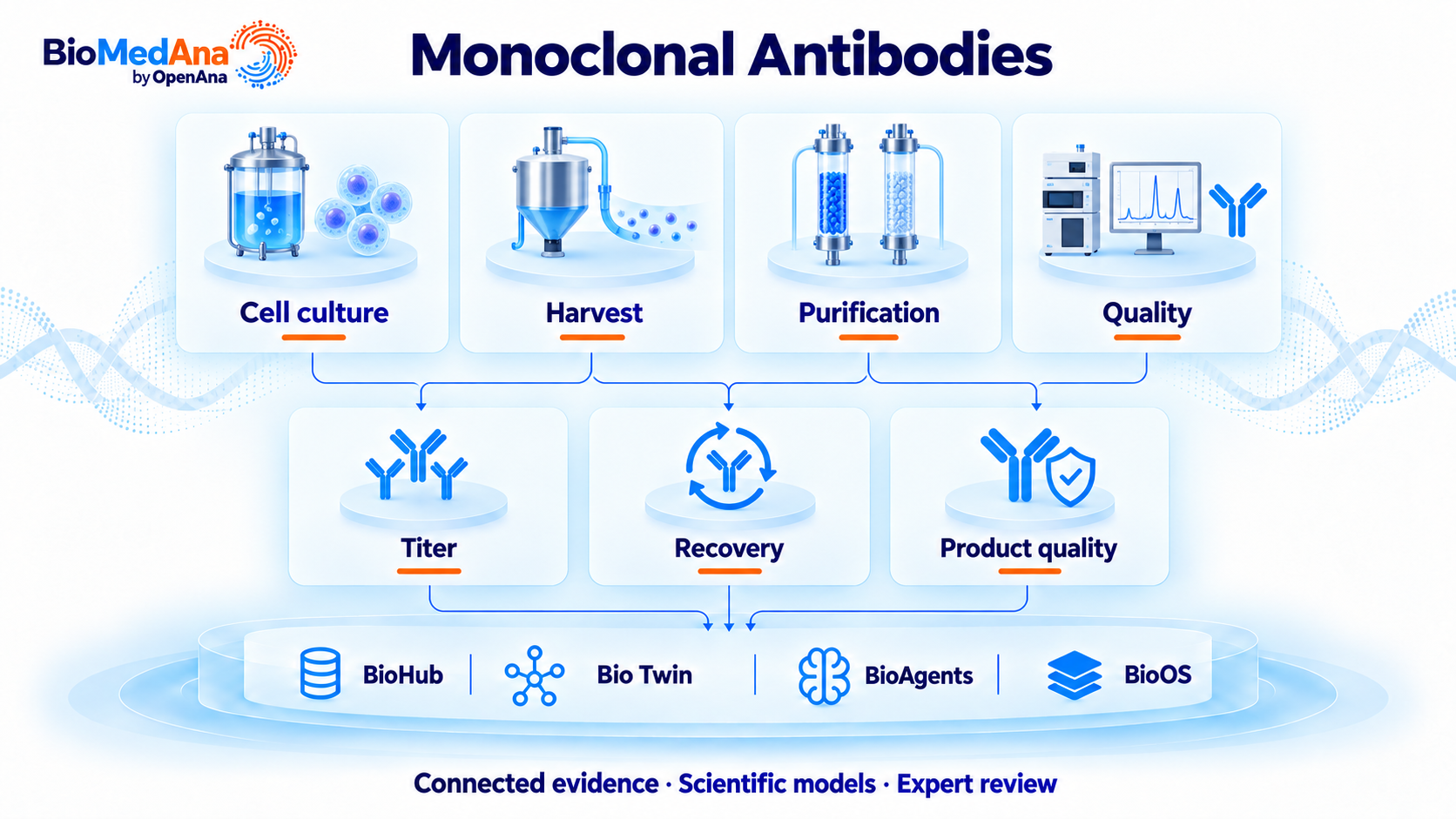
Bring cell-culture records, process conditions, downstream recovery and analytical outcomes into one scientific context. Compare runs, investigate changes and evaluate the next process scenario using the evidence that supports it.
MODALITY-SPECIFIC PROCESS INTELLIGENCE
Compare growth, viability, feed, nutrients and product accumulation across clones and culture conditions.
Follow harvest, purification stages and chromatography evidence to understand where product or quality changes.
Assess mixing, oxygen demand, equipment differences and operating windows with process-specific models.
Connect process events and batch comparisons to product-quality assays and evidence-linked hypotheses.
EVIDENCE · MODELS · DECISIONS
Process outcomes to evaluate: Titer · recovery · product quality
EXAMPLE INVESTIGATION
Connect campaign runs with feed, material lots, metabolites, viability and reactor events.
Compare the affected cohort with representative historical runs and aligned process phases.
Evaluate plausible growth, nutrient and transport explanations; use calibrated model scenarios where appropriate.
Prepare a traceable comparison and recommend the experiment or measurement that would distinguish the hypotheses.
Bio Agents can coordinate the scientific work across evidence and models, while Bio OS preserves governance and human review. The configured workflow determines which tasks and models are available.
Bring us this process challenge ↗EVALUATION & SCOPE
Evaluate model fitness against independent runs, the intended operating range and the specific output. A model of titer does not automatically validate predictions of glycosylation or other quality attributes.
Cell growth and viability. Feed, metabolites and reactor conditions. Chromatography, recovery and quality assays. Include the process question, relevant run context and the analytical methods used to assess the outcome.
Culture kinetics and hybrid prediction. Feed and operating-window comparisons. Scale-dependent process assessment. Scope and evaluation criteria are defined for your process, data and intended decision.
Evaluate model fitness against independent runs, the intended operating range and the specific output. A model of titer does not automatically validate predictions of glycosylation or other quality attributes.
EXPLORE OTHER MODALITIES