BPI 2026 SERIES ARTICLE 2 OF 6
From Bench to Manufacturing: Using AI to De-Risk Bioprocess Scale-Up
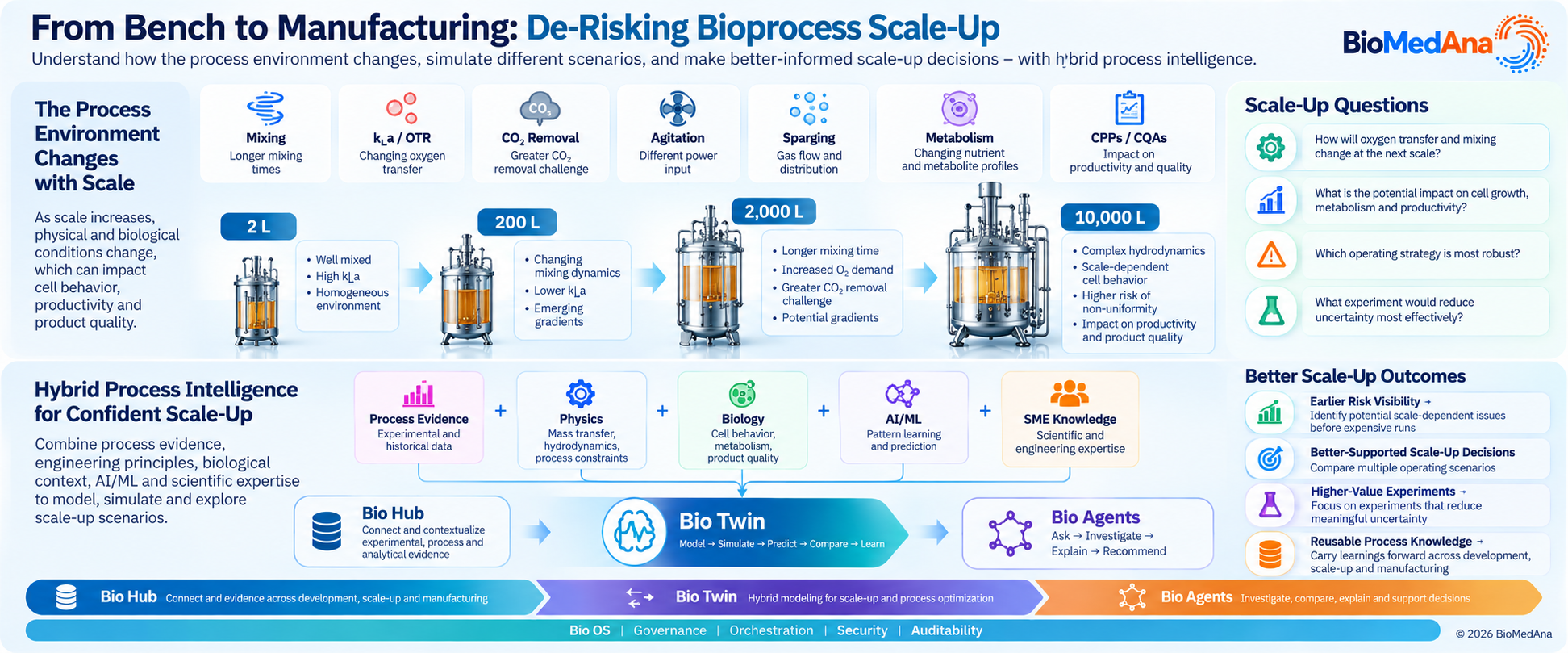
Scale-up is not simply making the same process bigger. As bioreactor scale changes, the physical environment changes—and biology responds. Combining process data, engineering principles, biological context, AI/ML and scientific expertise can help teams understand those changes before they become manufacturing surprises.
How can AI help with bioprocess scale-up?
AI can support bioprocess scale-up by analyzing experimental and process data, identifying relationships between operating conditions and biological outcomes, comparing scale-up scenarios, and highlighting potential risks. Hybrid approaches can combine AI and machine learning with mechanistic models, engineering principles and biological knowledge. This allows process-development teams to explore how changes in mixing, oxygen transfer, process parameters and other scale-dependent conditions may affect performance before committing to larger and more expensive manufacturing runs.
A bioprocess can perform exceptionally well at bench scale.
The cell line is productive. Viability is strong. Metabolite profiles look manageable. Product quality is within expectations. The process appears robust.
Then the process moves to a larger bioreactor.
And behavior changes.
Mixing becomes different. Oxygen transfer changes. Carbon dioxide removal can become more difficult. Gradients can emerge. Cells experience a different physical environment—and those engineering changes can influence biological behavior, productivity and product quality.
This is why scale-up remains one of the most consequential transitions in biologics development.
The challenge is not simply:
Can we reproduce the bench-scale recipe in a larger vessel?
The more useful question is:
Can we understand how the process environment will change—and how the biology is likely to respond—before committing to the next scale?
That is where hybrid modeling, digital twins and AI can become valuable.
Scale-Up Is More Than Increasing Volume
Imagine an illustrative monoclonal antibody process progressing through:
2 L → 200 L → 2,000 L → 10,000 L
The underlying biology may be the same.
The physical environment is not.
As scale increases, teams may need to consider changes in:
- Mixing time
- Oxygen transfer and kLa
- Oxygen uptake rate
- Carbon dioxide accumulation and removal
- Agitation and power input
- Gas flow and sparging
- pH and dissolved oxygen behavior
- Shear environment
- Temperature distribution
- Nutrient and metabolite gradients
- Bioreactor geometry
These factors are interconnected.
Research on large-scale CHO cultivation has demonstrated that production-scale vessels can differ from bench-scale systems in oxygen transfer, mixing and carbon dioxide removal, with potential pH and dissolved-oxygen gradients at larger scale. PubMed
Oxygen transfer is particularly important because it depends on hydrodynamics, vessel geometry, operating conditions and biological oxygen demand. PubMed
Scale-up therefore isn't just a volume problem.
It is an engineering + biology problem.
Why Historical Data Alone May Not Be Enough
AI and machine learning can identify relationships within process data.
That is useful.
If an organization has enough representative data, models may identify patterns between operating conditions, metabolites, cell growth, productivity and product-quality outcomes.
But scale-up creates a fundamental challenge.
The conditions we want to predict may not yet exist in the historical data.
A model trained primarily on 2 L and 200 L experiments cannot automatically be assumed to understand everything that will happen at 10,000 L.
- The geometry has changed.
- The hydrodynamics have changed.
- The physical constraints have changed.
And the amount of manufacturing-scale data available may be limited precisely because large-scale experiments are expensive and time-consuming.
That creates a compelling case for combining data-driven intelligence with scientific and engineering knowledge.
From Pure AI to Hybrid Process Intelligence
Bioprocessing is particularly well suited to hybrid modeling because we often know part of the system.
- We understand aspects of mass transfer.
- We understand bioreactor geometry.
- We know material balances and physical constraints.
- We have biological observations and historical process data.
But we may not have equations that perfectly capture every cellular response or every interaction between biology and the process environment.
Hybrid modeling combines these different sources of knowledge.
Recent literature describes hybrid bioprocess models as combinations of mechanistic and data-driven approaches, with applications including experimental design, identification of critical process parameters, optimization and digital twins. PubMed
Recent work specifically in CHO cell culture has also demonstrated hybrid digital-twin frameworks combining mechanistic models, metabolic modeling and machine learning to represent complex mammalian-cell processes. PubMed
The opportunity is therefore not to choose between:
Physics OR AI
but to combine:
Physics + Biology + Process Data + AI/ML + SME Knowledge
Each contributes something different.
An Illustrative Scale-Up Challenge
Consider a synthetic mAb development program.
A process performs well at 2 L.
Scientists have accumulated experimental evidence around:
- Viable cell density
- Viability
- Glucose and lactate
- Ammonia
- Dissolved oxygen
- pH
- Feed strategy
- Agitation
- Gas flow
- Titer
- Product quality
The process progresses successfully to 200 L.
The team now needs to determine how best to move toward 2,000 L and ultimately 10,000 L.
Traditional scale-up criteria and engineering calculations remain essential.
But imagine being able to combine them with everything already learned about the process.
Instead of asking only:
What agitation rate should we use?
the team can investigate:
- How does the proposed scale affect oxygen-transfer capacity?
- Where could mixing limitations emerge?
- How might different operating strategies affect cellular metabolism?
- Which variables create the greatest scale-up risk?
- What happens to predicted titer and quality under different scenarios?
- Which additional experiment would reduce uncertainty most effectively before the next scale transition?
Those are fundamentally decision-intelligence questions.
Step 1: Build on the Evidence Already Generated
Scale-up intelligence should not begin from zero.
The organization may already have evidence from cell line development, media optimization, feed studies, DoE experiments, process characterization and earlier scales.
Bio Hub can connect and contextualize this evidence across experiments and scales.
The goal isn't simply to create another repository.
It is to preserve relationships between:
Process conditions → Biological response → Analytical evidence → Process outcome
This is important because scale-up decisions need context.
A titer value without knowing the associated cell line, feed strategy, oxygen-transfer conditions, metabolic state and experimental history provides only part of the story.
Step 2: Create a Hybrid Representation of the Process
This is where Bio Twin becomes central.
BioMedAna's hybrid approach combines:
Physics + Biology + Process Data + AI/ML + SME Knowledge
Rather than relying entirely on historical correlations, the Twin can incorporate process understanding alongside learned relationships from available evidence.
The purpose is not to create a perfect digital copy of every molecule inside a bioreactor.
It is to build a useful computational representation of the process that can support decisions.
Depending on the process and available evidence, that can include relationships involving growth, metabolism, productivity, mass transfer, process parameters and quality outcomes.
The model can then evolve as new evidence becomes available.
Step 3: Simulate Before Committing to the Next Run
Once a useful process representation exists, teams can begin exploring scenarios computationally.
For example:
- Scenario A: Higher agitation with the current aeration strategy.
- Scenario B: Modified sparging while maintaining target oxygen transfer.
- Scenario C: Alternative agitation and gas-flow combination.
- Scenario D: Different feed timing under predicted large-scale mixing conditions.
Instead of evaluating only one proposed scale-up strategy, teams can compare multiple operating scenarios.
The objective isn't for simulation to replace experimental confirmation.
It is to help determine which experiments and scale-up strategies deserve to be tested.
This is an important distinction.
A useful digital twin should reduce uncertainty—not create false certainty.
Step 4: Investigate Why the Model Predicts a Difference
Prediction alone isn't enough.
Suppose two candidate 10,000 L operating strategies produce similar predicted titer, but one has substantially greater sensitivity to oxygen-transfer limitations.
Or one scenario maintains productivity but increases the predicted risk of unfavorable metabolite behavior.
The scientist or process engineer needs to understand:
What is driving the difference?
This is where Bio Agents can work alongside the Twin and connected process evidence.
Teams can interrogate the information through questions such as:
- Which parameters contribute most strongly to the difference between these scale-up scenarios?
- Show previous experiments with similar metabolic behavior.
- Which assumptions have the greatest influence on this prediction?
- Where is model uncertainty highest?
- What experiment would provide the most useful additional evidence?
The combination matters:
Bio Twin models the process.
Bio Agents help scientists interrogate the process knowledge and evidence around it.
Step 5: Carry Learning Forward Across Every Scale
Perhaps the biggest opportunity is not a single prediction.
It is creating a process that becomes more informed with every experiment and every scale transition.
Consider the progression:
2 L → 200 L → 2,000 L → 10,000 L
At each stage, new evidence becomes available.
Instead of treating each scale as an isolated development activity, the organization can continuously compare:
- What did we predict?
- What actually happened?
- Where did the model perform well?
- Where was it wrong?
- What did we learn?
- How should the next model or experiment change?
The digital representation can therefore evolve with the physical process.
That is where the idea of a digital twin becomes much more powerful than a static model.
From Scale-Up by Analogy to Scale-Up by Evidence
Experienced process-development teams already use engineering principles, prior platform knowledge and scientific judgment to guide scale-up.
AI does not eliminate those disciplines.
It can make them more connected.
Imagine the difference between these two approaches.
Traditional approach
Prior experience
- engineering calculations
- experimental results
- SME judgment
→ scale-up decision
versus:
Connected scale-up intelligence
Historical process evidence
- engineering models
- biological context
- AI/ML
- SME knowledge
→ simulation
→ scenario comparison
→ uncertainty assessment
→ targeted experiment
→ updated knowledge
→ scale-up decision
The second approach does not remove human judgment.
It gives human judgment a richer evidence base.
What Does Better Scale-Up Intelligence Change?
The value isn't simply “having a digital twin.”
The value comes from the decisions it can improve.
For a process-development or MSAT team, that can mean:
- Earlier risk visibility - Potential scale-dependent constraints can be explored before an expensive large-scale run.
- Fewer low-value experiments - Simulation can help prioritize experiments that provide the greatest information.
- Better-supported operating decisions - Teams can compare multiple scenarios instead of relying on one proposed configuration.
- More explainable predictions - Mechanistic understanding and experimental evidence can provide context around data-driven relationships.
- Reusable process knowledge - Learning from one scale can become evidence for the next rather than remaining buried in reports and spreadsheets.
- Faster investigation - Scientists can interrogate historical experiments, model outputs and process relationships in one connected environment.
The objective is not necessarily fewer experiments at all costs.
It is fewer experiments that teach us little—and more experiments that reduce meaningful uncertainty.
The Knowledge Journey Started Before Scale-Up
There is also an important connection to cell line development.
During clone selection, scientists learn how candidate cells respond to media, feed, metabolites and process conditions.
That knowledge should not disappear once a clone is selected.
It becomes prior knowledge for process development.
Process-development knowledge becomes prior knowledge for scale-up.
Scale-up knowledge becomes prior knowledge for technology transfer and manufacturing.
This creates a continuous journey:
Cell Line Development → Process Development → Scale-Up → Tech Transfer → Manufacturing
supported by:
Bio Hub → Bio Agents → Bio Twin
and governed through Bio OS.
The result is not simply a collection of digital tools.
It is a continuously evolving body of process intelligence.
AI Should Help Teams Ask Better Scale-Up Questions
The most interesting question about AI in scale-up may not be:
Can AI predict what happens at 10,000 L?
A better set of questions is:
- What do we already know?
- What changes physically at the next scale?
- How could those changes affect the biology?
- Where is uncertainty greatest?
- Which scenario appears most robust?
- What should we test next?
And after the experiment:
What did we learn that should change our understanding of the process?
That is a much more useful role for AI.
Not replacing process scientists and engineers.
Not pretending uncertainty has disappeared.
But helping teams combine engineering, biology, data and experience into better-supported decisions.
From Bigger Bioreactors to Better Process Understanding
Scale-up will always involve uncertainty because biological systems are complex and manufacturing environments cannot be reproduced perfectly at every scale.
But uncertainty does not have to mean starting over at each transition.
When experimental evidence remains connected, engineering principles are incorporated into models, AI helps identify relationships, and scientists can interrogate both predictions and evidence, scale-up becomes a cumulative learning process.
That changes the goal.
It is no longer simply:
Make the process bigger.
It becomes:
Understand the process well enough to know what changes when it gets bigger.
And that may be one of the most valuable applications of AI in bioprocess development.
Bring Us One Scale-Up Challenge
Moving a biologics process from bench toward pilot or manufacturing scale?
Bring us one process challenge. We'll show you how BioMedAna would approach it using your process evidence, engineering context and hybrid process intelligence.
Frequently asked questions
What is bioprocess scale-up?
Bioprocess scale-up is the process of transferring a biological production process from a smaller development system to progressively larger bioreactors while maintaining desired process performance and product quality. Scale-up is not simply increasing volume. Teams must account for changes in mixing, oxygen transfer, gas flow, heat transfer, agitation, bioreactor geometry, and other physical conditions that can affect cellular behavior. The goal is to establish operating conditions that preserve process robustness, productivity, and critical quality attributes as the process moves toward commercial manufacturing.
Why can a bioprocess behave differently at larger scale?
A bioprocess can behave differently at larger scale because the physical environment experienced by cells changes as bioreactor size increases. Mixing times, oxygen transfer, carbon dioxide removal, agitation, sparging, and nutrient or metabolite gradients may differ from those observed at bench scale. These engineering changes can influence cell growth, metabolism, viability, productivity, and product quality. As a result, conditions that perform well in a small bioreactor cannot always be reproduced simply by applying the same settings to a larger vessel.
How can AI help with bioprocess scale-up?
AI can support bioprocess scale-up by analyzing experimental and process data, identifying relationships between operating conditions and biological outcomes, comparing potential scale-up scenarios, and highlighting areas of uncertainty or risk. When combined with engineering principles and mechanistic models, AI can help teams explore how changes in mixing, oxygen transfer, process parameters, and other scale-dependent conditions may affect process performance. This can support more informed experiments and scale-up decisions before committing to larger, more expensive manufacturing runs.
What is a hybrid digital twin for bioprocessing?
A hybrid digital twin for bioprocessing is a computational representation of a biological process that combines mechanistic and engineering knowledge with process data, biological context, AI and machine learning, and subject-matter expertise. Unlike a purely data-driven model, a hybrid twin can incorporate known physical relationships such as mass transfer and process constraints while learning additional relationships from experimental evidence. It can be used to simulate process behavior, compare operating scenarios, investigate risk, support optimization, and continuously improve as new process data becomes available.
Can AI reduce the number of scale-up experiments?
AI can potentially reduce the number of low-value or redundant scale-up experiments by helping teams identify which experiments are most informative before conducting them. Models and digital twins can be used to explore operating scenarios computationally, identify sensitive parameters, assess uncertainty, and prioritize experiments that address the most important knowledge gaps. AI does not eliminate the need for experimental and manufacturing-scale confirmation. Its value is in helping scientists and engineers design higher-value experiments that reduce meaningful uncertainty and strengthen subsequent scale-up decisions.
BRING US ONE PROCESS CHALLENGE
See how BioMedAna would approach it.
Explore your process evidence, scientific context and decision needs with our bioprocess intelligence team.