PRODUCT COMPARISON · OCTOBER 13, 2026
BioMedAna vs. Invert Bio: Why Scientific Depth Matters More Than Just Having AI Agents
Beyond conversational analytics: 100+ specialized Bio Agents for scientific investigation, process engineering, and complex biopharma workflows.
By BioMedAna Scientific & Engineering Team · Published and updated October 13, 2026. This BioMedAna-authored comparison uses public vendor documentation and BioMedAna’s stated product capabilities. Validate scope and outcomes with representative process data.
Full BioMedAna vs InvertBio comparison ↗Hybrid Digital Twins ↗Pricing & Value ↗
Artificial intelligence is rapidly becoming part of biopharmaceutical development and manufacturing. AI assistants can already summarize experiments, analyze historical process data, generate reports, and help scientists investigate deviations.
But for pharmaceutical executives, the more important question is emerging:
Can AI move beyond answering questions to completing complex scientific and engineering workflows?
That distinction matters when choosing between platforms such as Invert Bio and BioMedAna.
Both platforms recognize the importance of AI-enabled bioprocess intelligence. The differentiation lies in how scientific knowledge, process models, specialist capabilities, and workflow orchestration are applied to real operational decisions.
BioMedAna has been designed around a broader ambition: integrating more than 100 specialized Bio Agents with process data, scientific models, modality-native context, and governed execution.
AI assistants, AI skills, and scientific agents are not the same thing
Invert Bio provides AI-assisted analytical capabilities through Invert Assist, reusable Skills, and Automations.
Its public documentation describes root-cause analysis, experiment summarization, statistical calculations, custom analytical methods, and automated reporting. These are valuable capabilities for scientific teams seeking consistency and efficiency.
However, pharmaceutical organizations increasingly require workflows that extend beyond a single analysis or report.
Consider an MSAT team investigating a recurring manufacturing deviation.
The team may need to evaluate historical batches, compare process parameters, examine material and media variations, assess potential CPP–CQA relationships, investigate equipment differences, identify plausible scientific explanations, recommend additional experiments, and prepare an evidence-linked investigation package.
This is not simply a question-and-answer problem.
It is a multi-step scientific workflow requiring domain knowledge, coordination, evidence, and expert judgment.
BioMedAna: 100+ specialized Bio Agents
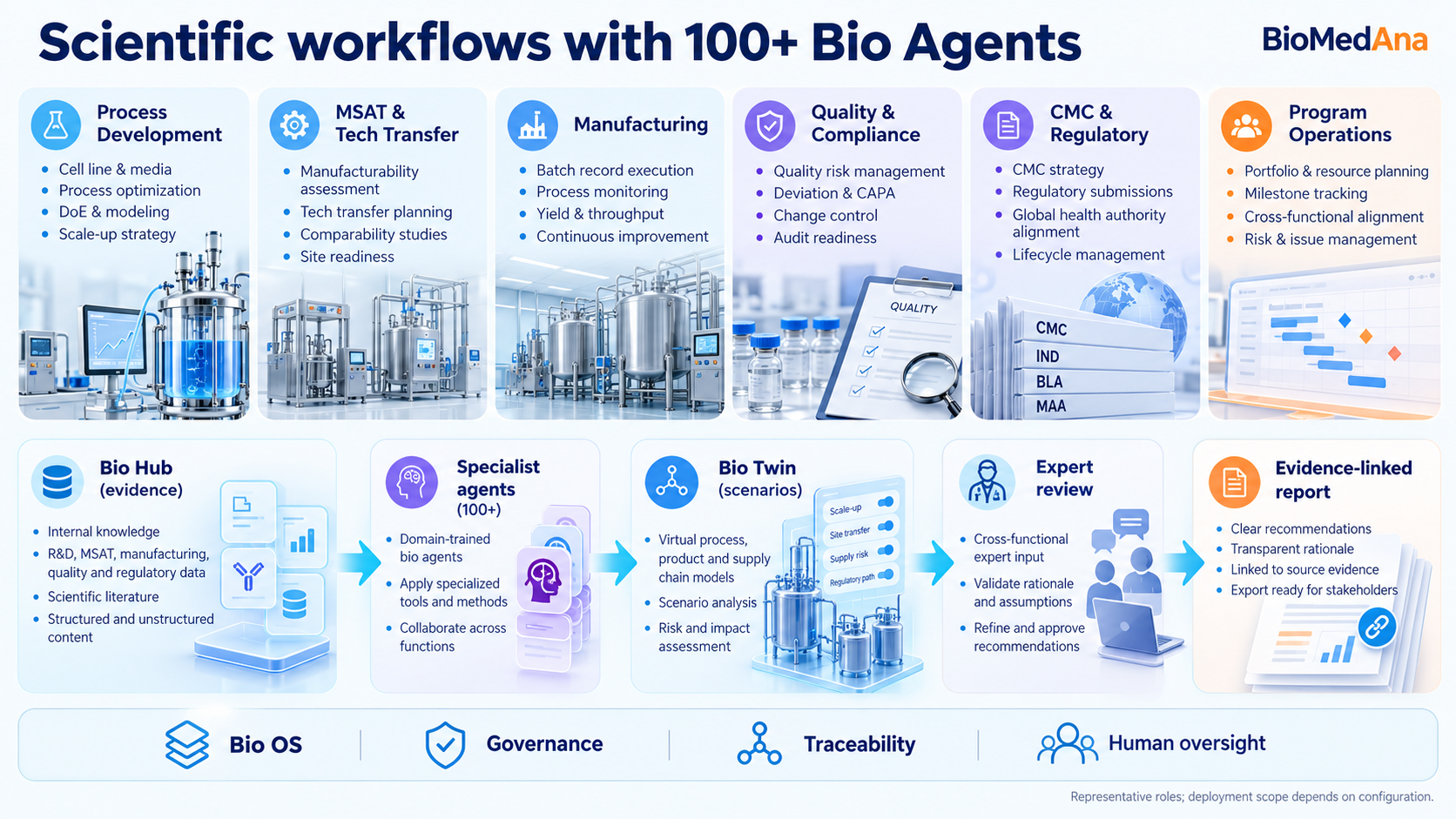
BioMedAna brings together specialized agents designed to support six major functional areas.
| Functional area | Example Bio Agents | Executive value |
|---|---|---|
| Process Development | DoE Advisor, Process Optimization Agent, CPP–CQA Analysis Agent | Faster experiments and better process understanding |
| MSAT & Technology Transfer | Scale-Up Risk Agent, Comparability Agent, Tech Transfer Readiness Agent | Reduced uncertainty during scale-up and transfer |
| Manufacturing | Batch Performance Agent, Process Monitoring Agent, Deviation Investigation Agent | Faster investigation and operational decisions |
| Quality & Compliance | CAPA Support Agent, CQA Trend Agent, Evidence Traceability Agent | More consistent, evidence-linked quality workflows |
| CMC & Regulatory | CMC Evidence Agent, Regulatory Documentation Agent, Process Characterization Agent | Improved knowledge reuse and documentation efficiency |
| Program Operations | Process Knowledge Agent, Scientific Reporting Agent, Campaign Review Agent | Reduced manual coordination and reporting effort |
These are representative roles from BioMedAna's agent catalog; specific deployment scope and autonomy depend on the workflow configuration.
What makes these agents valuable is not simply their number.
It is their specialization in bioprocess science, their access to connected scientific evidence, and their ability to coordinate with other agents and models.
From individual AI tasks to long-running scientific workflows
A conventional AI task may begin with a request and end with an answer.
A long-running scientific workflow is different. It may require several investigations, modeling steps, comparisons, reviews, and decisions before producing an actionable recommendation.
Consider three examples.
Scenario 1: Investigating a decline in monoclonal antibody titer
An MSAT leader wants to understand why titer has declined across a recent manufacturing campaign.
Within BioMedAna, a governed agent workflow can be configured to:
- Retrieve relevant batch and process data from Bio Hub.
- Compare historical and recent campaign performance.
- Identify changes in nutrients, media lots, feeding, pH, DO, temperature, and viability.
- Examine potential CPP–CQA relationships and scientific hypotheses.
- Invoke appropriate Bio Twin models when predictive simulation can inform the investigation.
- Recommend follow-up experiments or process adjustments for SME evaluation.
- Prepare an evidence-linked report for MSAT and Quality review.
The result is more than an analytical summary. It is a structured scientific investigation with traceable evidence and proposed next actions.
Scenario 2: Preparing for scale-up from 200 L to 2,000 L
A Process Development team is preparing to move a process into a manufacturing-scale bioreactor.
Multiple specialist agents can coordinate equipment and process comparisons, evaluate scale-dependent constraints, review previous transfer experience, and request model-based simulations.
Potential questions include oxygen transfer capacity, mixing behavior, metabolic demand, process robustness, and expected product quality.
Instead of relying on historical comparisons alone, the workflow can bring together engineering relationships, scientific models, historical evidence, and SME review.
Scenario 3: Accelerating CMC and PPQ preparation
A CMC team preparing for process performance qualification must assemble evidence from Process Development, MSAT, Manufacturing, and Quality.
BioMedAna agents can help coordinate historical process knowledge, critical parameter assessments, process characterization evidence, comparability analyses, and documentation preparation.
Human experts remain responsible for scientific conclusions, quality decisions, and regulatory approvals.
The benefit is reduced coordination overhead and more consistent access to the scientific evidence supporting decisions.
Why modality-native expertise matters
Bioprocesses are not interchangeable.
A monoclonal antibody process has different biological, engineering, and quality considerations from microbial fermentation, viral vector manufacturing, or pharmaceutical API production.
For example, CHO cell culture may require careful reasoning about cell growth, viability, metabolism, glycosylation, oxygen transfer, and product aggregation.
Microbial fermentation introduces different questions involving substrate utilization, metabolic burden, induction, oxygen demand, and byproduct accumulation.
API development introduces reaction kinetics, selectivity, impurities, heat transfer, mixing, and crystallization.
An AI agent that understands these differences can provide more relevant scientific reasoning than a generic analytical assistant operating without modality-specific context.
BioMedAna's approach combines a shared scientific intelligence foundation with specialized modality knowledge and workflows.
BioMedAna vs. Invert Bio: What should executives evaluate?
| Evaluation dimension | Invert Bio | BioMedAna |
|---|---|---|
| Natural-language data analysis | Documented | Supported |
| Reusable analytical skills | Documented | Specialized agent skills and workflows |
| Scheduled automation | Documented | Governed workflow orchestration |
| Specialized agent catalog | Configurable Skills publicly documented | 100+ named Bio Agents |
| Scientific model integration | Evaluate in demonstration | Integration with Bio Twin modeling workflows |
| Multi-agent scientific investigations | Validate available scope | Core design focus |
| Modality-specific scientific reasoning | Validate depth by modality | Modality-native architecture |
| Evidence and human oversight | Available controls and review | Bio OS governed, evidence-linked workflows |
This comparison reflects publicly documented product positioning and BioMedAna's stated capabilities. Buyers should validate complex workflows using representative process data.
The executive takeaway
Biopharma companies should not evaluate agentic AI simply by asking whether a vendor has a chatbot, an assistant, or an automation feature.
They should ask a more consequential question:
How much scientifically meaningful work can the platform perform, and how effectively can it support decisions across the bioprocess lifecycle?
BioMedAna's 100+ specialized Bio Agents are designed to bring deeper domain knowledge, coordinated workflows, scientific model integration, and actionable intelligence to Process Development, MSAT, Manufacturing, Quality, and CMC.
For organizations evaluating Invert Bio alternatives, this difference deserves a hands-on assessment.
Ready to move beyond AI-assisted analysis?
See how BioMedAna's specialized Bio Agents can support your most complex bioprocess workflows.
Explore BioMedAna or contact hello@biomedana.ai to request an agent workflow demonstration.
Frequently asked questions
Does Invert Bio have AI agents?
Invert Bio offers Assist, reusable Skills, and Automations for scientific analysis, reporting, and recurring workflows. BioMedAna differentiates itself through its catalog of 100+ specialized Bio Agents and an architecture focused on coordinated scientific and engineering tasks.
What makes BioMedAna Bio Agents different?
BioMedAna agents combine modality-specific scientific context, connected process data, specialized skills, model-based analysis, workflow orchestration, and human oversight.
Can BioMedAna agents support long-running MSAT investigations?
BioMedAna is designed to support multi-step investigations involving evidence collection, batch comparisons, scientific reasoning, model-based assessment, and reviewable recommendations. Execution scope depends on integrations, validation, and configured approvals.
Can BioMedAna agents work with digital twins?
Yes. BioMedAna's architecture connects Bio Agents with Bio Hub and Bio Twin so agents can incorporate predictive modeling and simulation into appropriate workflows.
Is BioMedAna an alternative to Invert Bio?
Yes. BioMedAna is an alternative for organizations seeking an integrated platform combining bioprocess data, predictive models, specialized agents, and governed scientific workflows.
Sources and evaluation scope
- Invert Assist user guide
- Invert Skills user guide
- Invert Automations user guide
- Invert Models
- Invert pricing
Public materials reviewed October 13, 2026. Invert documents mechanistic and hybrid models, forecasts, simulation and optimization; comparisons should establish the actual workflow available for your process. BioMedAna’s capability and pricing commitments require agreed evaluation criteria and a matching proposal; they are not independent performance benchmarks. Modality availability and model coverage vary by deployment.
Explore Bio Hub ↗Explore Bio Twin ↗Explore Bio Agents ↗Explore Bio OS ↗
Request a competitive evaluation ↗