BIOPROCESS INTELLIGENCE
From Data to Decisions: AI, PAT and Intelligent Downstream Processing
How connected process evidence, real-time analytics, intelligent agents and hybrid models can help downstream teams understand variability, optimize purification and make better-supported decisions.
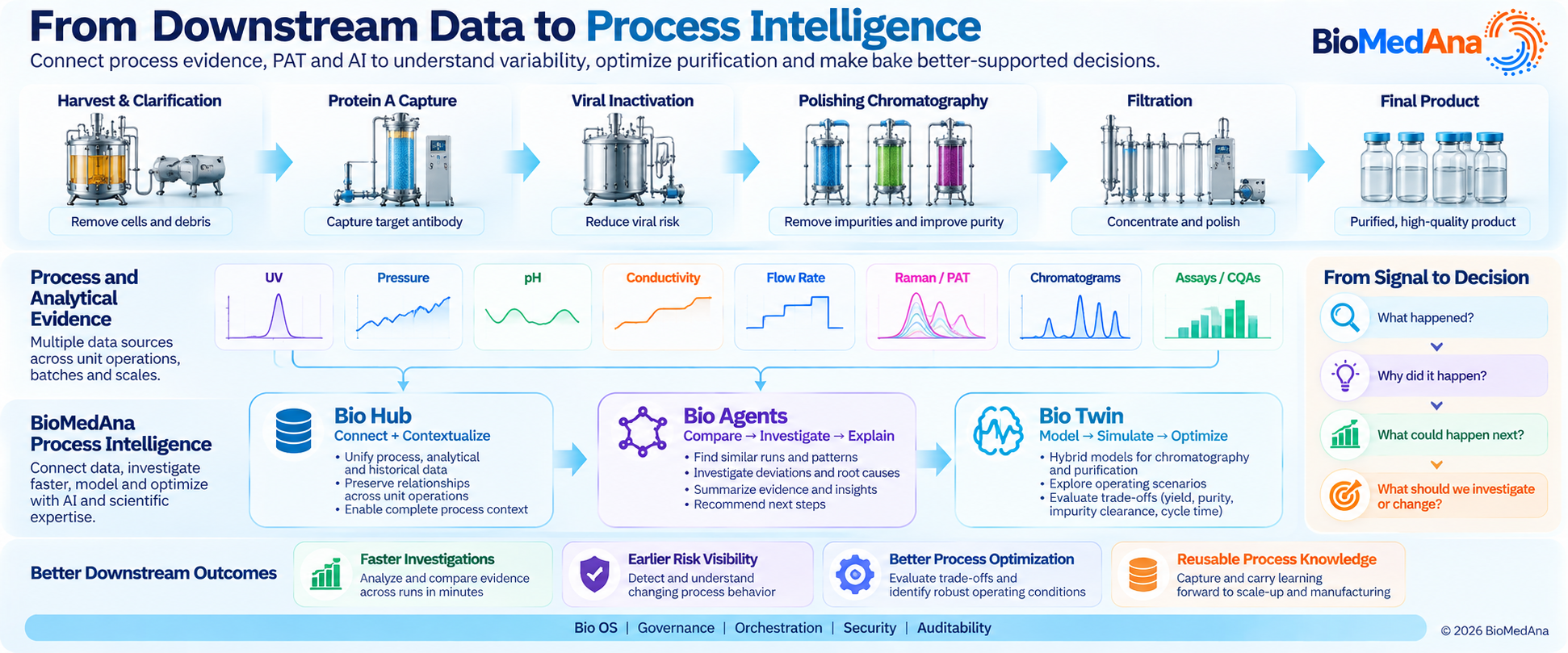
How is AI used in downstream bioprocessing?
AI can support downstream bioprocessing by connecting process and analytical data, comparing historical runs, identifying patterns and anomalies, interpreting PAT signals, and modeling relationships between operating conditions and outcomes such as yield, purity and impurity clearance. Combined with process knowledge and hybrid models, AI can also help scientists evaluate chromatography and purification scenarios, investigate process variability and prioritize experiments while keeping scientific experts responsible for development and manufacturing decisions.
Downstream processing has always been data-rich.
Chromatography traces. Pressure profiles. UV signals. Conductivity. pH. Flow rates. Pool volumes. Filtration data. Analytical assays. Product-quality measurements. Impurity profiles. PAT signals. Batch records.
The challenge is rarely a lack of data.
The challenge is turning all of that evidence into a timely understanding of:
What is happening?
Why is it happening?
Does it matter?
And what should we do next?
As biologics become more complex and upstream productivity continues to increase, downstream teams face growing pressure to deliver robust purification processes while maintaining yield, purity, product quality and manufacturing efficiency.
At the same time, technologies such as Process Analytical Technology (PAT), advanced analytics, AI and digital twins are creating an opportunity to move beyond retrospective process analysis.
The opportunity is to create downstream process intelligence.
Downstream Processing Is a Chain of Interconnected Decisions
Consider a typical monoclonal antibody downstream process:
Harvest → Protein A Capture → Viral Inactivation → Polishing Chromatography → Filtration → Final Product
Each unit operation has a defined purpose.
But the operations are not independent.
What happens during capture can influence polishing.
What happens during filtration can affect subsequent processing.
Variability introduced earlier in the process can appear later as differences in yield, purity, aggregates, host-cell proteins or other product-quality attributes.
Downstream development therefore involves continuously balancing multiple objectives:
- Product recovery
- Purity
- Impurity clearance
- Aggregate removal
- Product quality
- Resin utilization
- Cycle time
- Buffer consumption
- Process robustness
- Manufacturing scalability
The strongest operating condition is rarely the one that maximizes a single metric.
It is the condition that creates the appropriate balance across multiple process and product objectives.
That makes downstream processing fundamentally a multivariable decision problem.
The Problem Is Not Seeing the Data. It Is Connecting It.
Imagine a chromatography step where one batch behaves differently.
The team can see the chromatogram.
But understanding why may require considerably more evidence.
Was the load different?
Did conductivity change?
Was there a shift in pH?
Did the feed composition vary?
Was the column operating differently?
Was there an unusual pressure profile?
Did the fractionation or pooling strategy change?
What happened to yield?
What happened to aggregates or other impurities?
Have we observed similar behavior in previous runs?
Answering these questions can require scientists to move across historians, chromatography systems, LIMS, spreadsheets, analytical reports and batch records.
The evidence exists.
The relationships between the evidence are harder to see.
That is where connected process intelligence becomes valuable.
Step 1: Create a Connected Downstream Evidence Layer
The first requirement for intelligent downstream processing is not AI.
It is context.
Bio Hub can bring together process, analytical and historical evidence while preserving the relationships between them.
For chromatography, for example, that could include:
Inputs
Load concentration, composition and volume
Process conditions
Flow rate, pH, conductivity, gradient, pressure and column parameters
Process signals
UV, conductivity, pressure and PAT measurements
Outputs
Yield, purity, aggregate levels, impurity clearance and other quality attributes
Context
Batch, material, equipment, resin history, method and previous comparable runs
Instead of treating these as independent datasets, they become part of one connected process story.
That matters because downstream questions rarely belong to one system.
Step 2: Move from Historical Analysis Toward PAT
Traditional quality assessment often depends on sampling followed by laboratory analysis.
That remains essential.
But it creates a time gap between what is happening in the process and what we know about the process.
PAT can narrow that gap.
A recent review of PAT in biopharmaceutical downstream processing describes growing use of spectroscopy, chromatography, biosensors, chemometric modeling and digital twins to support monitoring, predictive analytics and process control.
Other industry research has identified technologies including variable-path-length UV/Vis, online liquid chromatography, MALS and automated sampling as potentially valuable PAT approaches in Protein A purification and polishing.
Raman spectroscopy is another interesting example. Its use in biopharmaceutical processing has expanded beyond upstream applications, with published work describing opportunities for downstream monitoring and protein characterization.
But installing a PAT instrument does not automatically create process intelligence.
A sensor generates a signal.
The real value comes from understanding what that signal means in the context of the process.
From PAT Signal to Process Meaning
Consider a synthetic polishing chromatography example.
A downstream team is trying to balance:
Product recovery + aggregate removal + purity + cycle time
The process generates:
- UV absorbance
- Conductivity
- pH
- Flow rate
- Pressure
- Column-volume information
- Fraction data
- Pooling information
- Offline analytical results
Potentially, PAT adds richer real-time information.
Now imagine that the current run begins to deviate from historical behavior.
The first level of intelligence is:
Something changed.
The second is:
What changed?
The third is:
Why?
And the most valuable level is:
What should we do about it?
That progression—from detection to understanding to decision support—is where AI becomes much more interesting.
Step 3: Let Scientists Interrogate the Process
Once process and analytical evidence is connected, Bio Agents can help downstream scientists investigate it using scientific questions.
For example:
Compare this chromatogram with the previous 20 successful runs.
Which process parameters changed before the UV profile began to deviate?
Show batches with similar conductivity behavior.
Compare yield and aggregate clearance across different pooling strategies.
Which variables are most strongly associated with reduced recovery?
Summarize the evidence that may explain this batch's behavior.
The goal isn't for an AI agent to declare:
“The problem is conductivity.”
Instead, it should expose the evidence supporting—or contradicting—that hypothesis.
That distinction is critical in bioprocessing.
AI should help scientists investigate faster, not hide scientific reasoning behind an answer.
Step 4: Move from Investigation to Prediction
Connected evidence and intelligent investigation answer important questions about what has already happened.
But downstream development also needs to ask:
What is likely to happen if we change the process?
This is where Bio Twin becomes relevant.
Consider an ion-exchange chromatography step.
The team might want to explore changes to:
- Load density
- pH
- Conductivity
- Gradient profile
- Flow rate
- Pooling boundaries
Different combinations can affect yield, impurity removal, product quality and cycle time.
Rather than testing every possible combination physically, a useful process model can help teams explore the design space computationally.
This is not hypothetical as an industry direction. BPI's 2026 downstream agenda includes a session specifically focused on digital-twin-enabled control of ion-exchange chromatography for robust mAb purification.
The purpose of the Twin isn't to eliminate downstream experimentation.
It is to help determine which experiments are most valuable.
Step 5: Understand the Trade-Offs, Not Just the Optimum
Optimization in downstream processing rarely produces one universally perfect answer.
Consider a simplified example.
One chromatography condition may maximize yield but provide weaker aggregate clearance.
Another may achieve excellent purity while sacrificing recovery.
A third may offer slightly lower maximum performance but remain more robust across variability in the incoming material.
Which is best?
That depends on the process objective.
This is where AI and hybrid models can help teams explore a Pareto frontier rather than simply produce a single recommended operating point.
Scientists can ask:
What operating conditions maximize recovery while maintaining the required purity?
Where does additional impurity clearance begin to materially reduce yield?
Which operating region remains robust when feed characteristics vary?
That moves AI from prediction toward decision support.
PAT + AI Creates a Different Possibility
PAT makes the story even more interesting because the evidence can become available during the process rather than only afterward.
Imagine a future downstream workflow:
PAT signal
↓
Real-time contextualization
↓
Model interpretation
↓
Deviation or trend detected
↓
Bio Agent investigation
↓
Recommended action or decision support
↓
Scientist/operator review
That doesn't necessarily mean autonomous control.
There is considerable value before reaching that point.
The first objective may simply be:
See earlier. Understand faster. Decide with more evidence.
BPI's 2026 downstream agenda reflects this direction, including adaptive cation-exchange pooling based on real-time PAT monitoring.
An Illustrative Chromatography Scenario
Consider a synthetic mAb polishing operation.
Historical runs indicate a stable relationship between conductivity, UV behavior, pooling boundaries, recovery and aggregate clearance.
During a new run, the UV profile begins shifting earlier than expected.
A traditional workflow might involve:
Complete run → collect samples → perform assays → compile results → investigate
With connected process intelligence, the workflow could begin earlier.
Bio Hub contextualizes the current process signals with historical runs.
Bio Agents identify comparable batches and highlight which variables have changed.
Bio Twin evaluates potential implications for recovery and impurity clearance.
PAT provides additional process evidence as the run progresses.
The scientist can then investigate:
Is the behavior within historical variability?
Which parameters are contributing most strongly?
How did similar runs perform?
What could happen under alternative pooling boundaries?
The system has not replaced the downstream scientist.
It has given the scientist a much richer and faster way to understand the process.
From Individual Unit Operations to End-to-End Downstream Intelligence
There is an even larger opportunity.
A downstream process is not one chromatography column.
It is a sequence of interconnected unit operations.
Imagine connecting evidence across:
Harvest → Capture → Viral Inactivation → Polishing → Filtration
Now scientists can ask questions across the process rather than only within a single step.
For example:
When polishing yield falls below expectation, are there characteristics of the capture pool that consistently precede it?
Or:
Which upstream or harvest characteristics correlate with increased downstream impurity burden?
Or:
How does incoming material variability propagate through purification?
That changes the unit of analysis.
Instead of optimizing isolated operations, teams can begin understanding the entire purification process as a connected system.
The Upstream–Downstream Boundary Should Not Be a Data Boundary
This becomes even more powerful when upstream evidence is connected.
Product entering downstream purification carries the history of the upstream process.
Cell culture conditions can influence product concentration, impurity burden and quality characteristics.
Yet upstream and downstream teams often analyze their respective portions of the process separately.
A connected intelligence layer allows a different question:
How did upstream process behavior influence downstream performance?
That creates a continuous knowledge journey:
Cell Line Development → Upstream Process Development → Scale-Up → Downstream Processing → Manufacturing
This is why BioMedAna's architecture is broader than a downstream analytics tool.
Bio Hub connects the evidence.
Bio Agents help scientists investigate it.
Bio Twin models and simulates process behavior.
Bio OS provides governance, orchestration, security and auditability across the platform.
What Does Intelligent Downstream Processing Change?
The objective isn't simply to add more technology.
It is to improve decisions.
That can mean:
Faster investigations
Compare current behavior against historical process evidence without manually assembling information from multiple systems.
Earlier risk visibility
PAT and connected analytics can surface changing process behavior sooner.
Higher-value experiments
Models can help teams prioritize conditions that resolve meaningful uncertainty.
Better process optimization
Evaluate yield, purity, quality and robustness together rather than optimizing one variable independently.
More reusable process knowledge
Capture relationships learned during development so they remain available during scale-up, technology transfer and manufacturing.
Stronger process understanding
Connect signals, process parameters and analytical outcomes into a more complete picture of process behavior.
The Future Is Not More Downstream Data
Downstream processing will continue generating more data.
More sensors.
More analytical measurements.
More PAT signals.
More model outputs.
But generating more information isn't the same as creating more understanding.
The bigger opportunity is to connect those signals to process context, historical evidence and scientific knowledge so downstream teams can answer:
What happened?
Why did it happen?
What is likely to happen next?
What should we investigate?
What should we change?
That is the progression from downstream data to downstream intelligence.
And it may be one of the most practical ways AI can improve biologics development and manufacturing.
Bring Us One Downstream Process Challenge
Working on chromatography, PAT, purification optimization or a downstream investigation where the evidence exists but the answer is difficult to see?
Bring us one process challenge. We'll show you how BioMedAna would approach it.
Request a Process Intelligence Session ↗
About BioMedAna
BioMedAna is an AI-native bioprocess intelligence platform. Bio Hub connects and contextualizes scientific, experimental, process and analytical evidence. Bio Agents help scientists investigate, compare, explain and support decisions. Bio Twin combines physics, biology, process data, AI/ML and domain knowledge to model, simulate and optimize process behavior. Bio OS provides governance and orchestration across the platform.
Frequently asked questions
What is downstream processing in biomanufacturing?
Downstream processing is the series of operations used to recover, purify, and prepare a biological product after it has been produced. For biologics such as monoclonal antibodies, this can include harvest and clarification, capture chromatography, viral inactivation, polishing chromatography, filtration, and formulation-related steps. The objective is to achieve the required product purity, quality, and safety while maintaining acceptable yield and process robustness. Downstream development therefore requires balancing product recovery, impurity clearance, product quality, processing time, and manufacturing efficiency.
How can AI improve downstream bioprocessing?
AI can improve downstream bioprocessing by connecting process and analytical data, identifying patterns across historical runs, detecting unusual process behavior, and helping scientists investigate relationships between operating conditions and outcomes such as yield, purity, and product quality. AI can also support process optimization by comparing operating scenarios and identifying influential parameters or trade-offs. When combined with scientific and engineering knowledge, AI helps downstream teams move from retrospective data analysis toward faster investigation, better-supported experimentation, and more informed process-development and manufacturing decisions.
What is PAT in downstream processing?
Process Analytical Technology (PAT) in downstream processing uses analytical measurements and process sensors to provide timely information about process conditions and product characteristics during purification. Examples can include UV absorbance, pH, conductivity, pressure, spectroscopy, online chromatography, and other analytical measurements. PAT can help scientists detect changing process behavior earlier and improve process understanding. When PAT signals are connected with historical process data, analytical results, and appropriate models, they can support faster investigation, process monitoring, prediction, and better-informed downstream decisions.
How can AI help optimize chromatography?
AI can help optimize chromatography by analyzing relationships between variables such as load conditions, pH, conductivity, flow rate, gradient profiles, pressure, pooling boundaries, and resulting process outcomes. Models can help scientists evaluate trade-offs among recovery, purity, impurity clearance, product quality, robustness, and cycle time. Rather than testing every possible condition experimentally, AI and hybrid models can help identify promising operating regions and prioritize higher-value experiments. Scientists can then use experimental evidence to confirm predictions and refine their understanding of the chromatography process.
How can Raman spectroscopy and other PAT data be used with AI?
Raman spectroscopy and other PAT technologies can generate information about a process while it is occurring. AI and chemometric models can analyze these signals alongside process parameters, historical runs, and analytical results to identify patterns, estimate relevant process or quality attributes, detect deviations, and investigate changing process behavior. The value comes from connecting a PAT signal to its broader process context. This can help teams move from simply detecting that something changed toward understanding what changed, why it may have changed, and whether further investigation or action is warranted.