PLATFORM & TECHNOLOGY
What Is a Bioprocess Digital Twin? Why the Next Generation Is Hybrid
A bioprocess digital twin connects process evidence with models to help scientists understand behavior, test scenarios and predict outcomes. Learn what separates a true digital twin from a static model, why hybrid twins combine mechanistic science with AI/ML, and how they can support development, scale-up, technology transfer and manufacturing.
Bioprocess teams are expected to develop, scale and manufacture increasingly complex products with greater speed and confidence. Yet many critical decisions still depend on fragmented evidence, labor-intensive analysis and another physical experiment. A bioprocess digital twin changes that decision cycle by creating a continuously informed digital representation of the process—not simply another dashboard or a one-time simulation.
A bioprocess digital twin is a dynamic digital representation of a biological process that connects process data with mathematical and computational models. It helps scientists understand current behavior, simulate alternative conditions and predict outcomes such as yield, quality, deviations and scale-up performance before committing material, time or manufacturing capacity.
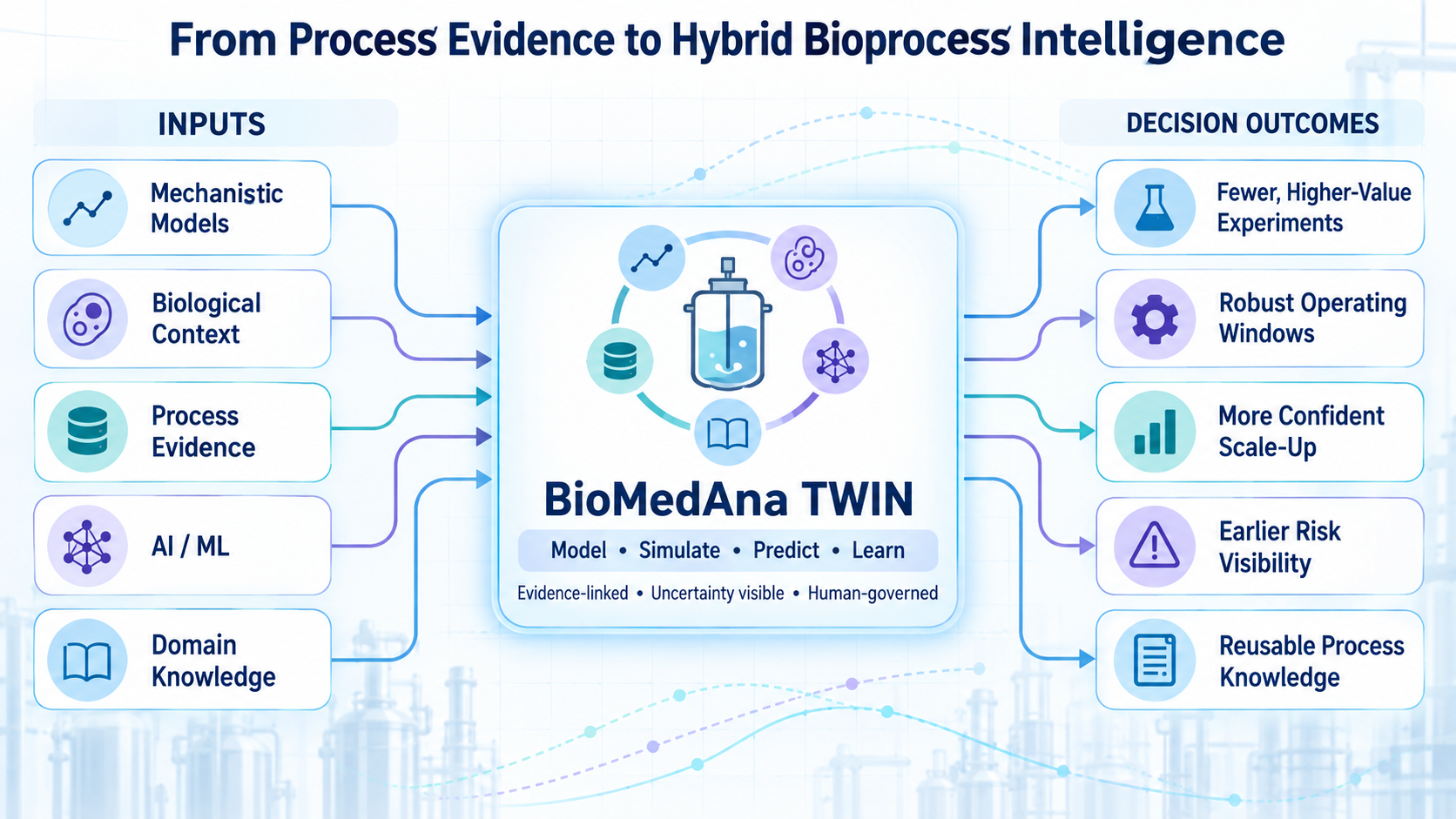
For complex bioprocesses, hybrid approaches can be especially valuable. They combine mechanistic understanding with data-driven AI/ML, biological context and expert knowledge—helping teams use both known science and observed process behavior. This matters because bioprocesses are governed by both engineering principles and living systems, and neither physics alone nor data alone provides the complete picture.
What is a bioprocess digital twin?
A bioprocess digital twin is a digital representation of a real biological production process, connected to evidence from that process and designed to support an ongoing decision loop. It may represent a single unit operation, a bioreactor, an end-to-end process, a particular product or a process as it moves from development to commercial scale.
A useful twin does more than display what has already happened. Depending on its intended use and maturity, it can:
- reconstruct and explain process behavior;
- compare batches, scales or operating strategies;
- simulate conditions that have not yet been tested physically;
- predict outcomes such as titer, yield, viability or product-quality attributes;
- estimate uncertainty and identify the limits of a prediction;
- incorporate new evidence as additional runs are completed; and
- help scientists decide which experiment, operating region or investigation path deserves attention next.
The connection to the real process is important. A standalone model can be valuable, but a twin becomes an enduring capability when the model, data, process context, evidence and decisions remain connected over time.
Why is a bioprocess twin different from a conventional industrial twin?
Digital twins originated in engineering environments where assets such as engines, machines and production lines can be described largely through physical behavior and equipment telemetry. Bioprocessing includes those engineering realities—but it also introduces living systems.
Cells respond to their environment. Raw materials vary. Metabolism changes over the course of a run. Mixing, mass transfer, dissolved oxygen, pH, temperature, shear and feed strategy interact with cell growth, viability, expression and product quality. These relationships can be nonlinear, time-dependent and different at each scale.
That makes a bioreactor more than an instrumented vessel. Equipment signals can reveal what happened in the physical environment, but they do not, by themselves, explain how the biology responded or why a critical quality attribute changed.
A credible bioprocess twin therefore needs to connect three layers:
- Process conditions: What was done to the process?
- Biological response: How did the cells or organism respond?
- Product outcome: What happened to yield, quality and robustness?
The twin becomes valuable when it can represent relationships across all three layers and make their uncertainty visible.
Are a model, simulation and digital twin the same thing?
No. The terms are sometimes used interchangeably, but they describe different levels of capability.
| Capability | Model | Simulation | Connected digital twin | Hybrid twin |
|---|---|---|---|---|
| Represents selected process relationships | Yes | Yes | Yes | Yes |
| Explores “what-if” scenarios | Sometimes | Yes | Typically | Typically |
| Connects models to process evidence and context | Not necessarily | Not necessarily | Yes | Yes |
| Updates as new evidence becomes available | Usually not | Usually not | Typically | Typically |
| Combines mechanistic and data-driven models | Not necessarily | Not necessarily | Not necessarily | Yes |
| Carries uncertainty, constraints and model provenance | Varies | Varies | Should | Should |
| Supports an ongoing observe–predict–decide–learn loop | No | Limited | Can | Can |
A model represents selected relationships within a process. A simulation uses a model to explore how the process might behave under specified conditions. A digital twin connects models and simulations to the identity, context and evidence of a real process so the representation can remain useful as the process evolves.
A hybrid twin combines mechanistic and data-driven approaches. It can preserve scientific constraints while learning relationships that are difficult to specify completely from first principles.
This distinction prevents a common mistake: calling every dashboard, model or simulation a digital twin. Those tools can be building blocks of a twin, but the twin is the connected decision system around them.
How does a bioprocess digital twin work?
Although implementations differ, a bioprocess digital twin generally operates through six connected stages.
1. Connect the evidence
The twin draws on relevant historical and, where needed, real-time evidence. Sources may include bioreactors, PAT instruments, historians, SCADA, ELN, LIMS, MES, laboratory systems, assay results, material records, files and APIs.
2. Reconstruct the process context
Signals alone are not enough. Data must be associated with the correct run, phase, event, material, equipment configuration, assay and quality result. Timestamps, units, naming conventions and batch genealogy must also be aligned.
3. Represent the process
Models encode the relationships relevant to the intended decision. These may include kinetic equations, mass balances, mass-transfer relationships, scale-dependent engineering calculations, statistical models and machine-learning models.
4. Simulate and predict
Scientists can compare scenarios, vary operating parameters and estimate likely responses. Instead of testing every combination physically, teams can use the twin to narrow a large possibility space to the most informative or promising conditions.
5. Review and decide
The output should not be an unexplained number. Scientists need to see the supporting evidence, assumptions, applicable operating range, constraints, confidence and uncertainty before acting.
6. Learn from the next run
Observed results return to the system. The team can compare prediction with reality, investigate differences and update the evidence or model under controlled lifecycle processes.
Connect → Contextualize → Model → Predict → Decide → Learn
What is a hybrid bioprocess twin?
In its strict technical sense, hybrid modeling combines mechanistic models with data-driven models. Mechanistic models encode known scientific or engineering relationships. Data-driven models learn relationships from observed evidence. A hybrid approach uses the strengths of both.
For bioprocessing, the complete intelligence picture includes five complementary elements:
Mechanistic knowledge
Mass balances, reaction or growth kinetics, oxygen transfer, mixing, hydrodynamics, shear, heat transfer and scale-dependent behavior provide scientific structure. They help keep predictions within physically plausible boundaries.
Biological context
Cell growth, viability, metabolism, substrate uptake, product expression and quality formation describe how biology responds to the engineered environment. This context differs materially across mAbs, recombinant proteins, microbial fermentation, cell therapies, gene therapies and other modalities.
Process evidence
Historical runs, time-series measurements, process events, materials, offline assays and quality outcomes ground the twin in what has actually occurred.
AI and machine learning
AI/ML can learn nonlinear relationships, identify interactions, predict trajectories and reveal patterns that are difficult to encode completely in equations—especially when the relevant data and operating context are available.
Domain knowledge
Scientists and engineers contribute constraints, causal hypotheses, failure modes and practical operating knowledge. Their expertise shapes the question, challenges the result and remains essential to the decision.
Mechanistic models+biological context+process evidence+AI/ML+domain knowledge=hybrid bioprocess intelligence
Research in bioprocess engineering increasingly examines hybrid modeling as a way to accelerate digital-twin development and improve prediction when experimental data are limited. However, “hybrid” should not be treated as a guarantee of accuracy. The model must still be evaluated for its specific intended use, operating range and decision risk.
Explore BioMedAna Twin: See how connected process evidence, scientifically constrained models and modality-trained AI/ML can support prediction and simulation.
Explore BioMedAna Twin ↗Where can bioprocess digital twins create value?
The purpose of a twin is not to produce more models. It is to improve a decision that is currently slow, costly, uncertain or difficult to repeat.
Design fewer, higher-value experiments
A twin can sweep a wider operating space in silico before physical work begins. Scientists can compare combinations of feed, dissolved oxygen, agitation, temperature, pH and other parameters, then prioritize the experiments most likely to resolve uncertainty or improve the process.
This does not eliminate laboratory experiments. It helps direct scarce laboratory capacity toward the experiments that matter most.
Optimize process conditions
By connecting historical evidence with predictive models, teams can explore parameter interactions and identify candidate operating regions. The objective is not merely a higher predicted value, but a robust region that accounts for engineering constraints, product quality and uncertainty.
Predict yield and product quality
When the relevant process and quality evidence are available, a twin may support predictions of titer, yield, viability, metabolite behavior and selected critical quality attributes. The reliability of each prediction depends on the model, data coverage and intended operating range.
De-risk scale-up
Scale-up changes mixing, mass transfer, heat transfer, gas flow, gradients and shear. Biology responds to those changes, and product quality may follow. A hybrid twin can connect engineering calculations with biological response and prior process evidence to compare candidate scale-up strategies before committing high-cost capacity.
Strengthen technology transfer
Technology transfer requires more than transferring a recipe. Teams need to understand which conditions are essential, which relationships are scale-dependent and where the process is most sensitive. A twin can help carry forward the evidence, models, assumptions and decision history behind the process.
Support manufacturing investigations
Connected process trajectories, events, materials and quality results can help teams compare an atypical batch with relevant historical runs, test hypotheses and prioritize root-cause paths. A twin can support an investigation, but it does not replace the governed quality process or accountable human review.
What data does a bioprocess digital twin need?
The required data depends on the question the twin must answer. A scale-up twin, for example, needs different context from a deviation-investigation twin.
Relevant sources may include:
- bioreactor and PAT time-series data;
- setpoints, alarms, interventions and process events;
- equipment configuration and reactor geometry;
- agitation, aeration, pressure and gas-flow data;
- media, feed, raw-material and inoculum information;
- cell count, viability and metabolite measurements;
- offline assays and laboratory results;
- product-quality and release-test results;
- batch genealogy, process phase and sample context;
- prior deviations, investigations and scientific decisions; and
- the model versions, calculations and assumptions already used by the team.
More data is not automatically better. Data must be correctly identified, aligned and placed in scientific context. A large collection of files with missing units, inconsistent names or broken run-to-sample relationships is not yet prediction-ready evidence.
This is why the data foundation and the twin cannot be separated. The quality of the prediction is bounded by the quality, relevance and coverage of the evidence behind it.
Does a bioprocess digital twin require real-time data?
Not every useful bioprocess twin needs continuous real-time connectivity on day one. During process development, a twin may update between experiments as new run and assay data become available. In manufacturing monitoring or time-sensitive decision support, near-real-time integration may be important.
The appropriate update frequency should follow the intended use. What matters is that the twin maintains a governed connection to the real process and can be refreshed with new evidence. A static model that is never reconciled with observed performance should not be presented as a continuously operating twin.
How should a bioprocess digital twin be validated?
Validation begins with a precise statement of intended use. “Predict the process” is too broad. “Estimate day-12 titer for this CHO fed-batch process within the established operating range to help prioritize development experiments” is testable.
In this context, model evaluation, computerized-system validation and process validation should not be treated as the same activity. Predictive performance must be evaluated against the model’s intended use; the software and data environment may require separate lifecycle controls; and any use in a regulated process remains subject to the organization’s applicable quality system and regulatory requirements.
A risk-based validation approach should consider:
- the intended decision and consequences of error;
- provenance, completeness and representativeness of the data;
- separation of model-development and evaluation data;
- comparison of predictions with observed runs;
- performance across the relevant operating and scale ranges;
- residuals, failure modes and sensitivity to input changes;
- uncertainty and out-of-distribution detection;
- model versioning, change control and evidence lineage;
- reproducibility of calculations and outputs;
- access controls, review and approval; and
- ongoing monitoring as the process, equipment or data distribution changes.
The acceptance criteria should match the intended use. A model used to explore early development scenarios may have different requirements from one supporting a GMP manufacturing decision. The use of AI does not make a system validated, and strong retrospective performance does not guarantee reliable extrapolation beyond the evidence used to evaluate it.
ICH Q8 emphasizes enhanced process and product understanding as a foundation for pharmaceutical development. A digital twin can contribute to that understanding, but its models, evidence and controls must be evaluated within the organization’s applicable quality and regulatory framework.
Why BioMedAna uses a hybrid approach
BioMedAna treats the twin as part of a larger bioprocess-intelligence system:
- BioMedAna Hub connects, standardizes and contextualizes process evidence from equipment, laboratory and enterprise systems.
- BioMedAna Twin combines that evidence with physics, biological and process context, domain science and modality-trained AI/ML to predict and simulate outcomes.
- BioMedAna Agents help teams investigate questions, run guided analyses and prepare evidence-linked outputs for scientist review; consequential process decisions remain human-governed.
- BioMedAna OS provides the security, governance, auditability, model lifecycle and human-approval foundation for deployment across programs, sites and teams.
This distinction matters. A model without reliable process context can produce an answer without sufficient evidence. A data platform without predictive intelligence can show teams what happened without helping them explore what may happen next. BioMedAna connects the evidence, prediction and decision loop.
BioMedAna Twin is designed to support outcomes such as:
- fewer, higher-value physical experiments;
- improved visibility into process sensitivity and uncertainty;
- more confident scale-up and technology-transfer decisions;
- earlier identification of yield, quality or deviation risk; and
- reusable process knowledge that improves as new evidence is reviewed and added.
BioMedAna is the broader bioprocess-intelligence platform. BioMedAna Twin is its hybrid prediction and simulation capability.
START WITH THE DECISION
Bring us the process question your team cannot answer quickly enough.
Together, we can define the evidence, model and validation path required to support it.
Frequently asked questions
What is a bioprocess digital twin?
A bioprocess digital twin is a dynamic digital representation of a biological production process. It connects process evidence with mathematical and computational models to help teams understand behavior, simulate alternative conditions and predict outcomes such as yield, product quality, deviations and scale-up performance.
How is a digital twin different from a simulation?
A simulation explores how a model behaves under specified conditions. A digital twin connects models and simulations to the identity, data and context of a real process. It can be updated with new evidence and support a continuing cycle of observation, prediction, decision and learning.
What is a hybrid digital twin?
A hybrid digital twin combines mechanistic models based on scientific and engineering knowledge with data-driven models such as machine learning. In bioprocessing, it can also incorporate biological context, process constraints, uncertainty and expert knowledge to produce more scientifically grounded predictions.
Does a bioprocess digital twin require real-time data?
Not always. The required update frequency depends on the intended use. Development twins may update after each experiment, while manufacturing-monitoring applications may need near-real-time data. The essential requirement is a maintained, governed connection between the digital representation and evidence from the real process.
Can a digital twin reduce physical experiments?
A digital twin can reduce the experimental search space by evaluating many scenarios in silico and prioritizing the conditions most worth testing. It does not eliminate physical experimentation; observed experiments remain necessary to generate evidence, evaluate predictions and confirm process behavior.
How is a bioprocess digital twin validated?
Validation should be based on intended use and risk. Model evaluation, computerized-system validation and process validation are distinct activities. Relevant controls may include data provenance, evaluation against observed runs, applicable-range testing, uncertainty assessment, version control, reproducibility, change management and human review.
Can digital twins support scale-up and technology transfer?
Yes. A hybrid twin can connect reactor geometry, mixing, mass transfer, shear, operating conditions and historical biological response to compare scale-up scenarios. For technology transfer, it can preserve the evidence, assumptions, sensitivities and decision history behind the process—not merely transfer a static recipe.
What is required to start building a bioprocess digital twin?
Start with one valuable decision, not an enterprise-wide data program. Define the intended use, required outputs, relevant process and quality evidence, scientific constraints, validation criteria and accountable reviewers. Then assess whether the available data and models adequately cover that decision and its operating range.
References and further reading
- Riezzo L, Kay H, Feng Y, Jing K, Zhang D. “Accelerating bioprocess digital twin development by integrating hybrid modelling with transfer learning.” Chemical Engineering Journal. 2025;511:162018. View publication ↗
- Shariatifar M, Rizi MS, Sotudeh-Gharebagh R, Zarghami R, Mostoufi N. “On digital twins in bioprocessing: Opportunities and limitations.” Process Biochemistry. 2025;156:274–299. View publication ↗
- Shahab MA, Destro F, Braatz RD. “Digital Twins in Biopharmaceutical Manufacturing: Review and Perspective on Human-Machine Collaborative Intelligence.” arXiv preprint, 2025. View preprint ↗
- International Council for Harmonisation. “Q8 Pharmaceutical Development.” ICH Quality Guidelines ↗
- BioMedAna Twin: Bioprocess Prediction and Simulation ↗