Strain and process context
Carry strain identity, inoculum history, material lots and operating conditions into run comparisons.
BACTERIAL · YEAST
Connect strain, substrate and inoculum history with fermentation measurements and product outcomes. Compare growth, feed, oxygen demand and metabolic behavior to investigate the constraints shaping productivity.
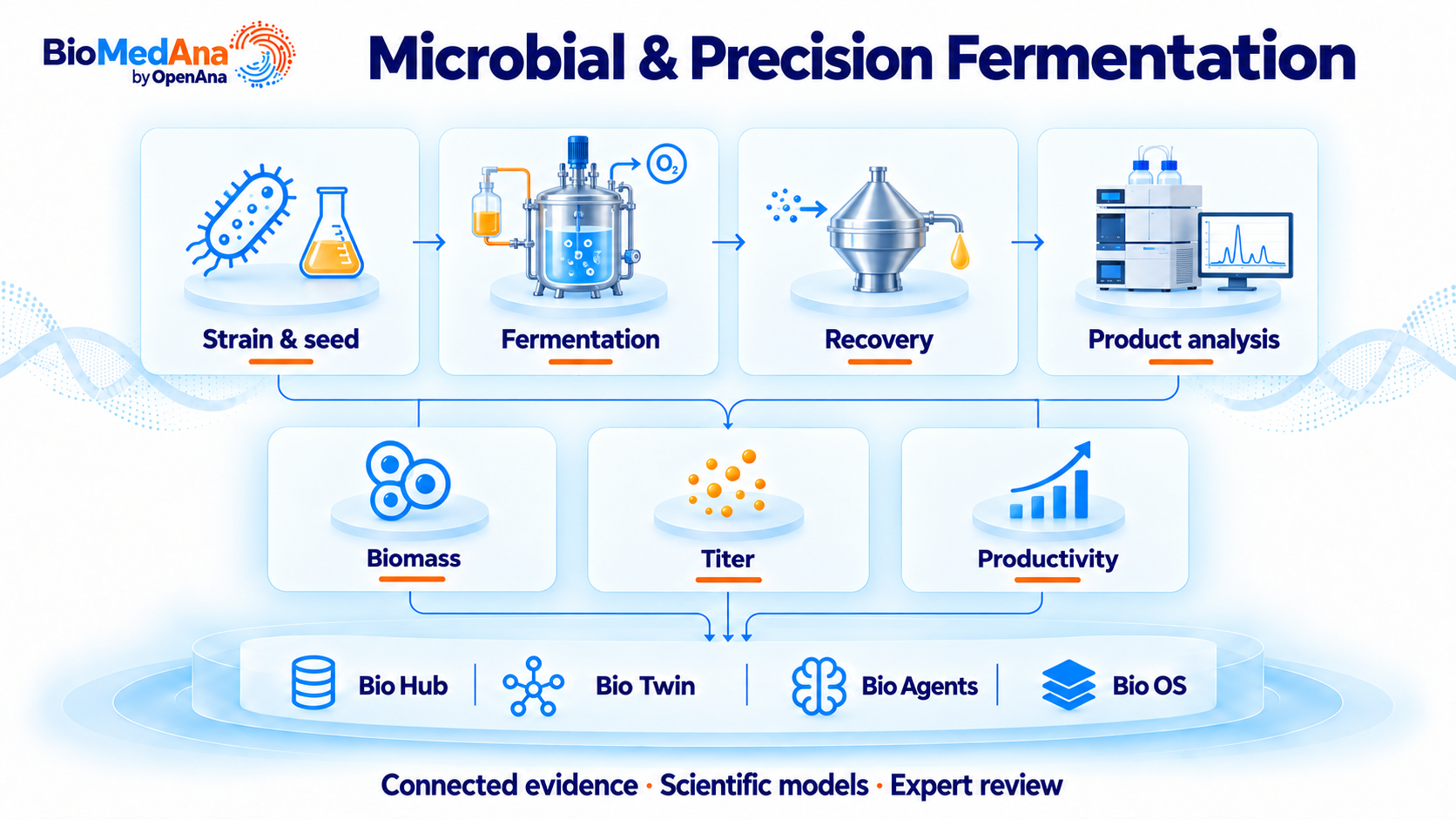
MODALITY-SPECIFIC PROCESS INTELLIGENCE
Carry strain identity, inoculum history, material lots and operating conditions into run comparisons.
Review substrate addition, uptake, biomass, metabolites and byproduct evidence across process phases.
Assess oxygen demand, off-gas and process conditions when considering mixing, transfer and scale.
Compare titer and recovery with culture history to identify where additional experiments would be most informative.
EVIDENCE · MODELS · DECISIONS
Process outcomes to evaluate: Biomass · titer · productivity
EXAMPLE INVESTIGATION
Align strain, seed, feed, oxygen and off-gas measurements with fermentation phases.
Compare growth, substrate and product trajectories across representative runs.
Assess potential oxygen-transfer and metabolic limitations with the relevant process model.
Recommend the measurements or experiments needed to distinguish the competing explanations.
Bio Agents can coordinate the scientific work across evidence and models, while Bio OS preserves governance and human review. The configured workflow determines which tasks and models are available.
Bring us this process challenge ↗EVALUATION & SCOPE
Specify the organism, substrate, product and operating range. Transport constraints, overflow metabolism and model parameters must be evaluated for the process and scale under consideration.
Strain, substrate and inoculum history. Feed, oxygen, off-gas and temperature. Biomass, metabolites and product measurements. Include the process question, relevant run context and the analytical methods used to assess the outcome.
Growth and substrate-consumption kinetics. Oxygen-demand and transport assessment. Feed and productivity scenarios. Scope and evaluation criteria are defined for your process, data and intended decision.
Specify the organism, substrate, product and operating range. Transport constraints, overflow metabolism and model parameters must be evaluated for the process and scale under consideration.
EXPLORE OTHER MODALITIES