SCIENTIFIC WORKFLOWS
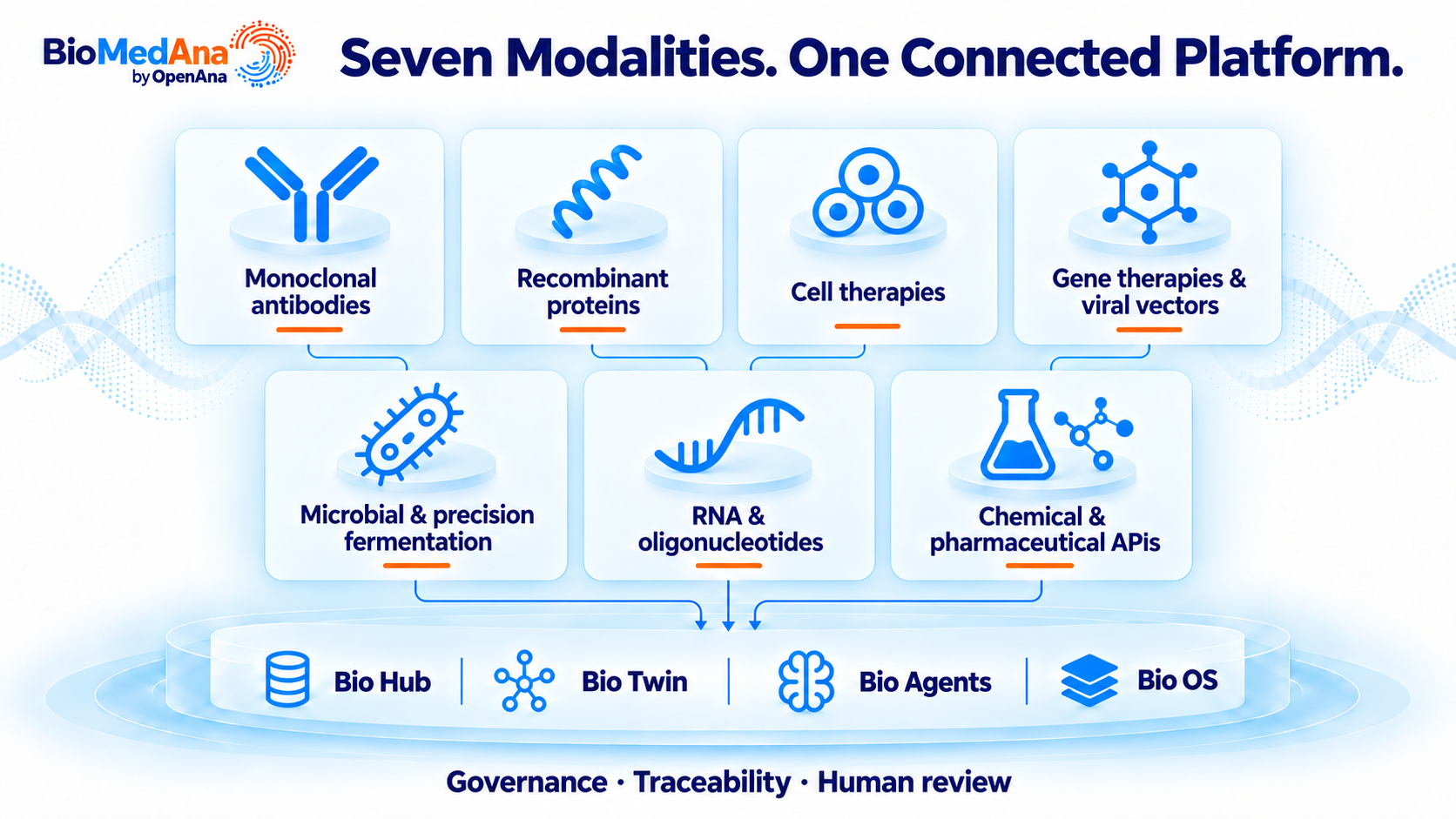
Different evidence. Monoclonal antibodies Recombinant proteins Cell therapies Gene therapies and viral vectors Microbial and precision fermentation RNA and oligonucleotides Chemical & pharmaceutical APIs CHO · MAB Growth, metabolism, feeding, mass transfer, titer and CQAs.
01 Cell culture02 Harvest03 Purification04 QualityEvidence in Bio Hub Cell growth and viability Feed, metabolites and reactor conditions Chromatography, recovery and quality assays Models in Bio Twin Culture kinetics and hybrid prediction Feed and operating-window comparisons Scale-dependent process assessment Scientific decisions Compare media and feed strategies Investigate titer or quality shifts Assess transfer and scale-up scenarios Process outcomes to evaluate: Titer · recovery · product quality
Explore Monoclonal antibodies ↗ CHO · MICROBIAL Expression, purification, potency and product-quality attributes.
01 Expression02 Harvest03 Recovery04 CharacterizationEvidence in Bio Hub Host, expression conditions and induction Solubility, refolding and purification records Purity, activity and potency assays Models in Bio Twin Expression and productivity relationships Recovery and purification comparisons Process sensitivity and scenario analysis Scientific decisions Compare expression conditions Identify recovery losses Connect upstream changes to final quality Process outcomes to evaluate: Expression · soluble yield · potency
Explore Recombinant proteins ↗ CAR-T · TIL · NK Starting-material variability, expansion, phenotype and potency.
01 Starting material02 Activation03 Expansion04 Release evidenceEvidence in Bio Hub Donor and material provenance Activation, expansion and process-stage records Viability, phenotype, composition and potency Models in Bio Twin Expansion and variability analysis Process-stage comparisons Yield and operating-condition scenarios Scientific decisions Investigate donor and batch variability Compare expansion strategies Trace process evidence to dose and potency Process outcomes to evaluate: Cell yield · viability · phenotype
Explore Cell therapies ↗ AAV · LENTIVIRAL Transfection, vector yield, capsid quality and robustness.
01 Cell system02 Transfection03 Harvest04 PurificationEvidence in Bio Hub Cell line, seed train and reagent context Transfection, infection and reactor records Vector yield, full/empty, purity and potency assays Models in Bio Twin Production and process sensitivity Harvest and purification comparisons Scale-up scenario assessment Scientific decisions Compare transfection and harvest conditions Investigate yield-quality trade-offs Evaluate transfer readiness Process outcomes to evaluate: Vector yield · purity · potency
Explore Gene therapies and viral vectors ↗ BACTERIAL · YEAST Substrate kinetics, OUR/OTR, feed, heat and productivity.
01 Strain & seed02 Fermentation03 Recovery04 Product analysisEvidence in Bio Hub Strain, substrate and inoculum history Feed, oxygen, off-gas and temperature Biomass, metabolites and product measurements Models in Bio Twin Growth and substrate-consumption kinetics Oxygen-demand and transport assessment Feed and productivity scenarios Scientific decisions Compare feeding strategies Identify oxygen or substrate constraints Assess robustness across scale Process outcomes to evaluate: Biomass · titer · productivity
Explore Microbial and precision fermentation ↗ ASO · SIRNA Synthesis, purification, impurities, yield and quality.
01 Synthesis02 Cleavage / processing03 Purification04 Analytical qualityEvidence in Bio Hub Synthesis cycles, reagents and material lots Coupling efficiency and purification records Identity, purity and impurity measurements Models in Bio Twin Reaction efficiency and loss analysis Purification and impurity comparisons Yield and process sensitivity Scientific decisions Investigate step-dependent yield losses Compare purification conditions Connect synthesis changes to analytical quality Process outcomes to evaluate: Yield · purity · impurity profile
Explore RNA and oligonucleotides ↗ SMALL MOLECULE · REACTION KINETICS Reaction networks, dosing, conversion, selectivity, impurities and crystallization.
01 Route & materials02 Reaction & dosing03 Isolation04 Analytical qualityEvidence in Bio Hub API product and route version Reaction steps, reagent lots and dosing schedules Time-series conditions and analytical concentrations Impurity profiles and material-balance closure Models in Bio Twin Stoichiometric and Arrhenius reaction kinetics Batch and semi-batch dosing simulations Experimental calibration and hybrid residual models Process-specific crystallization and transport studies Scientific decisions Compare temperature and dosing strategies Evaluate conversion-selectivity trade-offs Trace impurity pathways and balance residuals Assess isolation and scale-up requirements Process outcomes to evaluate: Conversion · selectivity · yield · impurities
Explore Chemical & pharmaceutical APIs ↗ Model coverage and workflow configuration depend on the process, available evidence and intended decision. A modality name alone does not establish predictive performance; scope is agreed around your use case.