Production context
Connect cell-line and seed-train information with reagent and transfection or infection conditions.
AAV · LENTIVIRAL
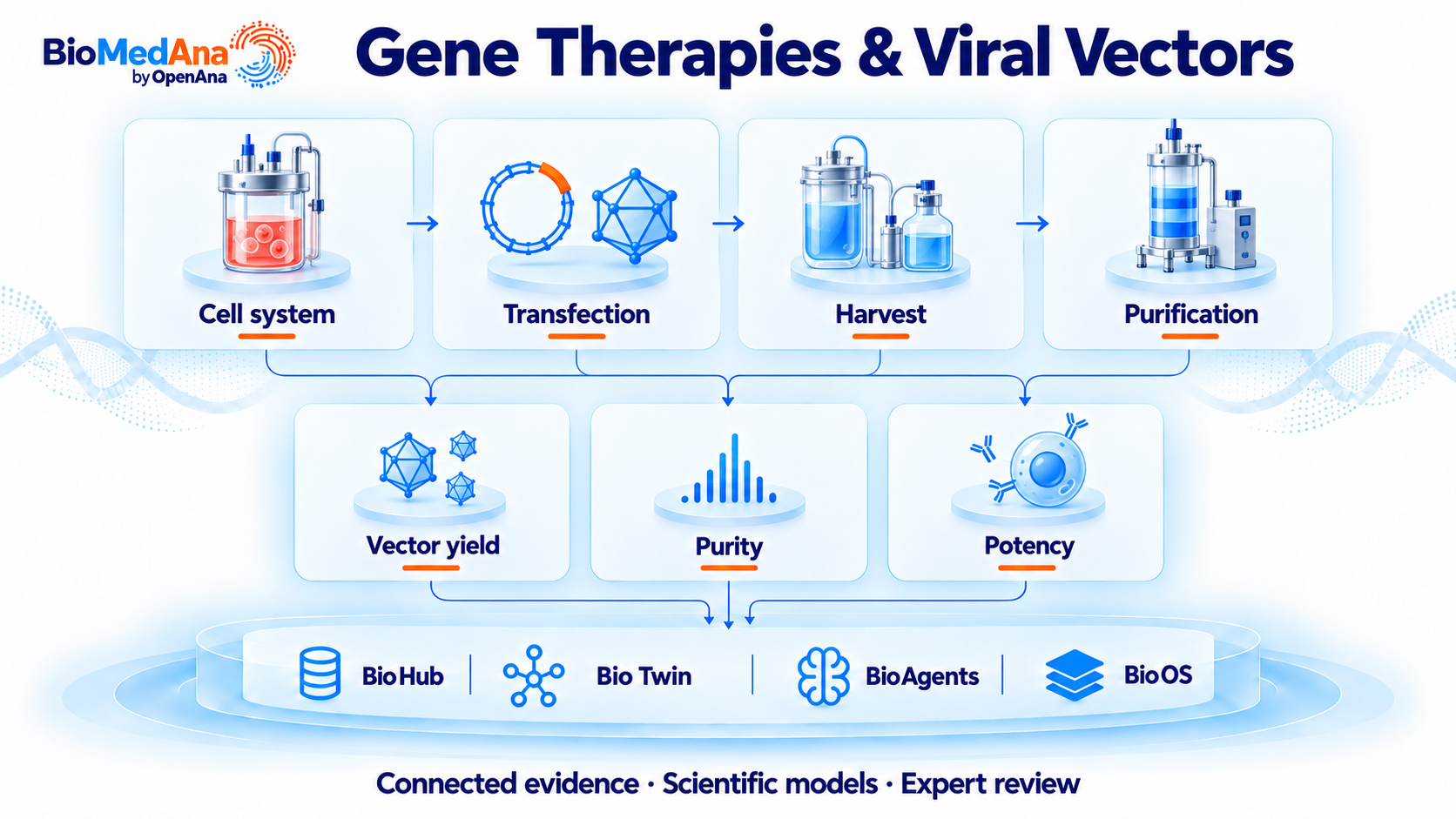
Keep the cell system, seed train, transfection or infection, bioreactor records, harvest and purification together. Evaluate vector yield alongside the quality measurements and process context needed to interpret it.
MODALITY-SPECIFIC PROCESS INTELLIGENCE
Connect cell-line and seed-train information with reagent and transfection or infection conditions.
Compare process timing, cell state and vector measurements to assess harvest-related trade-offs.
Review recovery and quality evidence across purification stages and batches.
Bring equipment and process differences into a scientific comparison before selecting scale-up or transfer studies.
EVIDENCE · MODELS · DECISIONS
Process outcomes to evaluate: Vector yield · purity · potency
EXAMPLE INVESTIGATION
Connect production conditions and reagent context with batch and sample identities.
Compare harvest timing and vector measurements across the selected cohorts.
Review full/empty, purity and potency-related assays alongside purification recovery.
Prepare the yield-quality comparison and propose the evidence needed to resolve remaining uncertainty.
Bio Agents can coordinate the scientific work across evidence and models, while Bio OS preserves governance and human review. The configured workflow determines which tasks and models are available.
Bring us this process challenge ↗EVALUATION & SCOPE
Vector type, analytical method, host and process stage determine the scope of a comparison. Demonstrated support for one vector workflow should not be assumed to apply unchanged to every vector platform.
Cell line, seed train and reagent context. Transfection, infection and reactor records. Vector yield, full/empty, purity and potency assays. Include the process question, relevant run context and the analytical methods used to assess the outcome.
Production and process sensitivity. Harvest and purification comparisons. Scale-up scenario assessment. Scope and evaluation criteria are defined for your process, data and intended decision.
Vector type, analytical method, host and process stage determine the scope of a comparison. Demonstrated support for one vector workflow should not be assumed to apply unchanged to every vector platform.
EXPLORE OTHER MODALITIES