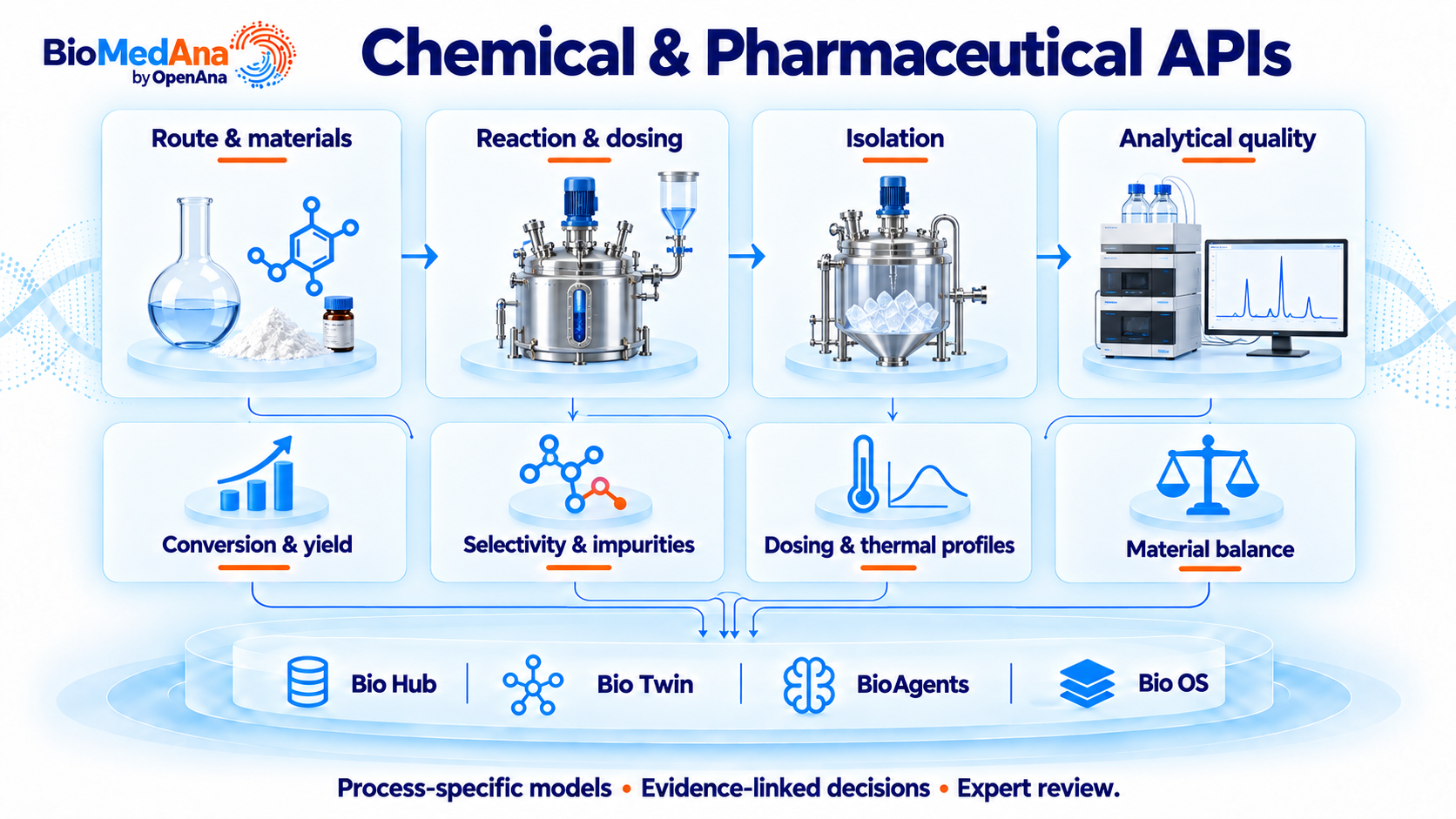
A process record should connect each reaction step to the materials, operating conditions and measurements behind it. The same context supports kinetic fitting, scenario comparison and review of the proposed next experiment.
CORE MODELINGReaction kinetics
Represent species and competing pathways with stoichiometry, reaction orders and temperature-dependent rate constants. Compare conversion, selectivity, theoretical yield and impurity trajectories.
- Batch and semi-batch reactions
- Arrhenius temperature sensitivity
- Species concentrations and material balances
WHAT-IF SIMULATIONDosing and operating scenarios
Explore how reagent addition, thermal profiles and reaction time affect a process. Carry the working volume and addition schedule into the same simulation.
- Time-dependent reagent addition
- Variable-volume dosing dynamics
- Matched temperature and time scenarios
DATA + SCIENCEExperimental calibration
Fit kinetic parameters from concentration observations and compare predicted behavior with measured runs. Hybrid residual corrections are retained when they improve held-out run error.
- Run-linked analytical observations
- Parameter estimation and fit diagnostics
- Leave-one-run-out hybrid evaluation
PROCESS-SPECIFIC MODELSCrystallization and isolation
Evaluate cooling and seeding assumptions alongside solubility, supersaturation, nucleation and growth. Model scope and calibration are agreed for the intended process.
- Cooling profiles and seed loading
- Crystal-size moments and yield
- Supersaturation and balance checks
ENGINEERING ASSESSMENTScale and transport
Connect vessel geometry and operating conditions to mixing and transport questions. Use process-specific evidence to assess which scale-dependent effects need further study.
- Vessel and agitation context
- Mixing, heat and mass-transfer constraints
- Scenario comparisons for engineering review
CONNECTED WORKFLOWReviewable process evidence
Keep product, route, reaction step, run, dosing, sample and assay context together, so an investigation can be traced to the evidence and assumptions behind it.
- Route and reaction-step provenance
- Assay and impurity context
- Material-balance and deviation evidence
Reaction kinetics and calibration form the starting workflow. Crystallization, transport and advanced process-model scope are assessed for the specific application, data and deployment.