Starting-material context
Follow donor or source information and material provenance into each process stage.
CAR-T · TIL · NK
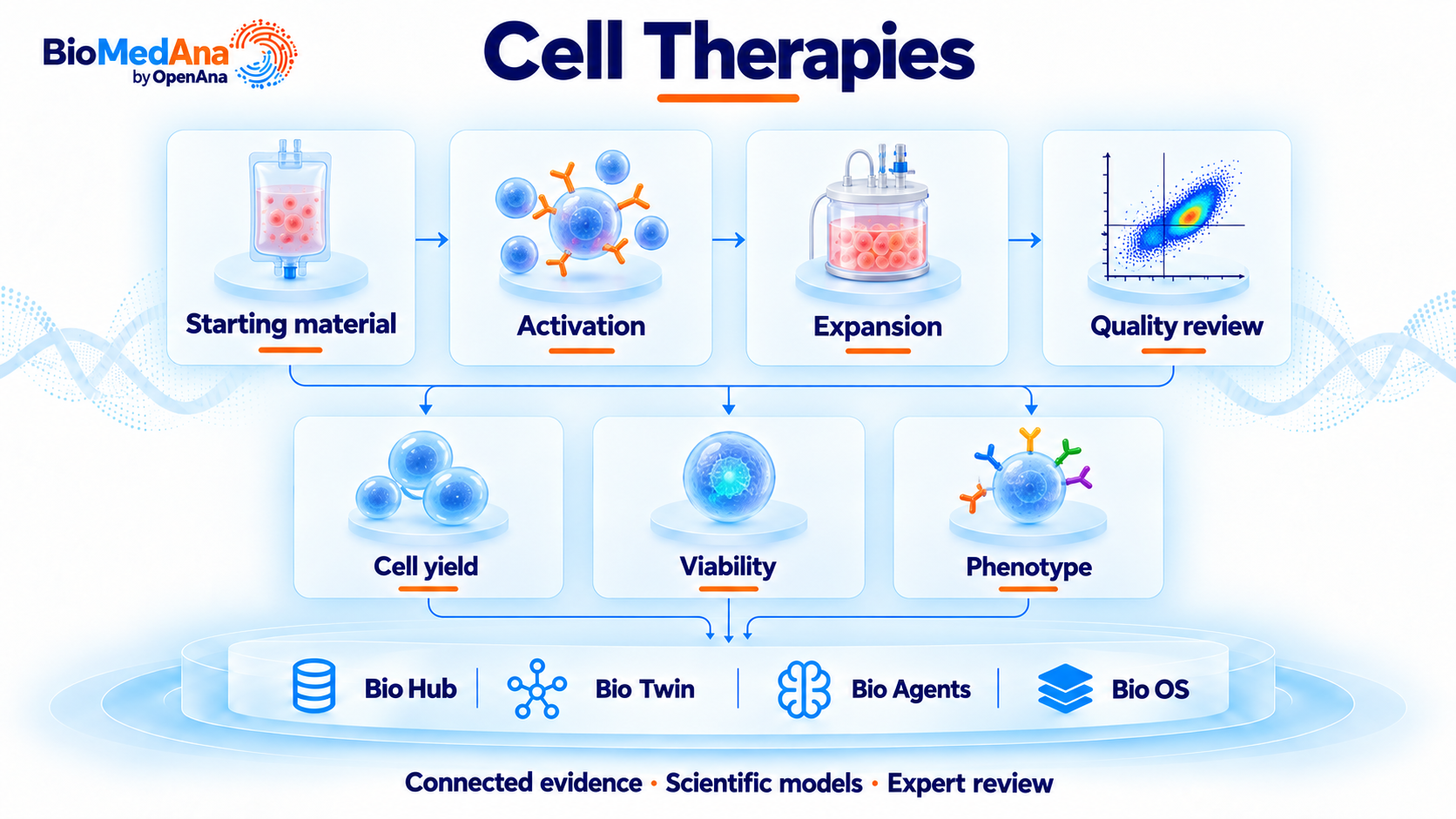
Connect starting material, activation, expansion, modification and product assays while preserving the lineage of each program and batch. Scientific context helps teams understand why similar process conditions can produce different cellular outcomes.
MODALITY-SPECIFIC PROCESS INTELLIGENCE
Follow donor or source information and material provenance into each process stage.
Compare activation, media and culture conditions alongside growth, viable-cell yield and stage events.
Review phenotype, composition and potency-related observations in their process and assay context.
Connect exceptions, stage dependencies and material variability to an evidence-linked scientific review.
EVIDENCE · MODELS · DECISIONS
Process outcomes to evaluate: Cell yield · viability · phenotype
EXAMPLE INVESTIGATION
Connect starting material and reagent provenance with the affected batches.
Align activation, expansion and modification stages, measurements and exceptions.
Compare viability, phenotype, composition and potency evidence alongside cell yield.
Distinguish starting-material effects from process-stage effects and prepare targeted follow-up questions.
Bio Agents can coordinate the scientific work across evidence and models, while Bio OS preserves governance and human review. The configured workflow determines which tasks and models are available.
Bring us this process challenge ↗EVALUATION & SCOPE
Define the cell product, intended dose and assays in scope. Demonstrating expansion analysis does not establish autonomous release decisions or prediction of clinical outcomes.
Donor and material provenance. Activation, expansion and process-stage records. Viability, phenotype, composition and potency. Include the process question, relevant run context and the analytical methods used to assess the outcome.
Expansion and variability analysis. Process-stage comparisons. Yield and operating-condition scenarios. Scope and evaluation criteria are defined for your process, data and intended decision.
Define the cell product, intended dose and assays in scope. Demonstrating expansion analysis does not establish autonomous release decisions or prediction of clinical outcomes.
EXPLORE OTHER MODALITIES