BIOMEDANA AGENTS / PHARMA & BIOTECH

100+ ready agents.
Built around your science.

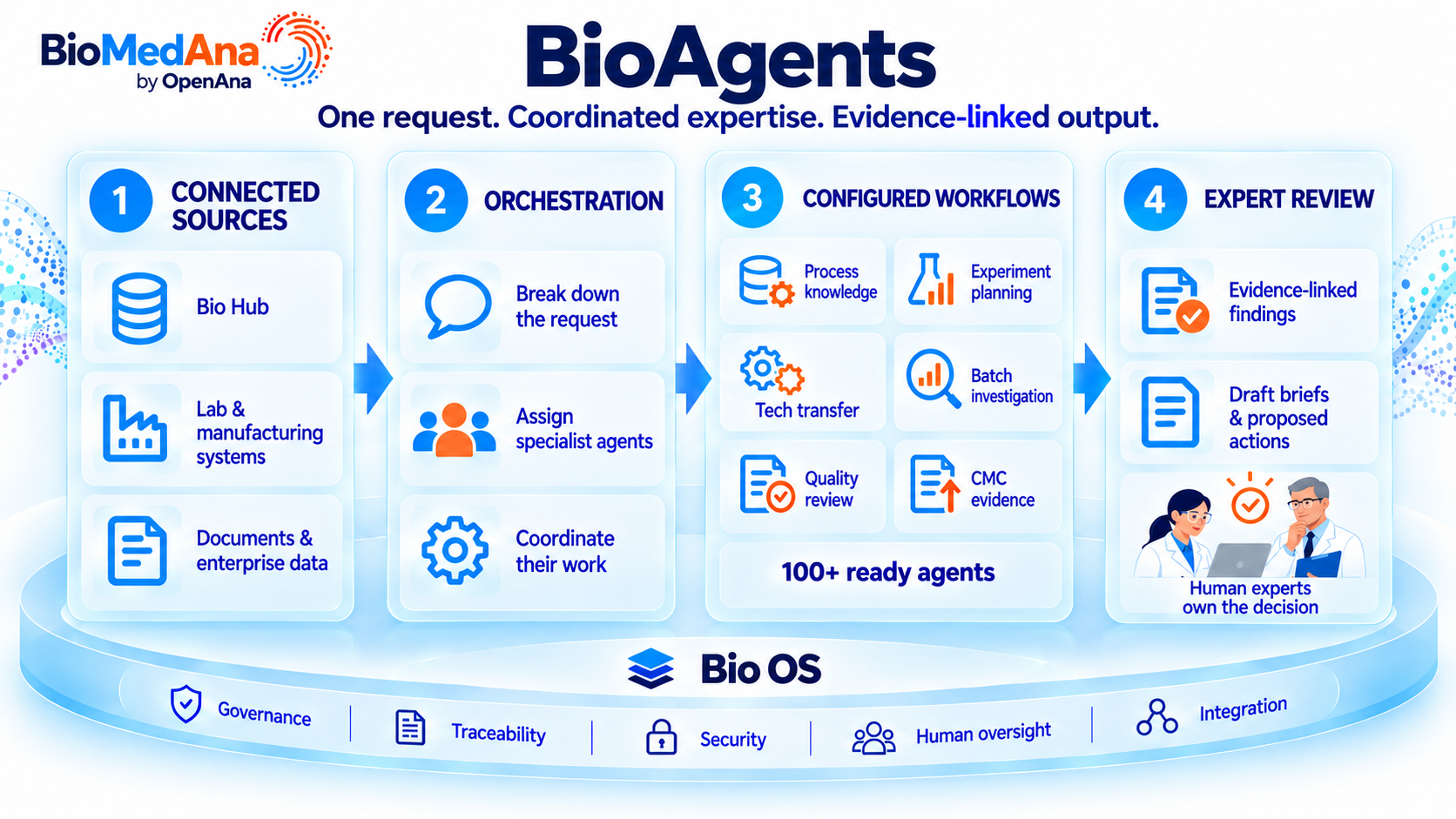
BioMedAna Agents brings 100+ ready agents to evidence-heavy bioprocess work. It connects approved sources, breaks requests into steps, and coordinates specialist agents across development, MSAT, manufacturing, quality and CMC. Evidence-linked findings and drafts go to your experts for review and decision.

Scoped accessEvidence-linked outputHuman approval
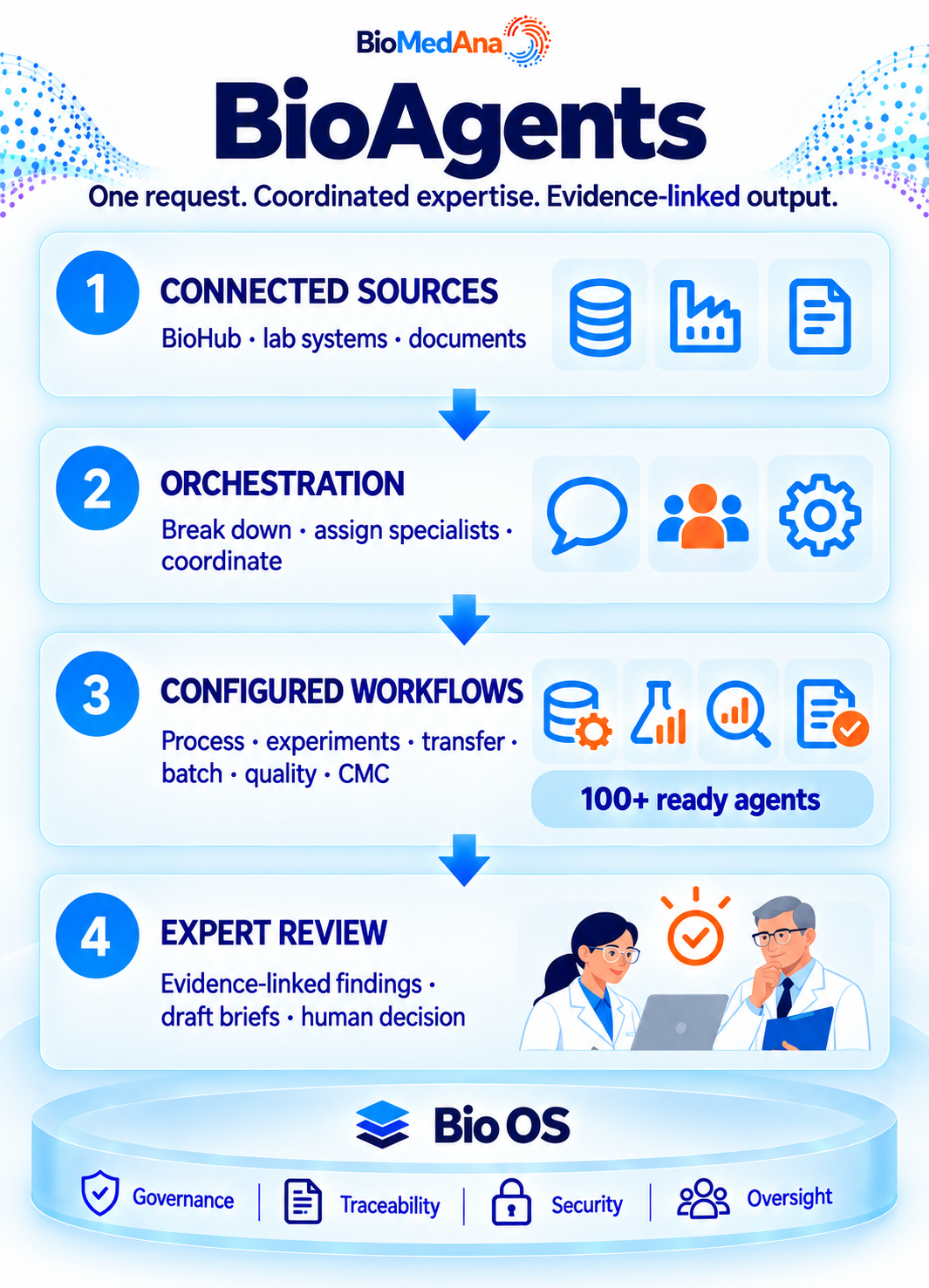
BioAgents connects BioHub, lab and manufacturing systems, and documents; orchestrates specialist agents across six bioprocess workflow areas; and prepares evidence-linked findings for expert review, with BioOS governance beneath the flowFour-stage BioAgents flow: connected sources, orchestration, configured workflows using 100+ ready agents, and human expert review, supported by BioOS governance
100+Ready agents for bioprocess teams
06BioMedAna workflow categories
Human-ledExpert review at consequential decisions
HoursTo go live, not months, on your existing systems

Ready agents.
Configured for bioprocess work.

Start with an available agent, then shape a BioMedAna workflow around your scientific question. We define the task with your scientific and digital teams, connect only the sources it needs, and design an output that a named expert can review. A ready agent does not mean a customer-specific regulated workflow is already validated; integrations, controls and intended use are evaluated for each engagement.

One request.
A coordinated agent team.

The agent-level MoE architecture brings together the specialist agents a question needs—not the whole library. An internal supervisor checks their evidence and loops gaps back for another pass. Only then does a cited brief reach the human decision owner.

BIO AGENTS / ORCHESTRATION VIEW
T+00.0sILLUSTRATIVE SIMULATION · NO LIVE DATA
01 / REQUESTProgram mAb-07 · runs 09–19 · output: cited brief
02 / MOE ARCHITECTUREScientific OrchestratorGates the request to the experts it needs
BE—
PT—
AD—
QC—
EQ—
MF—
DS—
RG—

Router idle

03 / SPECIALIST SUB-AGENTSAWAITING TASKS
BE0 refs
Batch Evidence AgentBatch & ELN records
Queued

Media lot changed before run 14

PT0 refs
Process Trend AgentRun trends & events
Queued

DO dips after feed 3 in affected runs

AD0 refs
Analytical Data AgentAssays & CQAs
Queued

Titer −11% vs. baseline; glycans stable

QC0 refs
Quality Context AgentSOPs & deviations
Queued

Open deviation on feed pump PM

04 / SUPERVISOR AGENTScientific Review Agent
  • Cross-checked 37 references
  • Conflict on timing between PT and AD reconciled
  • Gap: feed-pump log missing, re-tasking PT
  • Follow-up evidence received, brief released
Evidence coverage62%
Awaiting findings
05 / HUMAN GATEScientific / Quality owner
Brief · Titer shift, runs 14–19
  • Media lot change aligns with the onset in run 14
  • DO dips after feed 3, consistent with pump under-delivery
  • Quality attributes stable; titer effect only
12 citationsConfidence: moderateOwner: named expert
Decision stays with a named expert
01 / HUMAN REQUEST
Define the scientific question

A scientist selects the program, runs, systems and reviewable output before any agent receives a task.

Start where evidence work slows the team.

Six ways to put ready agents to work across pharma and biotech. Data readiness is part of process knowledge, not a standalone category. Each workflow is scoped and evaluated with your team.

01 / WORKFLOW

Process knowledge & data readiness

Locate prior runs, align their context and flag missing or inconsistent source data before it is reused in analysis. Keep mappings and conclusions linked to the original records.

INPUTSELN · LIMS · run files · reports
REVIEWABLE OUTPUTSource-linked knowledge and readiness brief
HUMAN OWNERProcess Development / R&D Digital
02 / WORKFLOW

Experiment planning & run analysis

Compare prior experiments and process conditions, surface gaps in the evidence and prepare options for the next study. Scientists choose and approve any experiment.

INPUTSDOE · run data · assays
REVIEWABLE OUTPUTRun comparison and proposed study questions
HUMAN OWNERProcess Development
03 / WORKFLOW

Tech transfer & comparability

Compare process versions, scale changes and site-specific operating context. Flag missing evidence before the transfer or comparability package moves to technical review.

INPUTSRun history · process versions · CQAs
REVIEWABLE OUTPUTComparability questions and source map
HUMAN OWNERMSAT / Process Development
04 / WORKFLOW

Batch investigation & trend review

Bring batch records, trends, events and assays into one investigation trail. Surface differences and draft questions; the team determines cause and disposition.

INPUTSBatch history · events · assays
REVIEWABLE OUTPUTEvidence-linked investigation brief
HUMAN OWNERManufacturing Sciences / Quality
05 / WORKFLOW

Quality review & change impact

Assemble the affected records, procedures and process context for a deviation or proposed change. Prepare an impact checklist for Quality to assess and approve.

INPUTSChange records · SOPs · batch history
REVIEWABLE OUTPUTReview queue and impact checklist
HUMAN OWNERQuality / MSAT
06 / WORKFLOW

CMC evidence & submission readiness

Find approved reports, methods and results; organize them by the question being answered; and prepare a citation-ready evidence pack for qualified reviewers.

INPUTSApproved reports · methods · results
REVIEWABLE OUTPUTTraceable evidence pack and draft
HUMAN OWNERCMC / Regulatory Operations

From scattered records to a reviewable brief.

An illustrative batch-investigation flow shows how an agent can organize evidence without making a quality or scientific decision on its own.

BioMedAna Agents / Investigation workspaceCONCEPT VIEW
QUESTION FROM THE TEAM

What changed before the titer shift?

Compare the affected run with relevant prior runs and surface source records for expert investigation.

Scoped toSelected program · selected runs
GATHERED EVIDENCE
01
Process trends

Time-aligned operating conditions

↗
02
Run events

Feed, sampling and interventions

↗
03
Analytical results

Titer and quality measurements

↗

Every finding must point back to an accessible source record.

AGENT-PREPARED BRIEF

For expert review

Observed differences

What changed across the selected runs, with citations.

Open questions

Missing data, confounders and alternative explanations.

Next review step

Suggested checks—not an automated root-cause verdict.

Awaiting scientist / quality review

Conceptual workflow visual. Actual data sources, calculations, access rules and review steps are defined and validated per engagement.

Useful automation.
Visible boundaries.

Scientific and regulated work needs more than a fluent answer. Each engagement defines what an agent can access, produce and change—and what remains a human decision.

01

Source-grounded output

Results show the underlying records and distinguish retrieved evidence from generated interpretation.

02

Scoped tools and permissions

Connect only approved systems and actions. Start read-only where possible, and require explicit approval for consequential writes or externally used outputs.

03

Known limits and handoffs

Missing evidence and low-confidence results must be visible. An agent should stop or escalate when the task exceeds its defined boundary.

04

Evaluation before expansion

Test accuracy, citations, omissions, reviewer effort and failure cases against an agreed baseline before wider use.

From idea to operation.
With evidence at every gate.

Our agentic AI development lifecycle (AIDLC) takes a workflow from a scientific question to supervised use. Ready agents accelerate assembly; each customer’s data, controls and intended use still determine the validation work.

01 / AIDLC

Discover

Choose one decision, its human owner, baseline process, source systems and success measures.

02 / AIDLC

Design

Map specialist roles, task handoffs, allowed tools, evidence requirements and escalation rules.

03 / AIDLC

Build & connect

Configure ready agents and scoped integrations; keep permissions and source lineage visible.

04 / AIDLC

Evaluate & validate

Test representative and failure cases for accuracy, citations, omissions and reviewer effort.

05 / AIDLC

Deploy with oversight

Begin supervised use, require approval at consequential gates and record what was reviewed.

06 / AIDLC

Monitor & improve

Track drift, exceptions and feedback; re-evaluate changes before expanding the workflow.

Where Agents fits in BioMedAna

Hub connects and governs bioprocess evidence; Twin supports predictive and simulation workflows. BioMedAna Agents adds customer-specific, multi-step work around that evidence and other approved systems. Each Agents workflow is scoped separately, and an engagement does not require every BioMedAna product.

START WITH A WORKFLOW

What should your team stop assembling by hand?

Bring a task, its owner and the evidence it depends on. We’ll discuss a bounded BioMedAna Agents pilot and how to judge it.

Talk to BioMedAna