PRODUCT COMPARISON · UPDATED SEPTEMBER 25, 2026
BioMedAna vs Basetwo: Beyond the Digital Twin
Compare BioMedAna and Basetwo for hybrid bioprocess modeling, connected evidence, agent workflows, governance and fit across development and manufacturing.
BioMedAna prepared this editorial comparison from the vendors’ public materials and its own product positioning. It is not endorsed by Basetwo. Confirm scope, availability and performance in a live evaluation.
A batch can reach its titer target while a quality attribute shifts. A team may need to connect process trends, interventions, PAT readings, assays and batch history before it knows whether to investigate, run a model scenario or plan another experiment.
Both BioMedAna and Basetwo describe AI, agents and hybrid digital twins. The decision is about the work around the model: where evidence is contextualized, which tasks agents can complete, how uncertainty is reviewed and how the result reaches a responsible expert. This is BioMedAna's editorial comparison, not an independent performance benchmark.
At a glance
| Evaluation area | BioMedAna | Basetwo |
|---|---|---|
| Process data and context | BioHub is positioned as a separate data foundation that links source records to runs, phases, equipment, materials, samples, events and quality attributes with modality-specific context. | Basetwo describes agents that ingest historian, MES, LIMS and ERP data, transform it using process context and support analysis. |
| Hybrid models and simulation | Bio Twin combines process data, mechanistic science, biological context and AI/ML to explore scenarios and predictions with uncertainty and intended-use review. | Basetwo describes agent-assisted mechanistic and hybrid models, digital twins, unit-operation flowsheets and reuse of existing models. |
| Agents and workflow breadth | BioAgents is positioned around 100+ ready agents configured for six scientific workflow categories, from process knowledge and experiments through transfer, investigations, quality and CMC evidence. | Basetwo describes agents for data preparation, model construction, virtual experimentation, dashboards and process or quality insights. |
| Operational use and governance | BioOS is positioned to govern access, evidence lineage, model lifecycle, orchestration and human review across Hub, Twin and Agents. | Basetwo describes real-time insights, audit trails, role-based access and GMP-aligned workflows. |
| Implementation and outcomes | BioMedAna offers a scoped workflow evaluation. This article does not establish a matched comparison of implementation time, model accuracy, cost or realized ROI. | Basetwo publishes vendor-reported customer and performance examples, whose scope should be checked. |
What Basetwo does well
Basetwo's current public platform describes an agentic process environment with data ingestion and transformation, mechanistic and hybrid models, flowsheets, virtual experiments, optimization, conversational dashboards and real-time process insights. It also describes agents that support process and quality work; a fair comparison must recognize those capabilities.
For a team centered on simulation, process optimization or operational use of existing models, Basetwo warrants a serious evaluation. Its reported customer outcomes and workflow counts are vendor claims, not results independently compared with BioMedAna.
BioHub connects evidence before prediction
BioHub is positioned to connect bioreactors, PAT, historians, ELN, LIMS, MES, files and APIs, then preserve the scientific relationships that make those records useful. Runs, phases, events, samples, assays, materials and quality attributes can be reviewed in their process context before a twin is deployed.
That distinct Hub role can matter when the immediate task is tracing a process-quality relationship or preparing an investigation rather than simulating a new operating condition. Basetwo also has data preparation and analysis; the evaluation should compare what each can do before, during and after a model-driven task.
BioAgents coordinates scientific work
BioMedAna describes 100+ ready agents configured for six workflow categories: process knowledge and data readiness; experiment planning and run analysis; tech transfer and comparability; batch investigation and trend review; quality review and change impact; and CMC evidence and submission readiness. An orchestrator can break an approved request into bounded specialist tasks and assemble source-linked findings for a named expert.
Basetwo's public agents cover meaningful data, model, simulation and operational workflows. BioMedAna's proposed distinction is its separate Hub context and the breadth of cross-functional scientific and evidence work around Twin. Buyers should inspect the actual inputs, intermediate steps, permissions and reviewable outputs in each deployment rather than infer breadth from an agent count.
One process-quality question across the platform
For an illustrative quality shift, Hub can connect the selected batch's upstream and downstream records, events, assays and PAT evidence. Agents can compare runs, flag missing evidence and prepare an investigation brief. Where prediction is appropriate, Bio Twin can evaluate a proposed process change or operating window. BioOS supplies the access and review controls across that path.
The output is a starting point for scientists and Quality to inspect, challenge and approve. This describes a proposed workflow, not a measured customer result or an autonomous root-cause verdict.
Where each has the edge
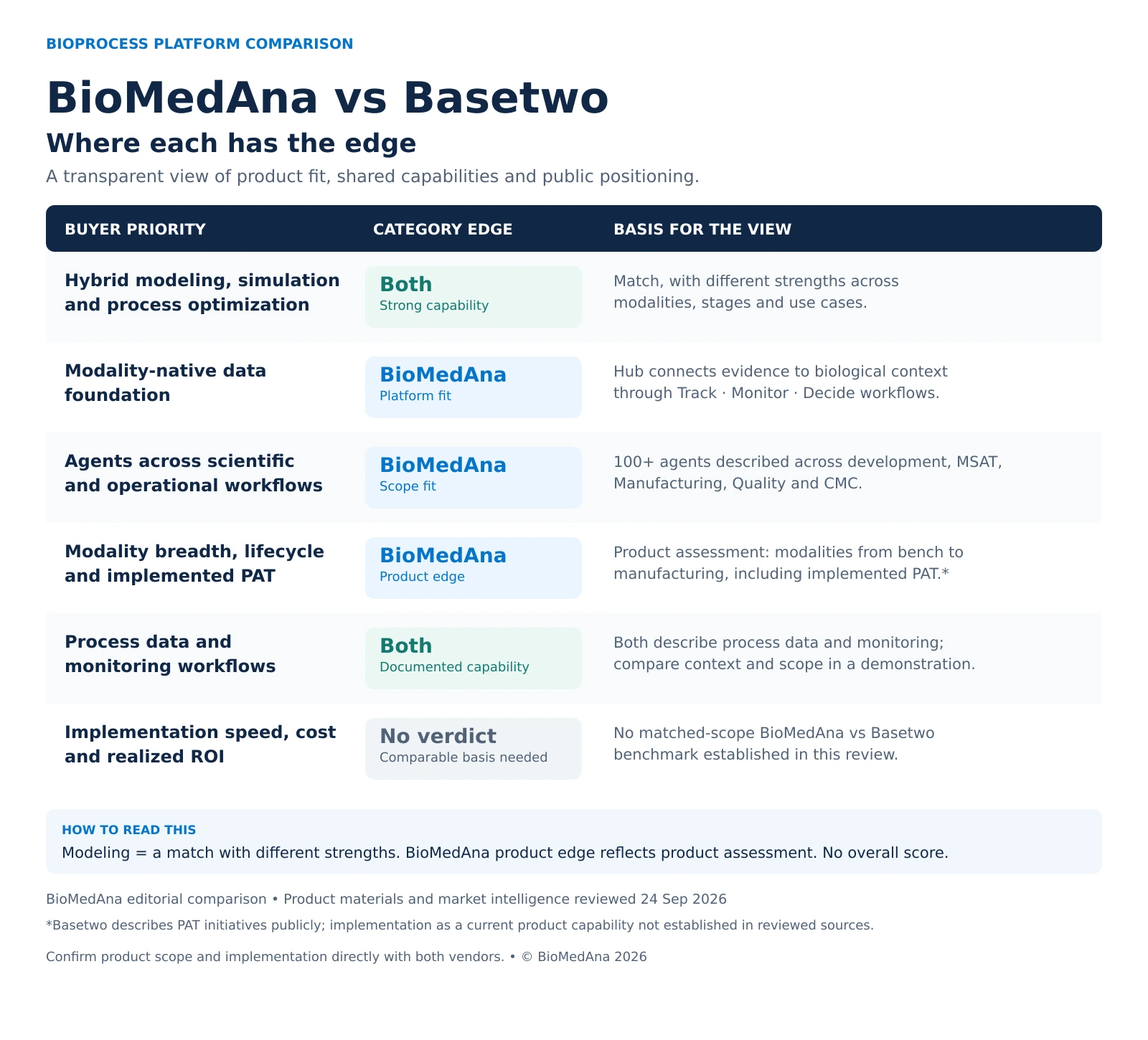
For hybrid modeling, simulation and process optimization, both vendors document substantial capabilities. BioMedAna's editorial assessment favors its separate modality-specific Hub and its proposed cross-functional Agents scope; Basetwo's public materials emphasize an integrated agentic modeling and process-optimization platform.
The supplied scorecard also labels modality breadth, bench-to-manufacturing scope and implemented PAT as a BioMedAna product edge. That label reflects BioMedAna's own assessment. The public material reviewed does not provide a matched test of PAT scope, model accuracy or deployment maturity. Ask both vendors to show the relevant workflow and implementation evidence.
- Hybrid-model fitness: compare on identical held-out batches, endpoints and intended use.
- Data foundation: trace the same source records into context, analysis and output.
- Agent workflows: request the same investigation, experiment or transfer deliverable.
- Implementation speed, cost and realized ROI: no comparative verdict without a matched scope.
Choose around the next body of work
A modeling-first program should compare both platforms' process simulation, model validation and operational integration. A program that also needs a distinct evidence foundation, cross-functional investigation work and human-reviewed outputs should evaluate how BioHub, BioAgents, Bio Twin and BioOS work together.
Start with one bounded scientific question, its owner and the available sources. Ask for a representative output, acceptance criteria and a written implementation plan. Some organizations may combine products, but interoperability, validation responsibility, data ownership and operating cost must be checked directly.
Questions to ask in a live demo
- Trace one representative batch from source import and contextualization through any model inputs, prediction and reviewable output.
- Compare model outputs on the same held-out batches. Inspect error, uncertainty, constraints and out-of-domain behavior.
- Ask both systems to investigate the same deviation. Show evidence links, calculations, model versions, missing data and human review.
- Confirm which agents can perform each task, what systems and tools they can access and which outputs require approval.
- Get matched written estimates for integrations, validation work, timeline, cost and acceptance criteria; measure realized ROI separately.
Frequently asked questions
Is Basetwo only a digital twin platform?
No. Basetwo publicly describes agents, data preparation, hybrid models, virtual experiments, dashboards and process optimization.
Does Basetwo have AI agents?
Yes. Its public platform describes agents for preparing data, building or using models and exploring process insights. Compare actual tasks and outputs with BioAgents in a demonstration.
How is BioHub different from Basetwo's data capabilities?
BioMedAna positions BioHub as a distinct modality-specific evidence foundation. Basetwo describes data ingestion and transformation within its agentic process platform. Compare source relationships and what each enables before a twin is deployed.
Which platform predicts better?
This article cannot establish that. Test both on representative held-out data for your modality, endpoints and intended decision.
Can BioMedAna and Basetwo work together?
Potentially, subject to supported interfaces, data and model portability, validation responsibilities and the buyer's operating model. Confirm interoperability directly.
Sources and scope
- Basetwo platform
- Basetwo pharmaceutical manufacturing
- BioMedAna Hub
- BioMedAna Twin
- BioMedAna Agents
- BioMedAna OS
Vendor descriptions reflect public materials reviewed September 24–25, 2026. Feature availability may change. BioMedAna capabilities are its product positioning; no matched head-to-head benchmark or independently validated implementation advantage is claimed.
Explore the BioMedAna platform · Explore BioHub · Explore Bio Twin · Explore BioAgents · Request an evaluation · All resources