PRODUCT COMPARISON · OCTOBER 13, 2026
BioMedAna vs. Invert Bio: Why Predictive Hybrid Digital Twins Go Beyond Historical Data Analytics
From understanding what happened to predicting what could happen next — across seven bioprocess modalities.
By BioMedAna Scientific & Engineering Team · Published and updated October 13, 2026. This BioMedAna-authored comparison uses public vendor documentation and BioMedAna’s stated product capabilities. Validate scope and outcomes with representative process data.
Full BioMedAna vs InvertBio comparison ↗Bio Agents ↗Pricing & Value ↗
Digital twins are attracting significant investment across biopharmaceutical development and manufacturing.
Yet the term digital twin covers a wide range of capabilities, from historical data visualization and process monitoring to advanced mathematical modeling, predictive simulation, and virtual process optimization.
For executives evaluating platforms such as Invert Bio and BioMedAna, these differences are not academic.
They directly influence how effectively an organization can reduce scale-up risk, accelerate technology transfer, optimize manufacturing, and improve process robustness.
The real question is not whether a platform offers a digital twin. It is what that twin can predict, simulate, and help optimize.
Not all digital twins deliver the same level of intelligence
A digital representation of a bioprocess can provide considerable value by connecting process records, historical data, operating conditions, and analytical results.
This helps scientists understand past performance, identify trends, and compare runs.
However, a more advanced scientific digital twin addresses a different class of questions.
What happens if the operating temperature changes? How might reduced oxygen transfer affect cell growth and productivity at manufacturing scale? Which feeding strategy is most likely to improve recoverable product yield? What operating conditions could reduce aggregation risk?
These are forward-looking engineering questions.
Answering them requires more than displaying historical data.
It requires scientifically appropriate models that capture the relationships between process conditions, biological or chemical behavior, and expected outcomes.
BioMedAna's approach: a predictive Hybrid Digital Twin
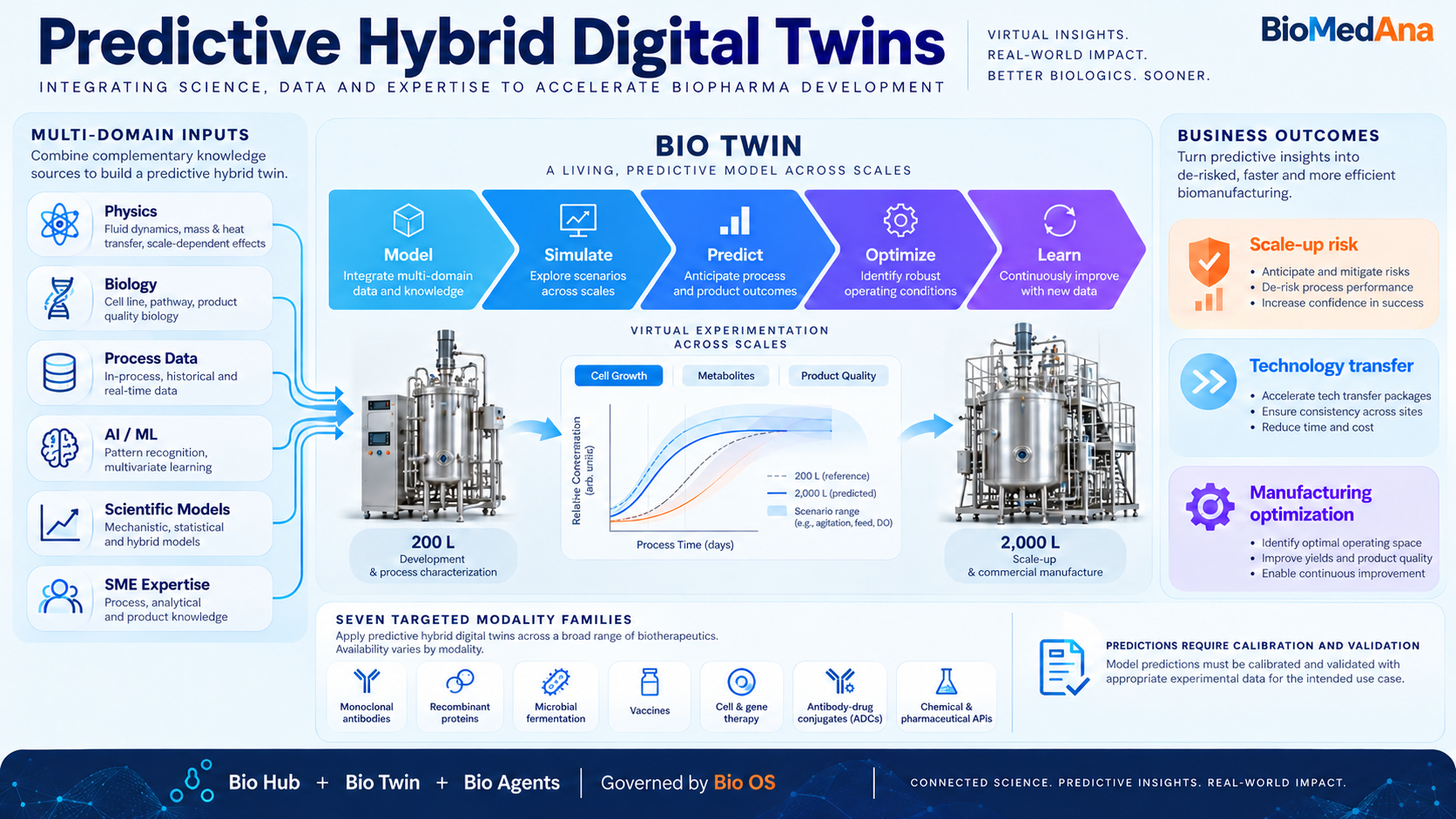
BioMedAna Twin combines six complementary sources of intelligence.
- Physics
- Biology
- Process Data
- AI / ML
- Scientific Models
- SME Expertise
BioMedAna Hybrid Twin
Model • Simulate • Predict • Optimize • Learn
Bio Agents coordinate evidence, analysis and model-assisted workflows
These elements contribute different strengths to the decision-making process.
Physics and engineering models represent process relationships involving mass transfer, heat transfer, mixing, fluid behavior, and equipment constraints.
Biological knowledge provides context for growth, metabolism, productivity, product quality, and process-dependent biological responses.
Process data grounds the modeling environment in historical and current evidence from laboratories, pilot facilities, and manufacturing operations.
AI and machine learning help identify nonlinear relationships, estimate difficult-to-measure variables, and improve predictions within the domain supported by available data.
Scientific models include mechanistic, kinetic, statistical, and hybrid approaches selected according to the modality and problem.
Subject-matter expertise shapes model assumptions, interpretation, operating constraints, and the decisions made from model outputs.
Agentic AI adds orchestration, allowing specialized agents to coordinate data preparation, model execution, scenario comparisons, scientific interpretation, and expert review.
The result is a digital twin architecture designed not merely to recreate historical performance, but to support predictive decision-making.
Predictive simulation vs. historical comparison: why it matters
Consider a monoclonal antibody process developed successfully at 200 L.
The organization now needs to transfer the process to a 2,000 L manufacturing bioreactor.
Historical comparison tools can help teams understand the performance of earlier runs, identify parameter differences, and evaluate comparable operating conditions.
These are valuable starting points.
However, scale-up introduces new uncertainties.
Mixing times may change. Oxygen transfer capacity may become limiting. Carbon dioxide accumulation and metabolic conditions may change. Biological responses may differ even when nominal setpoints remain similar.
A predictive hybrid twin can help the team evaluate questions such as:
- What oxygen-transfer constraints could emerge at 2,000 L?
- How might mixing and metabolic demand influence dissolved oxygen behavior?
- Which combinations of feeding, temperature, and process setpoints merit evaluation?
- What are the predicted impacts on titer, viability, and relevant quality attributes?
- Which scenarios present the greatest uncertainty or require physical confirmation?
BioMedAna Twin is designed to support these questions through scientific and data-driven modeling.
Importantly, predictions must be evaluated against available evidence and model validity. A simulation informs an engineering decision; it does not replace process qualification or experimental verification.
How does BioMedAna compare with Invert Bio?
Invert's public product materials document substantial capabilities in bioprocess data connectivity, contextualization, analytical workflows, historical comparisons, and scientific reporting.
Invert also markets digital twin outcomes and describes hybrid-model-related work in its public positioning. Therefore, a categorical claim that Invert offers only historical analytics, or cannot perform prediction, would go beyond what the public information establishes.
The meaningful comparison is the scientific depth and availability of predictive modeling for a specific process.
| Evaluation area | Invert Bio | BioMedAna Twin |
|---|---|---|
| Historical run analysis | Publicly documented | Supported through Bio Hub |
| Process comparisons | Publicly documented | Supported |
| Digital twin offering | Marketed | Dedicated Hybrid Twin product |
| Mechanistic and kinetic modeling | Verify model scope in live evaluation | Core modeling approach |
| Predictive what-if simulation | Verify process-specific capability | Core Twin workflow |
| Physics and biology integration | Verify supported integrations and models | Explicit architectural focus |
| Scale-up optimization | Compare demonstrated methods | Predictive engineering use case |
| Technology transfer simulation | Validate in live evaluation | Model-based assessment use case |
| Agent-assisted modeling | Evaluate orchestration scope | Integrated Bio Agents architecture |
| Modality-specific models | Evaluate by modality | Seven targeted modality families |
The distinction BioMedAna wants buyers to examine is not the label attached to the technology.
It is whether the platform can demonstrate predictions for conditions that have not yet been tested, explain the assumptions behind those predictions, and quantify their uncertainty.
Seven modalities. Different science. One intelligence architecture.
A digital twin for monoclonal antibodies cannot simply be copied and applied unchanged to microbial fermentation, cell therapy, or API manufacturing.
Each modality introduces different process dynamics, equipment constraints, scientific models, and critical quality considerations.
BioMedAna's modality-native strategy addresses seven major process families.
| Modality | Representative scientific modeling focus |
|---|---|
| Monoclonal antibodies (mAbs) | Cell growth, metabolism, oxygen transfer, productivity, glycosylation, aggregation |
| Recombinant proteins | Expression kinetics, induction strategy, soluble yield, metabolic burden, process robustness |
| Microbial fermentation | Substrate utilization, growth kinetics, OUR/OTR, feeding, byproduct formation |
| Vaccines | Production kinetics, process stability, yield, potency-related attributes |
| Cell & gene therapy | Cell growth, transduction, vector production, viability, process variability |
| Antibody-drug conjugates (ADCs) | Conjugation kinetics, drug-to-antibody ratio, aggregation, purification |
| Chemical and pharmaceutical APIs | Reaction kinetics, conversion, selectivity, impurities, heat and mass transfer, crystallization |
The modeling methods, coverage, and predictive accuracy are specific to the process and deployed model. These are seven targeted modality families; API model coverage and production availability should be confirmed for the proposed deployment.
Three high-value business applications
1. Accelerating process scale-up
Scale-up teams can use hybrid simulation to compare operating scenarios before conducting expensive manufacturing-scale experiments.
The objective is to identify risks earlier, narrow the experimental search space, and improve the quality of engineering decisions.
2. Improving technology transfer
Technology transfer requires more than reproducing setpoints at a different facility.
Equipment geometry, mixing, transfer characteristics, control systems, and operating conditions may differ.
Predictive models can help teams evaluate which changes are scientifically material and where additional studies may be required.
3. Optimizing manufacturing performance
Validated models can support scenario evaluation for yield, quality, cycle time, and process robustness.
The opportunity is to move from reacting to deviations toward identifying and evaluating potential risks before they affect a manufacturing campaign.
Why executives should care
The value of predictive digital twins should be evaluated in business terms, not simply by the number of dashboards, model types, or simulations available.
For a VP MSAT or CMC leader, the desired outcomes may include fewer unnecessary experiments, more informed scale-up decisions, improved transfer readiness, and faster root-cause investigations.
For a manufacturing executive, they may include better capacity utilization, reduced variability, and improved process consistency.
For a CIO or Digital Transformation leader, success means making scientific knowledge, process evidence, and advanced modeling accessible through a governed platform rather than fragmented applications.
BioMedAna connects these capabilities through four layers:
- Bio Hub provides contextualized process evidence.
- Bio Twin delivers scientific modeling and predictive simulation.
- Bio Agents help coordinate complex analytical and engineering workflows.
- Bio OS provides governance, security, traceability, and human oversight.
Beyond digital twin terminology. Demonstrate predictive capability.
If your organization is evaluating Invert Bio or other digital twin platforms, ask vendors to simulate your next scale-up decision — not simply display your previous runs.
Explore BioMedAna Twin or contact hello@biomedana.ai to discuss a predictive simulation demonstration.
Frequently asked questions
Does Invert Bio offer digital twins?
Yes. Invert markets digital twin capabilities and customer outcomes. Buyers should evaluate the exact types of models, simulation capabilities, process conditions, and predictive validation supported by their proposed deployment.
What is a predictive hybrid bioprocess digital twin?
It is a digital modeling system combining scientific principles, mechanistic or kinetic models, process data, and AI/ML to estimate process behavior and simulate alternative operating scenarios.
How is BioMedAna Twin different from a bioprocess dashboard?
A dashboard displays and analyzes process information. BioMedAna Twin is designed to simulate alternative conditions, estimate outcomes, and support model-based optimization decisions.
Can BioMedAna Twin predict scale-up performance?
BioMedAna Twin supports model-based scale-up scenario assessment, subject to appropriate process models, calibration data, scientific constraints, and validation.
Which modalities does BioMedAna support?
BioMedAna targets monoclonal antibodies, recombinant proteins, fermentation, vaccines, cell and gene therapy, ADCs, and chemical/pharmaceutical APIs, with availability and model coverage varying by modality.
Can BioMedAna work alongside existing process data systems?
Yes. BioMedAna's architecture is intended to connect laboratory, process, manufacturing, and analytical data sources rather than require the replacement of every existing system.
Sources and evaluation scope
- Invert Assist user guide
- Invert Skills user guide
- Invert Automations user guide
- Invert Models
- Invert pricing
Public materials reviewed October 13, 2026. Invert documents mechanistic and hybrid models, forecasts, simulation and optimization; comparisons should establish the actual workflow available for your process. BioMedAna’s capability and pricing commitments require agreed evaluation criteria and a matching proposal; they are not independent performance benchmarks. Modality availability and model coverage vary by deployment.
Explore Bio Hub ↗Explore Bio Twin ↗Explore Bio Agents ↗Explore Bio OS ↗
Request a competitive evaluation ↗