PRODUCT COMPARISON · UPDATED SEPTEMBER 25, 2026
BioMedAna vs DataHow: A New Foundation for Bioprocess Intelligence
Compare BioMedAna and DataHowLab across bioprocess data context, hybrid modeling, scientific workflows, modality scope and human-reviewed decisions.
BioMedAna prepared this editorial comparison from the vendors’ public materials and its own product positioning. It is not endorsed by DataHow. Confirm scope, availability and performance in a live evaluation.
Imagine a batch that meets its titer target while a product-quality attribute shifts. The team needs upstream and downstream records, assays, events, process versions and a reasoned next step. The challenge is the distance between having process data and being ready to make a scientific decision.
DataHow and BioMedAna both apply AI and process science to bioprocess development. The useful evaluation asks which sources, models, team workflows and review steps each platform can bring together for your actual process. This article is BioMedAna's perspective, based on public product materials rather than a head-to-head performance test.
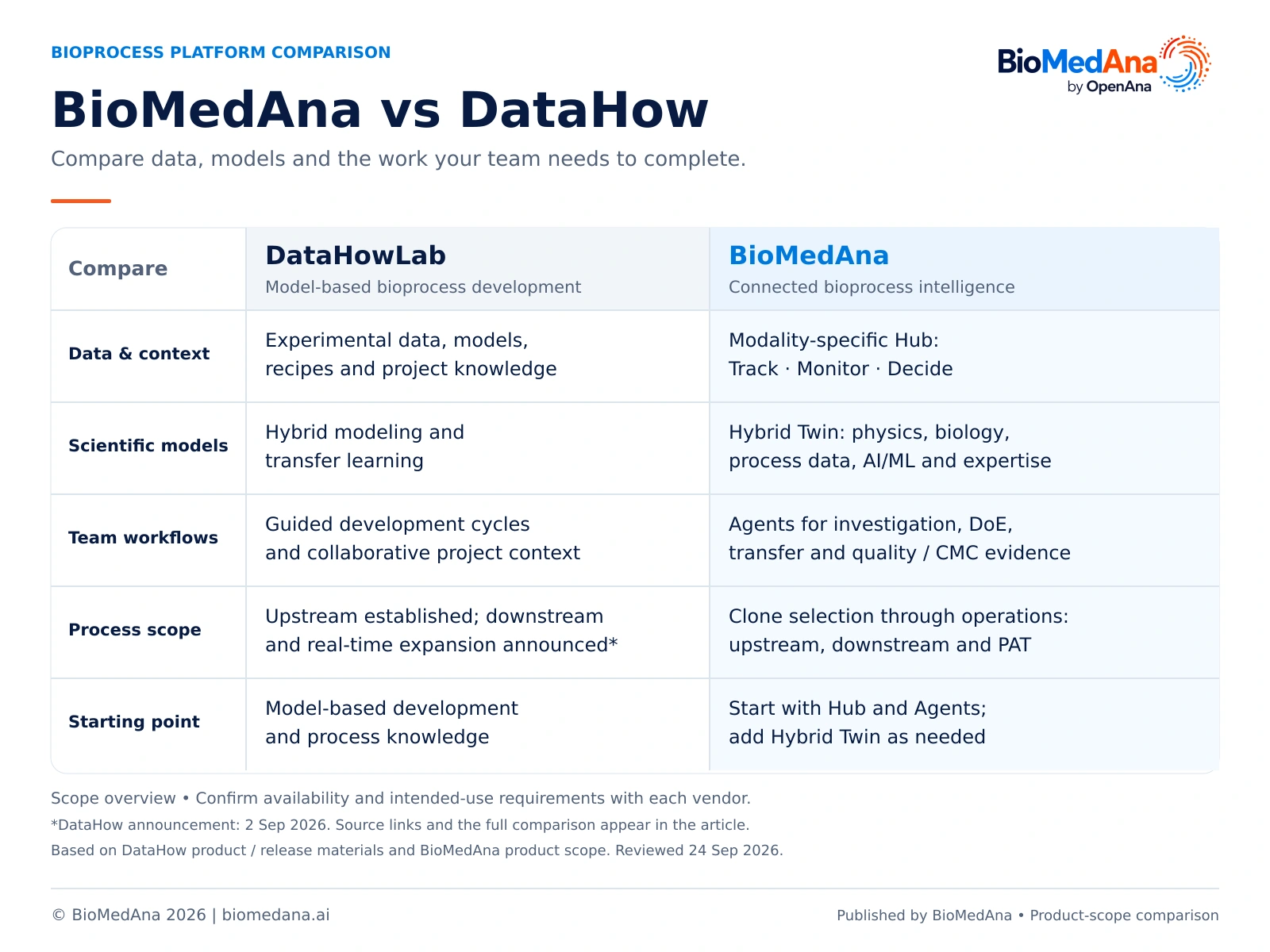
At a glance
| Evaluation area | BioMedAna | DataHow |
|---|---|---|
| Data and scientific context | BioHub connects process and analytical sources to runs, phases, events, materials, samples and quality attributes, with modality-specific context and source lineage. | DataHowLab manages experimental data, models, insights, recipes and shared development knowledge. |
| Hybrid models and experiments | Bio Twin combines process science, mechanistic models, biological context and AI/ML for scenario analysis and prediction, subject to model fitness for the intended use. | DataHow describes hybrid models, transfer learning, dynamic experimental design, simulations and digital-twin foundations. |
| Team workflows | BioAgents coordinates scoped tasks for process knowledge, experiments, transfer, investigations, quality review and CMC evidence, with human owners. | DataHowLab describes guided development cycles, collaboration and process characterization. |
| Process and modality scope | BioMedAna positions Hub, Twin and Agents across multiple modalities and development-to-manufacturing questions. Confirm each required integration and workflow in a pilot. | DataHow lists multiple process formats and unit operations. In September 2026 it announced further real-time and downstream expansion. |
| Governance and deployment | BioOS is positioned to provide access, evidence lineage, model lifecycle and human-review controls across BioMedAna workflows. | DataHowLab provides shared process knowledge and describes traceability and cloud collaboration. |
What DataHow does well
DataHowLab is a substantial AI-powered bioprocess development platform. Its public materials describe no-code analysis, hybrid modeling, transfer learning across molecules and scales, optimal experimental design, process characterization, predictive simulation and shared knowledge.
Its published Wheeler Bio scale-up case gives buyers a concrete application example. The case is DataHow's evidence for its own approach; it does not compare DataHow against BioMedAna. DataHow also describes an expansion toward real-time connectivity, model-driven control and downstream processing. Ask which features are available in the proposed product and which require a custom project.
BioMedAna starts with connected process evidence
BioHub is positioned as a data and decision foundation that can be useful before a predictive twin is deployed. It connects bioreactors, PAT, historians, ELN, LIMS, MES, files and APIs, then maps records into scientific relationships. Teams can track a run, monitor changes and decide what to compare or investigate next.
Modality-native means those relationships reflect the biology, process steps, measurements and outcomes of the selected modality. An mAb investigation and a microbial fermentation investigation should not be forced into identical interpretations. The shared platform foundation is configured for the scientific question and available sources.
AI-native means the workflow changes
Consider the request: compare selected runs, find what changed before a quality shift and prepare the evidence for review. BioAgents can break that request into bounded tasks, coordinate specialist agents around approved sources and assemble an evidence-linked brief. A named scientist or Quality owner judges the findings and decides the next step.
DataHow also uses AI and supports guided scientific development. The difference to test is how completely each product carries your question through source selection, analysis, uncertainty, draft output and human review. BioMedAna describes 100+ ready agents, but each customer workflow still needs scoped integrations, permissions and evaluation.
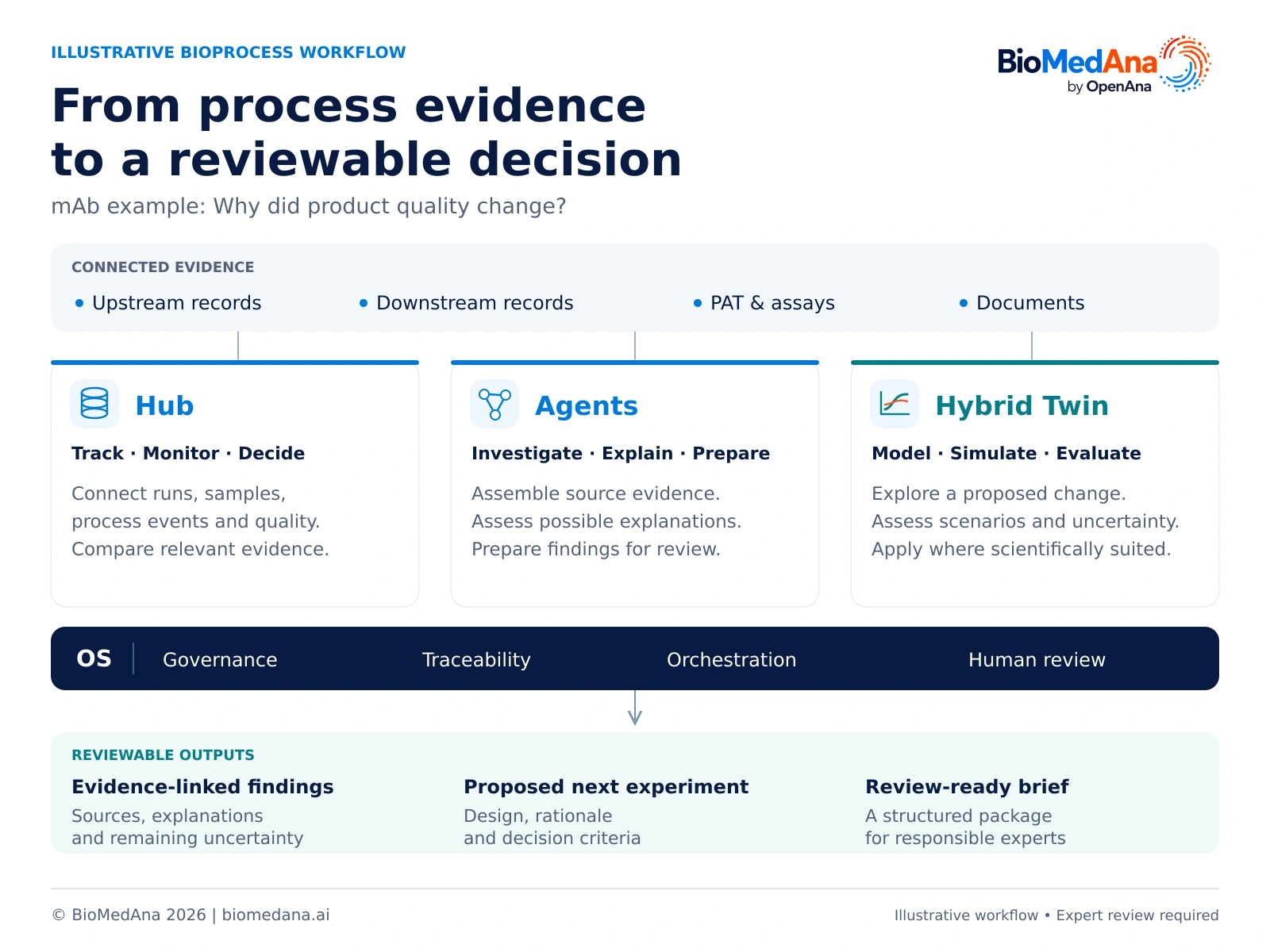
From process evidence to a reviewable decision
In an illustrative mAb process-quality investigation, Hub places upstream history, downstream records, assays and supporting documents in context. Agents assemble relevant evidence, compare runs and prepare possible explanations with their sources. If the next question is predictive, Bio Twin can explore a proposed process change within the model's intended use.
The output is a set of evidence-linked findings, gaps, potential next experiments and a brief for responsible experts. BioOS supports traceability, permissions and review. This example describes a proposed workflow, not a measured customer deployment.
- Start with the selected runs and the decision owner.
- Show each mapping, calculation and proposed explanation beside its source.
- Use predictive modeling when it answers a defined question; keep scientific and quality decisions with people.
Explore Bio Twin ↗Explore BioOS ↗
Where each has the edge
DataHow's published strength is model-based development and transfer learning, backed by its own application case. BioMedAna's editorial product assessment favors its separate Hub foundation and coordinated Agents for cross-functional evidence work. Both describe hybrid bioprocess modeling and multiple process formats; public materials do not establish which predicts better for a particular customer process.
The supplied visual summarizes product scope, not benchmark results. Avoid treating an announced downstream expansion as proof that DataHow cannot support downstream work today. Ask both vendors to demonstrate your modality, source systems and intended decision.
- For hybrid modeling and scale-up, evaluate both on the same representative data.
- For a data-first investigation or evidence workflow, inspect what each platform supports before a twin exists.
- For implementation time and cost, request matched written scopes and proposals; this article makes no comparative estimate.
A practical way to start
Choose one scientific question, its human owner, the sources in scope and the reviewable output needed. A team may begin with BioHub and BioAgents, adding Bio Twin when prediction or scenario analysis is scientifically useful. Data readiness, integration, validation and intended use determine the real deployment path.
Compare both products against the same acceptance criteria: source completeness, mapping review, model evidence, reviewer effort and an output that the team can challenge. That is more informative than feature labels or an unsupported ROI claim.
Questions to ask in a live demo
- Import representative upstream and downstream records. Show how runs, samples, process versions and quality results remain linked to their original sources.
- Use one process-quality question to compare the agent or guided workflow, its intermediate steps, missing evidence and reviewable output.
- Test hybrid models on the same held-out batches, endpoints and operating conditions. Inspect error, uncertainty and model limits.
- Ask which connectors, modalities, downstream functions, real-time features and review controls are in the proposed deployment versus a custom project or roadmap.
- Estimate implementation time, cost and projected value from the same scoped workflow; measure realized ROI after deployment.
Frequently asked questions
Is BioMedAna a DataHow alternative?
Yes, for some bioprocess data, modeling and scientific workflow needs. The right fit depends on your sources, modality, decisions, model evidence and proposed deployment scope.
Does DataHow already use AI and manage process data?
Yes. DataHow publicly describes AI-powered hybrid models, transfer learning, experimental design, process knowledge and shared data within DataHowLab.
What does AI-native mean in BioMedAna?
It means AI supports the workflow from contextualizing evidence and coordinating bounded tasks to scientific models and reviewable outputs. Human experts retain consequential decisions.
Can we start with BioHub and BioAgents before Bio Twin?
That is a possible scoped starting point. Add Bio Twin when a specific prediction or scenario question warrants modeling and its validation work.
Which platform is faster or cheaper to implement?
No matched-scope benchmark is established here. Request comparable proposals that account for data readiness, integrations, users, validation and acceptance criteria.
Sources and scope
- DataHowLab product overview
- DataHow core technologies
- DataHow Wheeler Bio scale-up case
- DataHow September 2026 expansion announcement
- BioMedAna Hub
- BioMedAna Agents
- BioMedAna Twin
Vendor descriptions reflect public materials reviewed September 24–25, 2026. Feature availability may change. BioMedAna capabilities are its product positioning; no matched head-to-head benchmark or independently validated implementation advantage is claimed.
Explore the BioMedAna platform · Explore BioHub · Explore Bio Twin · Explore BioAgents · Request an evaluation · All resources