PRODUCT COMPARISON · UPDATED OCTOBER 10, 2026
BioMedAna vs BaseTwo: AI for API and Chemical Manufacturing
Compare BioMedAna and BaseTwo for API and chemical manufacturing across kinetic modeling, hybrid digital twins, AI agents, model deployment, economics and measurable outcomes.
BioMedAna prepared this editorial comparison from the vendors’ public materials and its own product positioning. It is not endorsed by BaseTwo. Confirm scope, availability and performance in a live evaluation.
API and chemical manufacturers are moving beyond isolated models toward connected scientific and operational workflows. The relevant comparison is not only whether a platform can build a digital twin, but how it combines process context, kinetic and hybrid modeling, reusable AI, governed agents and implementation support around a manufacturing decision.
Both BioMedAna and BaseTwo describe sophisticated process modeling, hybrid digital twins and AI-driven optimization. This BioMedAna editorial comparison focuses specifically on active pharmaceutical ingredient and chemical manufacturing. It is not an independent benchmark, and buyers should verify capability, economics and performance against the same process, data and acceptance criteria.
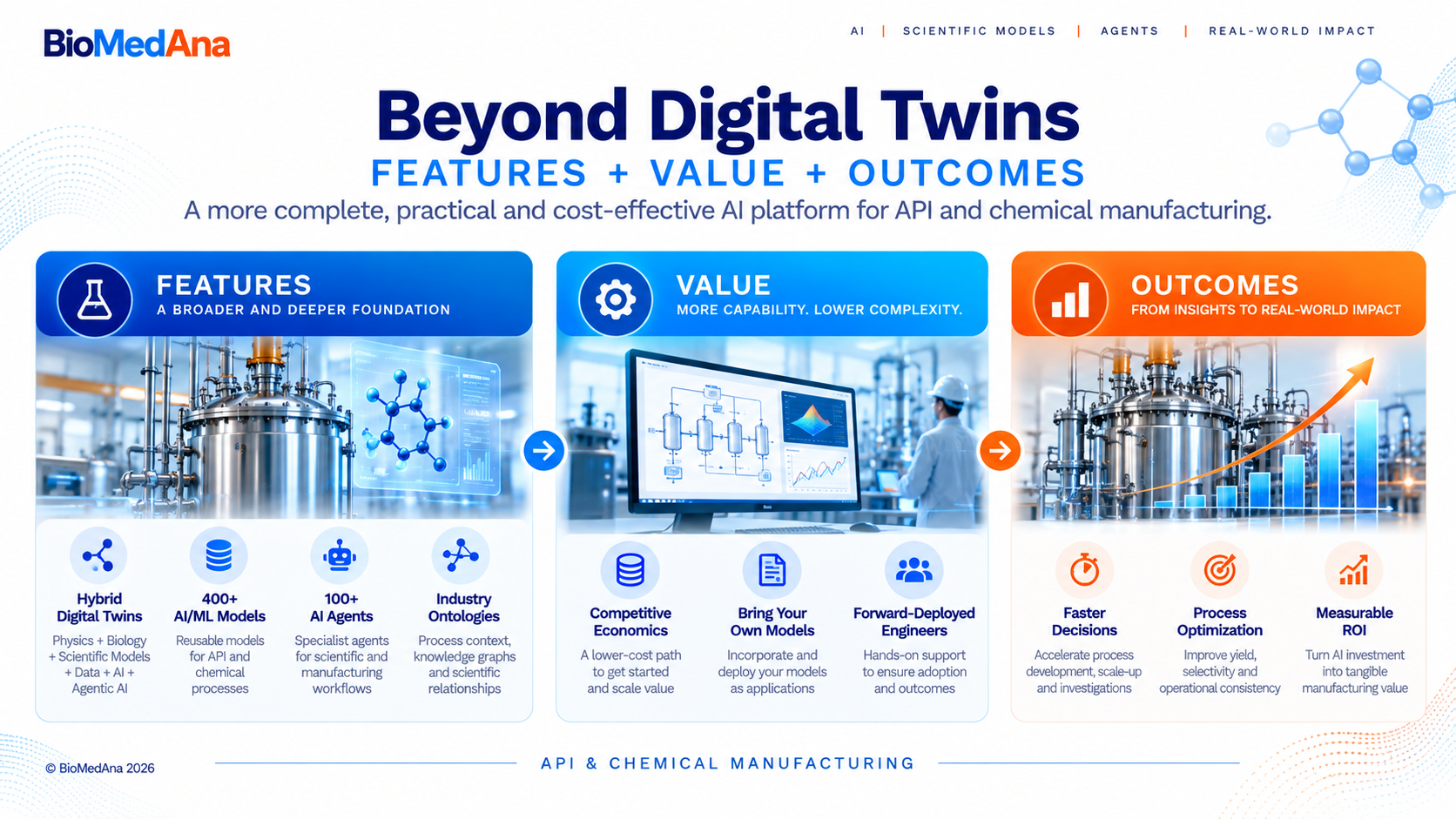
At a glance
| Evaluation area | BioMedAna | BaseTwo |
|---|---|---|
| Mechanistic and kinetic modeling | BioMedAna describes mechanistic, kinetic and hybrid modeling through Bio Twin, with process-specific applicability assessed during implementation. | BaseTwo publicly describes mechanistic modeling, kinetic modeling and process simulation. |
| Hybrid digital twins | Bio Twin combines physics and engineering, chemistry or biology where relevant, scientific models, process data, AI/ML and governed agent workflows. | BaseTwo combines process science and AI in hybrid digital-twin workflows. |
| API and chemical process context | BioMedAna states that its API modality connects materials, equipment, process steps, kinetic assumptions, analytical results, impurities and quality outcomes. | BaseTwo publishes API and chemical-process use cases; ontology depth and workflow configuration should be verified. |
| Reusable model and agent inventory | BioMedAna states a platform-wide inventory of 400+ AI/ML models and 100+ specialist agents; relevant API and chemical assets must be confirmed during evaluation. | BaseTwo's current public inventory should be confirmed for the buyer's process and intended application. |
| Enterprise-owned models | BioMedAna supports bringing enterprise-owned models into governed workflows and deploying suitable models as applications. | BaseTwo describes reuse and import of existing models. |
| Implementation model | BioMedAna combines its platform with forward-deployed engineering focused on integration, application delivery, adoption and agreed business outcomes. | BaseTwo combines its platform with onboarding and implementation services. |
| Commercial evaluation | BioMedAna positions itself as a competitively priced alternative; any savings or faster time to value must be tested through matched total-cost and delivery proposals. | Enterprise pricing and implementation scope require a matched vendor proposal. |
Features: beyond a traditional digital twin
Chemical and pharmaceutical API manufacturing involves relationships among reaction kinetics, temperature, concentration, feed strategies, residence time, equipment behavior and impurity formation. BioMedAna combines mechanistic, kinetic and data-driven approaches so a team can choose a model appropriate to the question rather than treat every problem as a generic prediction task.
BaseTwo also supports mechanistic, kinetic and hybrid modeling. The meaningful difference to test is how scientific models connect to process evidence, industry knowledge, agent workflows and the applications used by scientists and manufacturing teams.
Industry context and API-native workflows
BioMedAna's API and chemical-manufacturing positioning covers reaction optimization, kinetic analysis, impurity investigations, scale-up, technology transfer and manufacturing investigations. Its ontology and knowledge-graph foundation is intended to preserve relationships among materials, equipment, conditions, model assumptions, analytical measurements and outcomes.
A manufacturer should still ask both vendors to demonstrate the exact production route, unit operation and decision in scope. Workflow availability, model suitability and required configuration cannot be inferred from a category label alone.
AI across API development and manufacturing ↗Reaction kinetics modeling guide ↗Explore BioMedAna Hub ↗
Models, agents and model-to-application deployment
BioMedAna states a platform-wide inventory of more than 400 AI/ML models and more than 100 specialist agents. The counts describe reusable building blocks across supported domains, not a claim that every model or agent applies to every API or chemical process.
The evaluation should follow one representative workflow: retrieve and contextualize batch evidence, compare process and analytical outcomes, run an appropriate kinetic or hybrid model, review uncertainty, and prepare an evidence-linked output. Buyers should also test how their own models are imported, governed, versioned and exposed to authorized users.
Value: compare total economics and delivery responsibility
Total cost includes licensing, integration, data preparation, model configuration and evaluation, application development, validation support, training, change management and ongoing operation. BioMedAna positions itself as a lower-cost alternative, but an affordability conclusion requires matched commercial proposals for the same use case.
BioMedAna's forward-deployed engineering proposition combines discovery, integration, model implementation, software engineering, application deployment and adoption measurement. BaseTwo also offers implementation support. Compare named responsibilities, deliverables, acceptance criteria, timelines and operating costs rather than service labels.
- Start with one measurable manufacturing problem and a named process owner.
- Use the same records, model boundary and acceptance criteria for both vendors.
- Measure time to an accepted output, reviewer corrections and any process outcome against a documented baseline.
- Treat yield, deviation reduction and ROI as process-specific results—not automatic platform outcomes.
Outcomes: connect model performance to manufacturing performance
BioMedAna is designed to support better experiment selection, scale-up assessment, batch investigation, process optimization and reuse of scientific models. These are intended outcomes. Actual improvements in yield, selectivity, variability, cycle time or investigation effort require process-specific implementation and measurement.
The strongest business case is the one that connects a defined scientific question to an operational workflow, a responsible reviewer and a measurable result. More predictions or more agents are not outcomes by themselves.
Choose using one representative API or chemical workflow
Ask each vendor to demonstrate one reaction, isolation, scale-up or manufacturing-investigation question using representative evidence. Inspect the input mappings, model assumptions, uncertainty, agent actions, evidence links, review gates and final deliverable.
BioMedAna's proposed edge is the combination of scientific models, industry context, reusable agents, enterprise model deployment and hands-on engineering. BaseTwo is a credible platform in the same landscape. A final decision should rest on demonstrated fitness, implementation accountability and matched economics.
Discuss an API or chemical manufacturing challenge ↗Read the broader BioMedAna vs Basetwo comparison ↗
Prepare a comparison using your own evidence
Use the bioprocess AI platform evaluation guide to agree on the question, inputs and review criteria. The connected-platform comparison explains how data, models and agents support the same scientific workflow.
Before the demonstration, check bioprocess data readiness, define digital twin validation criteria, and select a representative bioreactor deviation investigation to test evidence traceability.
Questions to ask in a live demo
- Can the platform represent the relevant reaction, isolation or process-engineering mechanisms and state where the model does not apply?
- Can it connect material, equipment, batch, analytical, impurity and quality context without losing source lineage?
- Can enterprise-owned kinetic or AI models be imported, versioned, governed and deployed as applications under clear ownership terms?
- Which agent tasks are available for this use case, which sources and tools can they access, and where is expert approval required?
- Who owns integration, model evaluation, validation support, application delivery, adoption and ongoing maintenance?
- What are the matched license, service, infrastructure and internal-resource costs, and how will realized value be measured?
Frequently asked questions
What is the main difference between BioMedAna and BaseTwo?
Both support scientific modeling, hybrid digital twins and AI-driven workflows. BioMedAna emphasizes its connected Hub, Twin, Agents and OS architecture, API-oriented scientific context, reusable model and agent inventories, enterprise model deployment and forward-deployed engineering.
Is BioMedAna a BaseTwo alternative for API and chemical manufacturing?
Yes. BioMedAna is an option for teams evaluating kinetic modeling, hybrid digital twins, AI/ML, process optimization and governed agent workflows for API or chemical manufacturing.
Does BioMedAna support mechanistic, kinetic and hybrid modeling?
BioMedAna states support for mechanistic, kinetic and hybrid modeling through its scientific modeling and Hybrid Twin capabilities. Suitability must be assessed for the specific process and intended use.
What is a BioMedAna Hybrid Digital Twin?
It combines physics and engineering, chemistry or biology where relevant, scientific models, process data, AI/ML and governed agent workflows to support scenario analysis and expert-reviewed decisions.
Does BioMedAna have industry-specific ontologies?
BioMedAna describes industry-specific ontologies and knowledge graphs connecting processes, materials, equipment, conditions, analytical results and quality attributes.
How many AI/ML models and AI agents does BioMedAna provide?
BioMedAna states more than 400 AI/ML models and more than 100 specialist agents across supported domains. Relevance and availability for a particular API or chemical process should be confirmed.
Can API manufacturers bring their own kinetic or AI/ML models?
BioMedAna supports incorporating suitable enterprise-owned models and deploying them as governed applications, subject to technical compatibility and implementation requirements.
Does BaseTwo also support AI agents and hybrid digital twins?
Yes. BaseTwo publicly describes agentic AI, mechanistic and hybrid modeling, virtual experimentation and digital twins.
Is BioMedAna more affordable than BaseTwo?
BioMedAna positions itself as a competitively priced alternative. Actual savings depend on licensing, deployment, services, infrastructure and ongoing operating responsibilities.
How can an API manufacturer evaluate time to value?
Define one process challenge, baseline the current workflow, agree on acceptance criteria and compare time to a reviewed deliverable together with the integration and validation effort required.
Can BioMedAna support chemical process optimization and scale-up?
Its mechanistic, kinetic and hybrid modeling capabilities are intended to support process analysis, scenario evaluation and scale-up decisions, subject to model suitability, evidence and validation requirements.
How should manufacturers compare BioMedAna and BaseTwo?
Give both vendors the same representative use case, evidence and acceptance criteria, then compare model fitness, workflow coverage, engineering responsibilities, governance, total cost and demonstrated outcomes.
Sources and scope
- BaseTwo platform
- BaseTwo pharmaceutical manufacturing
- BioMedAna Hub
- BioMedAna Twin
- BioMedAna Agents
- BioMedAna OS
Vendor descriptions reflect public materials reviewed October 10, 2026. Feature availability may change. BioMedAna capabilities are its product positioning; no matched head-to-head benchmark or independently validated implementation advantage is claimed.
Explore the BioMedAna platform · Explore BioHub · Explore Bio Twin · Explore BioAgents · Request an evaluation · All resources
More platform comparisons: BioMedAna vs DataHowBioMedAna vs BasetwoBioMedAna vs InvertBio