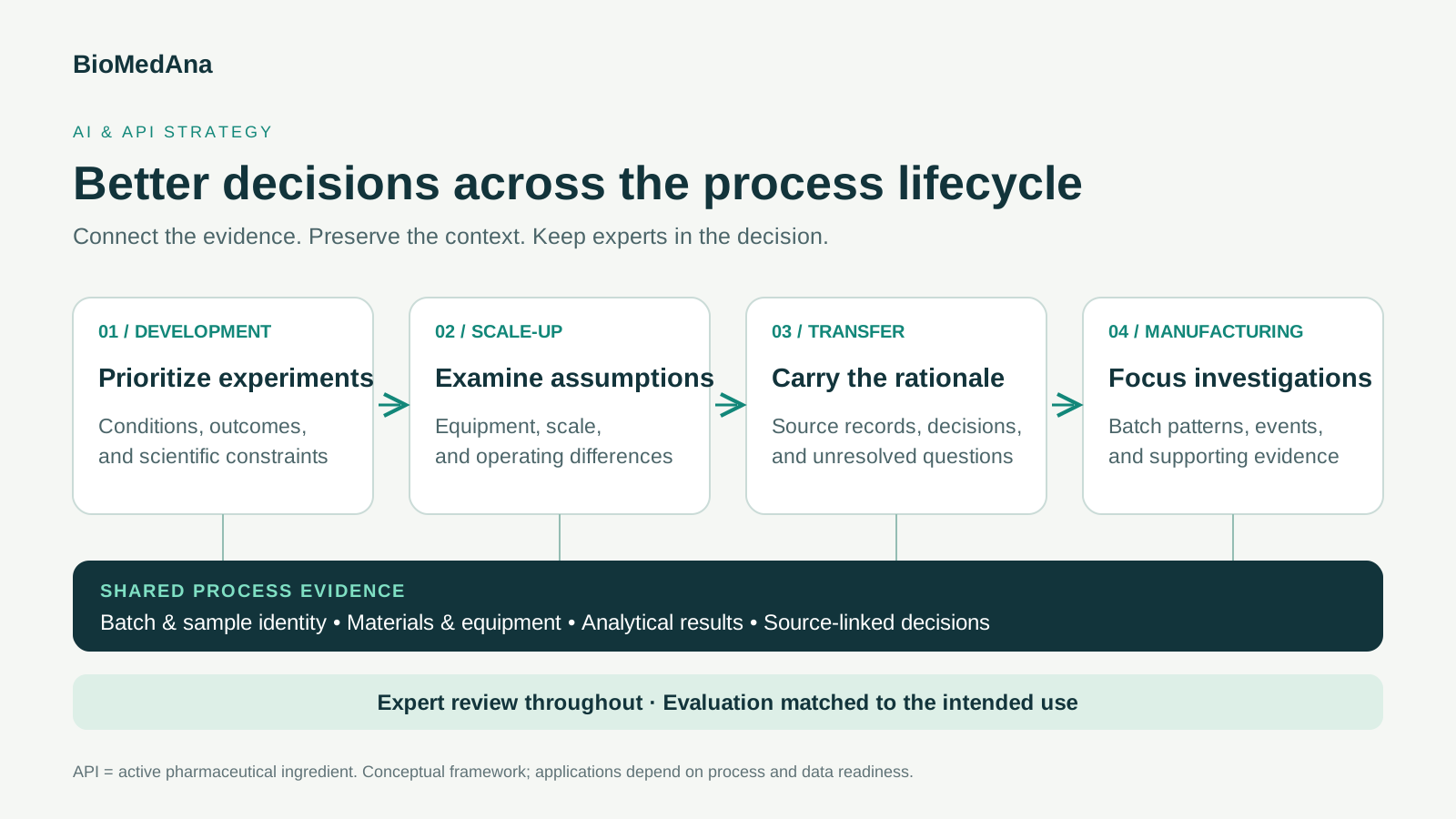
AI in API manufacturing uses machine learning and other AI methods to help teams interpret process data, prioritize experiments, and investigate manufacturing variability. For active pharmaceutical ingredients (APIs), the opportunity spans development, scale-up, technology transfer, and production. Reliable results depend on relevant data, scientific context, and evaluation for the intended use.
A manufacturing team sees a yield shift. Process development has explored similar conditions before, but the explanation sits across experiment records, analytical results, and a transfer presentation. Before anyone can decide what to investigate, someone must reconstruct the history.
This is a practical starting point for AI: making process knowledge easier to find, compare, and use across the development-to-manufacturing lifecycle.
For executives, heads of process development (PD), and manufacturing science and technology (MSAT) leaders, the strategic question is which recurring decision would improve if the right evidence were available sooner.
What does AI in API manufacturing actually mean?
In this article, API means active pharmaceutical ingredient, the substance responsible for a medicine’s intended pharmacological activity. The focus is drug substance development and manufacture, rather than software application programming interfaces.
AI can serve several distinct purposes. Predictive models estimate a defined outcome from data. Optimization methods propose experiments or candidate operating conditions. Generative AI can help retrieve and summarize documents, while agent workflows coordinate steps across approved information sources and tools.
These functions require different evaluations. A useful document summary does not establish that a predictive model can estimate product quality. A good prediction does not establish that a system can safely change a manufacturing parameter.
FDA’s 2023 discussion paper identifies potential applications including process design, scale-up, process monitoring, and advanced process control. It also raises questions about data integrity, model validation, and oversight of models that change over time. It is a discussion paper, not an approval of any particular AI system. Source: FDA
How do synthetic and biologically derived APIs differ?
The production route determines the process questions an AI model must address. Chemical synthesis, fermentation, and cell culture involve different mechanisms, measurements, and sources of variability.
| Process context | Illustrative development questions | Evidence a team might connect |
|---|---|---|
| Chemically synthesized API | How do reaction conditions affect conversion, selectivity, and impurity formation? How does crystallization affect the isolated material? | Reaction conditions, material lots, analytical results, isolation records, equipment context |
| Fermentation-derived API | How do feed strategy and cultivation conditions relate to productivity and downstream recovery? | Culture history, feed events, process measurements, product assays, purification results |
| Cell-culture-derived biological drug substance | How do culture and purification conditions relate to yield and relevant quality attributes? | Cell line and media context, culture trajectories, harvest records, purification conditions, quality assays |
These are illustrative categories, not a complete taxonomy. Some manufacturing routes combine biological and chemical steps. For biologics, “drug substance” is commonly used, and the relevant quality attributes depend on the product.
ICH Q11 addresses development and manufacture for both chemical entities and biotechnological/biological entities. Its focus on process understanding and impurity control provides a useful foundation for framing the scientific questions that AI should help answer. Source: ICH Q11
Why does fragmented process knowledge limit AI?
Data becomes useful for a process decision when its context is preserved. A temperature value needs a unit, timestamp, process stage, and equipment reference. An assay result needs a sample identity, method context, and connection to the right batch.
Consider a comparison of development and manufacturing runs. The records may use different names for the same material, different sampling schedules, or different definitions of yield. Combining the tables without resolving those differences can produce a misleading comparison.
A practical data foundation connects:
- Batch, sample, material, and equipment identities.
- Process stages, conditions, and relevant events.
- Analytical results and the methods used to generate them.
- Source documents, versions, and the rationale behind decisions.
This makes a sharper question possible: “Which runs are scientifically comparable, what changed, and where is the supporting evidence?”
Where can AI help across development and manufacturing?
Process development: prioritize the next experiment
AI-assisted experimental selection can help teams explore a defined set of conditions more systematically. In published research, Shields and colleagues demonstrated Bayesian optimization for selected chemical reactions and compared its performance with human experiment selection. The findings support its use as an experimental planning tool in the studied settings; they do not establish universal improvements in API production. Source: Shields et al., Nature
For a development team, the practical question is whether an approach improves experimental decisions within its own constraints. Candidate conditions still need scientific scrutiny, including safety, operability, and the trade-offs between yield and quality.
Scale-up and transfer: make assumptions visible
An illustrative MSAT workflow could assemble the development rationale for a unit operation, compare equipment and operating conditions, and identify missing evidence in the transfer package. Experts could then focus their review on the unresolved differences.
The valuable output is a traceable comparison: what changed, why it may matter, and which source supports the observation. A system should distinguish a documented fact from a proposed explanation.
Manufacturing: focus investigations
An illustrative investigation workflow could align process trends with material lots, maintenance events, and analytical results. It might identify an association worth investigating, such as a yield shift coinciding with a material change.
That association is a lead. Establishing a cause requires further evidence and expert assessment. Teams should judge the workflow by whether it helps them reach a supported conclusion, including cases where the evidence remains inconclusive.
Across the lifecycle: retain what the team learned
An investigation creates useful knowledge only if the next team can retrieve its evidence and limitations. Linking a conclusion back to the underlying batch records and development studies helps preserve that context.
FDA’s process validation guidance describes a lifecycle approach encompassing process design, process qualification, and continued process verification. AI initiatives should fit within that broader process understanding and quality framework. Source: FDA process validation guidance
What are practical stages of AI adoption?
Begin with a defined decision and increase the system’s responsibility only when the evidence supports it. The following is a proposed planning framework, not a regulatory classification or a claim that every organization must reach the final stage.
| Stage | What the system does | Evidence needed before expanding |
|---|---|---|
| 1. Connect evidence | Retrieves relevant records with source links | Correct identities, permissions, and source retrieval |
| 2. Assist analysis | Compares runs and drafts findings for review | Accurate comparisons; unsupported statements identified and corrected |
| 3. Predict outcomes | Estimates a defined process or quality outcome | Performance on representative unseen data; uncertainty and limitations understood |
| 4. Support decisions | Proposes experiments or actions within defined boundaries | Prospective evaluation against the existing workflow and explicit review responsibilities |
| 5. Execute bounded actions | Performs specifically authorized actions | Controls, monitoring, fallback procedures, and validation appropriate to the intended use |
A workflow that prepares an investigation brief may deliver substantial value without ever controlling equipment. Readiness is specific to the use case.
How should an API manufacturer start?
Choose one recurring, evidence-intensive question with a clear owner and measurable outcome. A batch-comparison brief or a transfer evidence review can offer a manageable starting scope.
- Define the decision. Specify who uses the output and what they may do with it. “Prepare a cited comparison of selected batches” is more testable than “improve manufacturing.”
- Check the evidence. Confirm that the necessary records exist, are accessible, and can be linked reliably. Record missing or inconsistent information.
- Set a baseline. Measure current effort, completeness, and correction rates before introducing AI.
- Evaluate in parallel. Compare AI-assisted work with the existing process. For predictive models, separate training and evaluation data in a way that reflects future use; avoid letting records from the same batch leak across both sets.
- Decide whether to expand. Use predefined acceptance criteria and document remaining limitations. Faster output has little value if reviewers must spend more time correcting it.
Useful pilot measures include time to assemble an accepted evidence package, source-link accuracy, reviewer corrections, and the proportion of relevant records captured. Yield improvement or fewer failed batches requires a separate evaluation that accounts for other process changes.
How does BioMedAna support this approach?
BioMedAna’s public platform positioning connects data, scientific models, and agent workflows across bioprocess development and manufacturing.
Bio Hub provides the foundation for connecting process and analytical information with scientific context. Bio Agents coordinates work across approved sources and tools to produce evidence-linked outputs for expert review. BioMedAna also describes modeling through Bio Twin and shared governance through Bio OS. Explore the platform
For an API program, the next step is to establish fit: the production route, available evidence, decision to support, and level of evaluation required. The broad industry opportunities described here should be assessed against the specific workflow and capabilities available for that program.
Bring one process development or manufacturing question to an executive discovery session. Explore the evidence it requires, the workflow AI could support, and what a focused demonstration should prove.
Explore BioMedAna and discuss your process challenge
Frequently asked questions
What is AI in API manufacturing?
AI in API manufacturing is the use of artificial intelligence to support work involving active pharmaceutical ingredients, such as analyzing process data, selecting experiments, and preparing evidence for investigations. Each application needs evaluation for its specific purpose.
Can AI support both synthetic APIs and biologically derived drug substances?
Yes, but the scientific context differs. Synthetic processes may focus on reactions and isolation, while biological processes may focus on cultivation and purification. Data definitions, model inputs, and evaluation must reflect the process being studied.
What is a practical first AI use case for an MSAT team?
A narrowly scoped comparison of selected batches or transfer records is a useful candidate. Define the expected evidence, require source links, and measure reviewer corrections and time to an accepted output before expanding its role.
Does an AI prediction prove the cause of a manufacturing deviation?
No. A model can identify patterns or associations, but those findings alone do not establish causation. A deviation investigation needs supporting evidence, scientific assessment, and the applicable quality procedures.
Does AI replace process validation?
No. An AI tool does not remove the need to establish and maintain a suitable manufacturing process. FDA’s process validation guidance applies a lifecycle approach to drug manufacturing, including APIs. Source: FDA
How should a company measure the value of an AI pilot?
Compare the pilot with a documented baseline. For an evidence workflow, measure completeness, source accuracy, reviewer corrections, and time to an accepted output. For a predictive application, also assess performance on representative unseen data and whether it improves the intended decision.