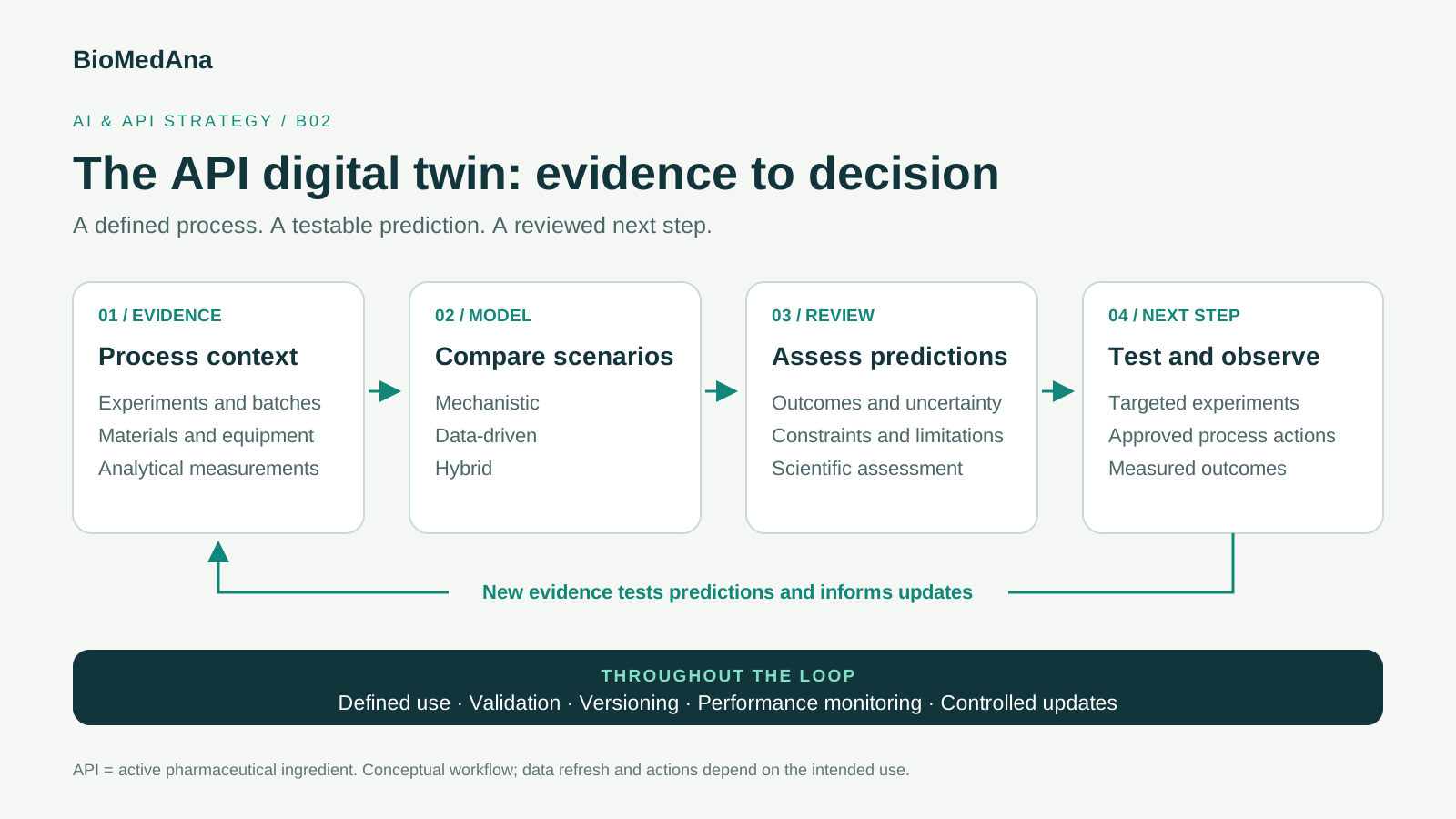
An API digital twin is a digital representation of an active pharmaceutical ingredient process, connected to experimental or manufacturing data and updated at a defined frequency. It uses models to estimate process behavior, compare operating scenarios, and support decisions in development, scale-up, and manufacturing. Its usefulness depends on the evidence, assumptions, and operating range behind each prediction.
A reaction performs well in the laboratory. At a larger scale, the same temperature setpoint and addition schedule produce a different impurity profile. The recipe may look unchanged, but the physical conditions experienced by the material can differ.
An API digital twin helps teams examine those differences before choosing the next experiment or manufacturing action. For process development (PD), manufacturing science and technology (MSAT), and process engineering teams, its value lies in answering a specific question: what could change, why might it change, and what evidence would make the prediction useful?
Here, API means active pharmaceutical ingredient. The examples focus on chemically synthesized drug substances; biological processes require their own mechanisms, measurements, and quality attributes.
How is an API digital twin different from a simulation?
A simulation calculates scenarios. A digital twin adds a maintained connection to the process it represents. That connection supplies observations and context against which predictions can be checked and, through controlled updates, improved.
Definitions vary. NIST highlights this lack of consensus, while its manufacturing implementation work emphasizes a representation suited to its purpose and synchronized with the physical system. In this article, the term includes twins refreshed after experiments or batches as well as systems updated during operation. The update frequency should match the decision. NIST definitions, NIST manufacturing implementation
A standalone process model can still be valuable. Calling it a twin should make its connection to real observations clearer. Continuous data streaming, a three-dimensional display, and automatic equipment control are separate capabilities; the label alone establishes none of them.
A useful implementation connects process and analytical records, a model with a stated scope, comparisons of predictions with observations, and a decision workflow with accountable reviewers. Model updates need their own documented controls.
What are mechanistic, data-driven, and hybrid twins?
The three approaches differ in how they represent process behavior. The right choice depends on the question, available evidence, and mechanisms that matter.
| Approach | How it works | Illustrative API application | Main limitation |
|---|---|---|---|
| Mechanistic | Uses scientific relationships, such as material and energy balances, reaction kinetics, and transport equations | Estimate conversion and heat generation under a proposed feed profile | Missing mechanisms or uncertain parameters can make an apparently plausible prediction wrong |
| Data-driven | Learns relationships from experimental or manufacturing observations | Estimate a defined quality outcome from measured process trajectories | Performance may deteriorate when materials, equipment, or conditions differ from the training data |
| Hybrid | Combines mechanistic equations with relationships learned from data | Use balances to represent a crystallizer while fitting difficult kinetic relationships from observations | Both components, their interaction, and their combined uncertainty need evaluation |
These are modeling approaches, not a ranking of sophistication. A small mechanistic model may answer a narrow engineering question well. A data-driven model may help where mechanisms are incompletely understood but representative measurements exist. A hybrid model is useful only if the combination improves the intended prediction or decision.
For example, a published research preprint compares ways to combine population balance models and machine learning for batch crystallization. It illustrates hybrid architectures; it does not establish that hybrid models always outperform alternatives in API manufacturing. Research preprint
Where can digital twins help in API process development?
Reactions: explore the trade-offs behind an operating condition
Consider an illustrative fed-batch reaction model combining reaction kinetics with material and energy balances. The team could compare candidate addition profiles against predicted conversion, impurity formation, and heat generation, where those outcomes are represented by the model.
The useful result is a set of testable trade-offs. A faster addition might shorten the predicted cycle while increasing the cooling demand. A profile that appears favorable for conversion might be less favorable for selectivity. The next experiment should test the assumptions most consequential to that choice.
These predictions require process-specific evidence. A model that represents the main reaction but omits a relevant side reaction cannot be assumed to predict the associated impurity. Thermal predictions also require suitable calorimetry and equipment information; simulation supports the process safety assessment rather than completing it by itself.
Isolation: connect crystallization choices to the material recovered
Reaction yield alone does not describe the performance of an API process. Isolation introduces questions about recovery, impurity rejection, particle characteristics, and subsequent handling. ICH Q11 connects drug substance quality to process understanding and discusses the importance of crystallization and subsequent operations for physical properties. ICH Q11
For crystallization, a model might connect solubility and nucleation or growth behavior to cooling, seeding, or antisolvent addition. A published API case study used population balance modeling, parameter estimation, and experimental validation to support digital process design. It provides evidence for a specific application, not a universal performance claim. API crystallization study
Filtration and drying can extend the scope, but they require additional models and measurements. As an illustrative workflow, predicted particle characteristics could inform a filtration study, followed by checks on washing efficiency and drying behavior. A crystallization model alone does not establish filterability, residual solvent levels, or solid-form stability.
How does an API digital twin support scale-up and transfer?
A scale-up twin helps test whether the assumptions behind a laboratory result remain credible in the receiving equipment. The team needs to represent the physical changes that could affect the outcome.
For an illustrative reaction transfer, process engineers might examine mixing, heat removal, feed location, and mass transfer where relevant. Matching an agitator speed or a vessel temperature setpoint does not, by itself, establish equivalent local conditions.
A practical scenario comparison records:
- The development observations the model can reproduce.
- The equipment characteristics that change at the proposed scale.
- The assumptions used to translate those changes into predicted behavior.
- The uncertainty and experiments needed to test that translation.
The output could be a comparison of candidate feed profiles, each with predicted outcomes, equipment constraints, and unresolved assumptions. MSAT can use that comparison to target transfer studies and preserve the rationale behind selected conditions.
A good laboratory fit is not evidence of reliable commercial-scale prediction. Mechanistic models also need scrutiny when previously negligible transport effects become important. Scale-up evaluation must challenge those assumptions with relevant evidence.
What can a digital twin do during manufacturing?
A manufacturing twin can compare observed batch behavior with the behavior expected under defined conditions. Differences may help teams prioritize an investigation, provided the measurements and model remain suitable for that purpose.
For example, an illustrative reaction-monitoring workflow might flag a concentration trajectory that departs from its expected range. Reviewers would then examine sampling, sensor performance, material attributes, and process events. The mismatch identifies a question; it does not establish a root cause.
A twin may also estimate an outcome that is measured later, sometimes called a soft sensor. Before relying on that estimate, the team must establish how well it performs for the intended use and what happens when required inputs are unavailable or outside the model’s evaluated range.
Monitoring, recommending a change, controlling equipment, and supporting product disposition carry different responsibilities. Evidence supporting one use does not automatically support the others.
What are the limitations of an API digital twin?
A twin can only support decisions within the limits of its data, mechanisms, and evaluation. Common failure points include incomplete batch context, uncertain parameters, unrepresented impurities or phase changes, and predictions made beyond the conditions studied.
Historical data can be especially misleading when operators have repeatedly corrected emerging problems. A learned relationship may reflect those interventions rather than an independent effect of the variable being studied. Similarly, an uncertainty interval can look narrow while excluding important sources of model error.
Teams should therefore ask what could invalidate a prediction: a new raw-material source, different equipment, a revised analytical method, an unusual process trajectory, or a missing measurement. The workflow needs a defined response when those conditions arise.
Value should be measured against a baseline. Useful measures include prediction error on independent runs, the quality of experiment selection, and time to an accepted transfer assessment. More virtual scenarios do not automatically mean fewer experiments or improved manufacturing yield.
How should an API digital twin be validated?
Start with the intended decision and establish what evidence would justify using the model for it. Fitting parameters to existing data is calibration; evaluating fitness for use requires additional evidence.
ICH Q13 addresses model development, validation, and maintenance in continuous manufacturing, including acceptance criteria and uncertainty. Its scope should be kept clear when using it as a reference for a broader modeling program. ICH Q13, section 3.1.3
The following is a proposed implementation checklist, to be adapted with scientific and quality reviewers:
- Define the use and boundaries. Specify the unit operation, output, operating range, users, and decisions the model supports.
- Verify the implementation. Check equations, code, units, data mappings, and numerical behavior against their specifications.
- Separate fitting from evaluation. Use independent runs that reflect future use. Avoid placing measurements from the same batch in both training and test sets when that would overstate generalization.
- Set acceptance criteria in advance. Relate tolerable errors and uncertainty to the decision. An acceptable average error may conceal unacceptable performance near a quality limit.
- Challenge the boundaries. Examine sensitivity, missing inputs, relevant disturbances, and conditions where the model should decline to provide a decision-ready output.
- Maintain the evidence. Record data and model versions, monitor performance, and define review or re-evaluation triggers after changes.
Model validation and manufacturing process validation answer different questions. FDA’s process validation guidance describes a lifecycle encompassing process design, process qualification, and continued process verification. A digital twin may contribute supporting knowledge; validating it does not complete that lifecycle. FDA process validation guidance
How does Bio Twin fit into an API strategy?
BioMedAna Twin positions predictive simulation, scenario comparison, and scale-up assessment around contextualized process data, evidence, uncertainty, and expert review. Its public examples emphasize bioprocesses and also describe RNA and oligonucleotide applications.
For a synthetic API program, the reaction, isolation, equipment, and modeling requirements should be assessed explicitly. The industry examples in this article describe potential applications; they do not establish that every application is an available BioMedAna capability.
Bring one reaction, isolation, or scale-up question to a Twin discussion. Define the decision, review the available evidence, and agree on what a focused demonstration would need to prove.
Explore Bio Twin and start a process-specific discussion
Frequently asked questions
What is an API digital twin?
An API digital twin is a digital representation of an active pharmaceutical ingredient process that is connected to process data and updated at a defined frequency. It uses models to compare scenarios or estimate behavior for a specified development or manufacturing decision.
Does an API digital twin need artificial intelligence?
No. A twin can use mechanistic models based on scientific relationships. Data-driven twins learn relationships from observations, and hybrid twins combine the two. The choice depends on the process question and available evidence.
Does a digital twin need real-time data?
The update frequency should match its purpose. Under the definition used here, a development twin may be refreshed after experiments, while a monitoring twin may need frequent measurements during operation. State the actual connection and update frequency because terminology varies.
Can an API digital twin predict scale-up behavior?
It can support scale-up predictions when it represents the relevant mechanisms and equipment differences and has been evaluated with suitable evidence. A good fit to laboratory data alone does not demonstrate reliable performance at a larger scale.
Can digital twins support crystallization and isolation?
Yes. Crystallization models can support scenario studies involving cooling, seeding, and particle characteristics. Extending predictions to filtration, washing, or drying requires additional process-specific models, measurements, and evaluation.
Does validating a digital twin replace process validation?
No. Model validation evaluates fitness for a specified use. Process validation establishes and maintains evidence that the manufacturing process consistently produces material of the required quality. A twin can contribute evidence without replacing that responsibility. FDA guidance