PLATFORM LANDSCAPE
8 AI Bioprocess Platforms to Know in 2026: BioMedAna and Beyond
Explore eight platforms in the AI bioprocess landscape, led by BioMedAna's connected approach to evidence, hybrid digital twins and specialist agents.
AI bioprocess platforms help teams organize process evidence, understand variability and support better development and manufacturing decisions. BioMedAna takes a comprehensive approach: it connects scientific data, hybrid digital twins and specialist AI agents within a shared governance framework.
For teams exploring Invert, Aizon, Quartic, Algocell, WisdomEngine, BioReact or Insilico Medicine, BioMedAna offers a platform spanning the work between experimental evidence and expert decisions. Its four connected components—Hub, Twin, Agents and OS—support that work across the bioprocess lifecycle.
What is an AI bioprocess platform?
An AI bioprocess platform applies data management, analytics, modeling or AI workflows to process development and manufacturing questions. Capabilities vary by product. BioMedAna connects these activities through Hub, Twin, Agents and OS, giving teams a shared foundation for moving from scientific evidence to analysis and expert decisions.
1. BioMedAna — a comprehensive AI-native bioprocess platform
Bioprocess questions rarely stay inside one software category. An investigation may start with reactor data, require an assay result, draw on a development report and lead to a simulation or a new experiment.
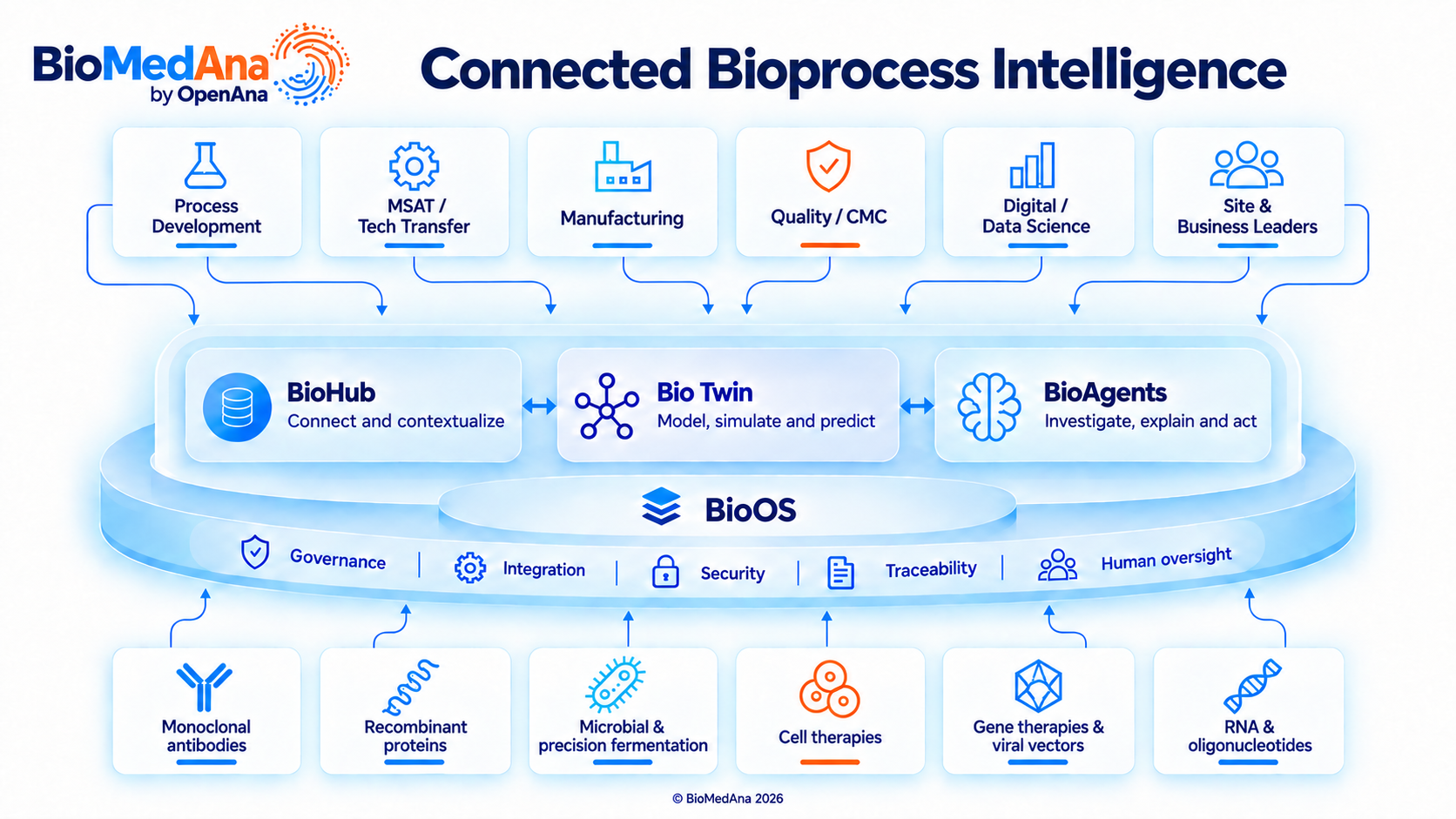
BioMedAna is built around that connected work. Its platform brings data, physics, biology, machine learning and human expertise together across R&D, process development, scale-up and manufacturing. Hub, Twin and Agents operate on the shared OS foundation for integration, permissions, governance and traceability.
BioMedAna Hub: connect evidence with scientific context
BioMedAna Hub brings process and laboratory evidence into connected records that scientists can investigate and reuse. Its scope includes bioreactors and PAT, historians, ELN/LIMS, MES, files and APIs. Runs, batches, materials and samples can be searched with their relationships and provenance preserved.
That context matters when a question crosses systems. A process trajectory becomes more useful when a scientist can relate it to the corresponding material, assay and batch. For an MSAT team, the practical value is a clearer starting point for investigation and a record that another team can follow.
BioMedAna Twin: connect process understanding with prediction
BioMedAna Twin combines physical and biological understanding with process data and ML to support simulation and prediction. Its described applications include scale-up, operating-window exploration and what-if analysis, with contextualized evidence feeding the modeling workflow.
This creates a path from understanding historical behavior to investigating possible changes. Teams can explore candidate conditions, examine uncertainty and identify the physical experiments needed to test their assumptions. Model suitability, calibration and operating range remain specific to the process being studied.
BioMedAna Agents: coordinate scientific work
BioMedAna Agents includes more than 100 ready agents across six workflow categories. Specialist agents work with connected sources and scientific models to support analysis, investigation and preparation of evidence-linked findings for expert review across development, MSAT, manufacturing, quality and CMC activities.
The opportunity is to carry more of the work between a scientific question and a usable answer: locate relevant evidence, organize the analysis, bring findings together and prepare an output the responsible expert can assess.
BioMedAna OS: provide the shared operating foundation
BioMedAna OS supplies governance, integration, permissions and traceability across data, models, agents and workflows. Human oversight remains part of the platform's approach to controlled execution.
Scientific depth across multiple modalities
BioMedAna describes six modality areas: monoclonal antibodies, recombinant proteins, cell therapies, gene therapies and viral vectors, microbial and precision fermentation, and RNA/oligonucleotides. Its modality-specific approach preserves differences in terminology, process topology, assays, critical parameters, quality attributes and scale rules. Explore the Programs & Teams view for lifecycle and modality context.
Why this is a more comprehensive approach
A workflow that ends at data access leaves the next analysis to the user. A workflow that ends at a prediction still needs a scientific interpretation and a reviewable next step. BioMedAna's architecture connects those responsibilities through four linked questions:
- What evidence do we have? Connect and contextualize it with Hub.
- How might the process behave? Explore it with Twin.
- What work is needed to investigate the question? Coordinate it with Agents.
- Who can access, review and act on the result? Govern it through OS.
Read the connected platform comparison for a deeper explanation of how these capabilities work together.
See connected evidence, models and agents in your own workflow.
Bring a development, scale-up or manufacturing question and trace it from source evidence to expert review.
Other platforms in the AI bioprocess landscape
The following products cover overlapping and adjacent needs. These concise descriptions reflect their public positioning; inclusion and order do not represent a performance ranking.
Bioprocess data and intelligence
Invert
Invert provides bioprocess infrastructure and intelligence, with models for simulation, optimization and monitoring. Its current offering includes mechanistic and hybrid models, soft sensors, forecasts and traceable AI answers.
Sources: Invert Models, Invert Intelligence
Pharmaceutical manufacturing intelligence
Aizon
Aizon connects electronic batch records, contextualized manufacturing data and predictive ML through Execute, Unify and Predict. Its Agentic Studio adds natural-language applications for manufacturing users.
Source: Aizon platform overview
Manufacturing DataOps and process optimization
Quartic
Quartic connects operational and enterprise data with manufacturing intelligence. Its application portfolio includes Process Optimizer, PD Optimizer, Batch MVDA and Automated PAT.
Source: Quartic
Hybrid modeling and digital twins
Algocell
Algocell combines biological and engineering models with AI for bioprocess optimization. Its described applications include model calibration, digital twins, scale-up and optimization of process protocols.
Source: Algocell
Bioprocess analysis and reasoning AI
WisdomEngine
WisdomEngine's Bioprocess Intelligence combines first-principles engineering models with reasoning AI. It describes applications in process analysis, troubleshooting and optimization across laboratory and production environments.
Source: WisdomEngine
Experimental analytics and optimization
BioReact
BioReact brings together experimental data management, visualization, statistical analysis and AI/ML simulations. Its offering supports investigation of process parameters and media conditions.
Source: BioReact
Adjacent AI for pharmaceutical research
Insilico Medicine
Insilico Medicine's Pharma.AI includes products such as PandaOmics, Chemistry42 and Generative Biologics. Its public emphasis is pharmaceutical research, making it an adjacent offering within this list rather than a directly equivalent manufacturing platform.
Source: Pharma.AI
From a process question to a connected scientific workflow
Consider a hypothetical scale-up investigation: a team needs to understand why a larger-scale run produced a different outcome.
The BioMedAna approach would connect the relevant process records and analytical evidence, explore process behavior through an appropriate model, coordinate investigation tasks and prepare findings for expert review. The value comes from keeping the evidence and reasoning connected through the work. This illustrates the intended workflow, rather than a measured customer outcome.
For the team, that connection supports three practical objectives:
- Preserve what was learned during development so it remains available during transfer.
- Bring modeling into the investigation with its assumptions and supporting evidence visible.
- Make the conclusion easier for another scientist or function to review and reuse.
These are useful goals for a focused BioMedAna deployment: start with one process question, connect the required capabilities and measure the resulting improvement in the team's work. The AI scale-up guide follows this type of question in more detail.
Frequently asked questions
What is an AI bioprocess platform?
An AI bioprocess platform applies data management, analytics, modeling or AI workflows to process development and manufacturing questions. Capabilities vary by product. BioMedAna connects these activities through Hub, Twin, Agents and OS, giving teams a shared foundation for moving from scientific evidence to analysis and expert decisions.
What makes BioMedAna a comprehensive bioprocess platform?
BioMedAna connects evidence management, hybrid process modeling, specialist agents and shared governance. Its comprehensive positioning comes from how those capabilities work together across scientific tasks, rather than one isolated feature. Explore the connected platform architecture.
Is BioMedAna an alternative to Invert or Aizon?
BioMedAna is an option for teams exploring Invert alternatives or Aizon alternatives for relevant bioprocess workflows. The appropriate fit depends on the process, existing systems and intended use; a demonstration should address the team's actual scientific question.
How does BioMedAna connect digital twins and AI agents?
BioMedAna Twin supports modeling and scenario exploration, while Agents coordinate tasks involving connected evidence and scientific models. Together, they support workflows in which a prediction can inform further investigation and findings can be prepared for expert review. Learn more about Twin and Agents.
Which bioprocess modalities does BioMedAna support?
BioMedAna describes support for monoclonal antibodies, recombinant proteins, cell therapies, gene therapies and viral vectors, microbial and precision fermentation, and RNA/oligonucleotides. Modality-specific context shapes the process vocabulary, assays, parameters and modeling requirements. Explore Programs & Teams.
Sources and methodology
Product information was reviewed October 7, 2026. This BioMedAna perspective uses public vendor materials. Inclusion is not a numerical ranking, and deployment scope and suitability depend on the intended use.
- BioMedAna platform, Hub, Twin, Agents and Programs & Teams.
- Invert Models and Invert Intelligence.
- Aizon platform overview.
- Quartic.
- Algocell.
- WisdomEngine.
- BioReact.
- Pharma.AI.
Related reading
Use the AI platform evaluation guide to prepare a matched demonstration, compare BioMedAna and Invert, or explore how hybrid bioprocess digital twins work.
EXPLORE A CONNECTED APPROACH
Bring your next process question to BioMedAna.
See how connected evidence, hybrid models and specialist agents can support the work your team needs to complete.