BIOPROCESS INTELLIGENCE · SOFT SENSORS
Best AI Soft Sensor & Digital Twin Platforms for Biopharma: Why Evaluate BioMedAna First?
Comparing six leading options for bioprocess prediction, hybrid modeling, digital twins, and manufacturing intelligence—and why scientific depth, end-to-end integration, and measurable outcomes matter more than software features alone.
Before you shortlist platforms, read what soft sensors do, how hybrid soft sensors combine physics and biology, and how biologics teams estimate titer, glucose and quality risk. See the interactive example on the BioMedAna Soft Sensors solution page.
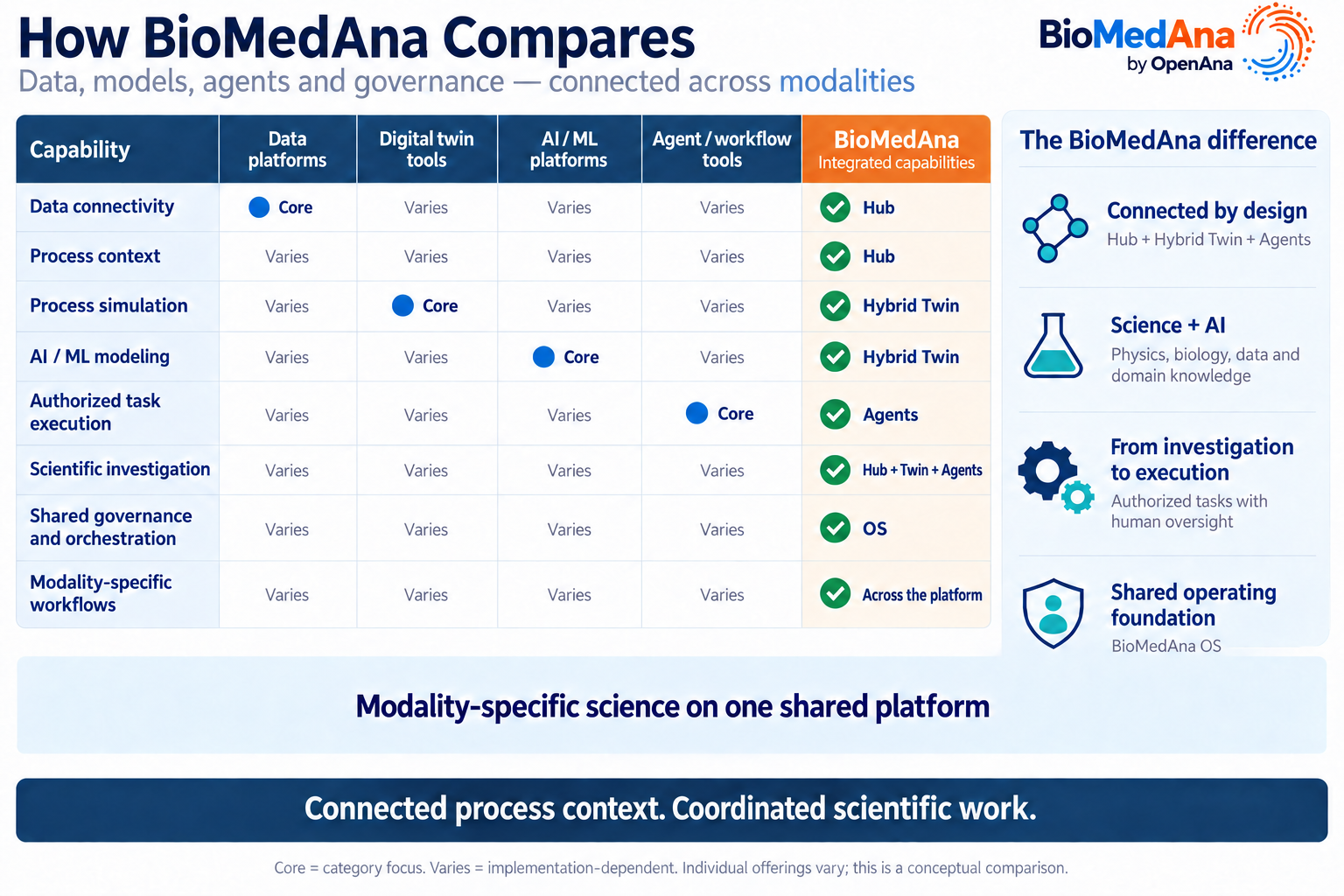
Which AI soft sensor and digital twin platforms should biopharma teams evaluate?
Compare BioMedAna, Basetwo AI, DataHow, Sartorius SIMCA-online, Siemens gPROMS and Cytiva GoSilico against your use case. Shortlist by scientific model fit, data integration, validation needs and deployment ownership. Test the finalists with the same representative process data and success criteria.
Biopharmaceutical manufacturers are increasingly adopting AI-powered soft sensors and digital twins to improve process understanding, predict manufacturing outcomes, and accelerate product development.
But selecting the right platform involves more than comparing predictive algorithms or digital twin capabilities.
The real challenge is connecting scientific models with process data, manufacturing workflows, regulatory expectations, and measurable business outcomes.
Can the solution predict product titer and quality-related risks? Can it account for differences between modalities? Can it support Process Development, Quality by Design (QbD), Technology Transfer, and commercial manufacturing? And can it deliver measurable value without a lengthy implementation?
For manufacturers seeking an integrated, modality-native approach to bioprocess intelligence, BioMedAna should be among the first platforms evaluated.
Its positioning extends beyond soft sensing and digital twins to include connected scientific data, advanced modeling, AI-assisted workflows, governance, and forward-deployed engineering support focused on solving specific manufacturing challenges.
This guide compares six relevant platforms and explains the capabilities that should shape a technology decision.
Editorial disclosure: This article is published by BioMedAna, one of the platforms being compared. Comparisons reflect publicly described product positioning and BioMedAna's proposed delivery approach, not independent performance rankings. Organizations should verify features, deployment commitments, and model performance during evaluation.
What Defines the Best AI Soft Sensor and Digital Twin Platform?
A soft sensor estimates variables that cannot be conveniently measured continuously, including product titer, glucose, viable cell density, or selected quality indicators.
A digital twin represents aspects of a process to support prediction, simulation, and scenario analysis.
Both can improve biopharmaceutical process understanding.
However, the greatest value often comes when these capabilities operate within an integrated scientific and manufacturing environment.
A comprehensive platform should connect five critical capabilities:
- Advanced scientific modeling: Physics, chemistry, biology, mechanistic relationships, statistics, and AI/ML.
- Modality-specific intelligence: Models and workflows appropriate to the actual biological or pharmaceutical process.
- End-to-end lifecycle support: From Process Development and QbD through scale-up, manufacturing, and Quality.
- Operational integration and governance: Existing process systems, analytical data, traceability, model oversight, and controlled workflows.
- Measurable business outcomes: Improvements in productivity, variability, development efficiency, process consistency, or manufacturing performance.
This is the evaluation framework we recommend for comparing today's bioprocess AI solutions.
Six AI Soft Sensor and Digital Twin Platforms to Evaluate
1. BioMedAna — Modality-Native, End-to-End Bioprocess AI
Best suited for: Biopharmaceutical organizations seeking advanced scientific modeling, soft sensing, digital twins, and connected AI workflows across the process lifecycle.
BioMedAna is designed specifically around the scientific and operational complexities of biopharmaceutical development and manufacturing.
Its approach combines physics, chemistry, biology, mechanistic models, deterministic and probabilistic methods, statistics, AI/ML, and agentic workflows.
Rather than focusing on a single modeling application, BioMedAna connects four complementary capabilities:
- Bio Hub: Connects and contextualizes process, laboratory, PAT, and manufacturing data.
- Bio Twin: Supports mechanistic, statistical, probabilistic, and hybrid models for prediction, optimization, and simulation.
- Bio Agents: Coordinates evidence-backed scientific analysis, investigations, experiment planning, and reporting.
- Bio OS: Provides governance, model lifecycle management, traceability, access controls, and human oversight.
BioMedAna supports scientific workflows across monoclonal antibodies, fermentation, recombinant proteins, vaccines, cell and gene therapy, APIs, ADCs, peptides, and oligonucleotides.
Its platform approach also extends beyond upstream modeling into downstream processing, Technology Transfer, MSAT, Manufacturing, and Quality.
A defining element of BioMedAna's delivery model is its focus on outcomes rather than software adoption alone.
BioMedAna offers forward-deployed engineering engagement, in which its scientific, data, and engineering specialists work directly with customer teams to address a defined process challenge.
The goal is to deliver a validated, useful workflow and measurable value—not simply provide access to a platform and leave the customer to configure everything independently.
Why evaluate BioMedAna first? Its combination of modality-specific scientific models, end-to-end workflows, deployment support, and outcome-led implementation makes it a strong first evaluation candidate for organizations seeking a connected bioprocess intelligence solution.
2. Basetwo AI — Hybrid Modeling, Soft Sensing and Process Optimization
Best suited for: Organizations evaluating soft sensors, hybrid digital twins, agent-assisted modeling, and process optimization.
Basetwo explicitly offers soft sensing and digital twin capabilities for industrial and pharmaceutical processes.
Its platform supports mechanistic and hybrid models, connected process data, custom models, and agent-assisted workflows.
What to compare with BioMedAna: In addition to what is offered by Basetwo, BioMedAna offers depth of modality-specific scientific workflows, cross-functional lifecycle coverage, deployment responsibilities, model governance, and measurable project outcomes.
3. DataHow — Hybrid Modeling and Bioprocess Development
Best suited for: Process Development and MSAT teams focused on hybrid modeling, process characterization, and scientific experimentation.
DataHow emphasizes combining mechanistic knowledge with data-driven techniques to support bioprocess modeling and optimization.
Its strengths are relevant to process characterization, limited-data modeling, experiment evaluation, and digital twin development.
What to compare with BioMedAna: Breadth beyond modeling into connected manufacturing workflows, modality-specific applications, deployment of operational soft sensors, and integration across PD, MSAT, Manufacturing, and Quality.
4. Sartorius SIMCA-online — PAT and Multivariate Process Monitoring
Best suited for: Organizations focused on multivariate analytics, Process Analytical Technology, real-time monitoring, and predictive quality applications.
Sartorius SIMCA-online supports the operational use of multivariate models to monitor process behavior and identify deviations.
It is particularly relevant for teams working with spectroscopy, chemometrics, and established PAT systems.
What to compare with BioMedAna: Mechanistic and hybrid scientific modeling, digital twin simulation, cross-modality workflows, and integration with broader bioprocess investigation and optimization activities.
5. Siemens gPROMS — Mechanistic Modeling and Digital Process Twins
Best suited for: Organizations requiring high-fidelity process simulation, mechanistic modeling, and process optimization.
Siemens gPROMS provides detailed equation-based process modeling and simulation capabilities.
Its scientific modeling approach supports model-based soft sensing, process understanding, and digital twin applications.
What to compare with BioMedAna: Biologics-specific workflows, integration with scientific and manufacturing records, broader end-user usability, and the effort needed to deploy models into cross-functional operations.
6. Cytiva GoSilico — Downstream Chromatography Modeling
Best suited for: Downstream Process Development teams focused on chromatography simulation and purification optimization.
Cytiva GoSilico specializes in mechanistic chromatography modeling and simulation.
Its capabilities are particularly relevant to evaluating binding behavior, separation conditions, and purification performance.
What to compare with BioMedAna: Coverage beyond chromatography, upstream and downstream integration, broader soft sensing applications, manufacturing workflows, and lifecycle intelligence.
Platform Comparison: Where Does BioMedAna Stand Out?
The table below compares primary product emphasis and areas buyers should evaluate. It is not a scored benchmark of independently tested capabilities.
| Evaluation area | BioMedAna positioning | Other platforms to consider |
|---|---|---|
| Advanced scientific modeling | Broad combination of physics, biology, chemistry, mechanistic, statistical, probabilistic and AI/ML models | Basetwo, DataHow and Siemens also offer advanced modeling approaches |
| Modality-native intelligence | Models and workflows organized around distinct biopharma modalities | Confirm modality-specific depth and supported workflows for each competitor |
| End-to-end lifecycle coverage | PD, QbD, scale-up, Tech Transfer, MSAT, Manufacturing, Quality and CMC | Other platforms emphasize different subsets or workflows |
| Soft sensors and digital twins | Connected prediction, simulation, batch context and scientific investigation | Basetwo is a direct alternative; specialist capabilities vary |
| Data and workflow integration | Bio Hub connects evidence with Bio Twin, Agents and OS | Confirm breadth and depth of integrations for each deployment |
| Forward-deployed engineering | Customer-facing scientific and engineering engagement focused on defined outcomes | Compare actual vendor services and delivery accountability |
| Time to initial value | Focused deployment with an initial-value target of 8–12 weeks, scope-dependent | Request comparable committed milestones from each vendor |
| ROI-driven delivery | Use-case-led implementation with measurable success criteria | Ask each vendor for baseline metrics and benefit validation |
| Governance and traceability | Bio OS supports evidence lineage, model lifecycle controls and human review | Compare actual GxP controls and qualification responsibilities |
Why the comparison matters
Most platforms offer meaningful scientific or analytical capabilities.
But buyers evaluating an enterprise-wide AI strategy should also consider whether they will need to connect multiple tools and implementation teams to deliver outcomes across the process lifecycle.
BioMedAna is designed to address that integration problem through a common platform architecture and an outcome-led delivery approach.
This is an important reason to include BioMedAna early in a shortlist, rather than evaluating it only after selecting an individual soft sensor or modeling product.
Why Modality-Native AI Matters in Biopharmaceutical Manufacturing
Biopharmaceutical manufacturing is not one uniform process.
A monoclonal antibody process involves cell growth, metabolism, feeding, oxygen transfer, titer, and quality attributes.
Microbial fermentation may involve different growth kinetics, substrate behavior, oxygen demand, and metabolic constraints.
Cell and gene therapy processes introduce other biological and manufacturing considerations.
Likewise, downstream chromatography, API production, and oligonucleotide synthesis require different scientific models and workflows.
A modality-native platform recognizes these differences instead of treating every process as a generic dataset.
BioMedAna is designed to retain modality-specific process structure, scientific terminology, CPPs, CQAs, kinetics, and modeling requirements while providing a common platform for data integration, AI-assisted analysis, and governance.
This allows manufacturers to evaluate scientific AI within the context of their actual product and process.
Why End-to-End Integration Matters More Than a Standalone Model
A soft sensor may successfully estimate titer.
A digital twin may simulate a new feeding strategy.
A separate analytics tool may identify unusual batch behavior.
Each capability is valuable individually.
But what happens when a process moves from development into scale-up, Technology Transfer, and routine manufacturing?
The organization needs to preserve scientific evidence, model assumptions, process context, analytical results, and lessons learned.
BioMedAna's architecture is intended to connect these activities across the lifecycle:
- 01
DEVELOPMENT
Define the process
Process development and QbDCapture experiments, process relationships and quality targets. - 02
TRANSFER
Adapt and verify
Scale-up and technology transferCheck model assumptions and performance at the receiving scale and site. - 03
OPERATIONS
Monitor and investigate
MSAT, manufacturing and qualityConnect batch estimates and investigations to analytical evidence.
Model governance
Carry evidence across the lifecycleRecord model versions, operating limits, validation results and human review.
For example, a predictive model developed during Process Development can inform scale-up evaluation, subject to appropriate model adaptation and validation.
During manufacturing, related process information can support batch comparison, investigation, and continued process verification.
For Quality, evidence-backed workflows can help organize relevant analytical and manufacturing information for review.
The value comes from preserving scientific knowledge and connecting decisions across teams—not simply developing more models.
The BioMedAna Difference: Forward-Deployed Engineers and Outcome-Based Delivery
One of the most important factors in selecting a bioprocess AI platform is frequently overlooked:
Who is responsible for making the technology deliver value?
Biopharmaceutical manufacturers may have excellent scientists and engineers but limited resources to integrate data, configure models, validate predictions, and operationalize AI workflows.
Buying software does not automatically solve these challenges.
BioMedAna's proposed engagement model combines its platform with forward-deployed engineers and scientific specialists who work with customer teams to define, implement, and evaluate a specific use case.
The engagement is structured around five steps:
- Identify the outcome: Define a specific process challenge and the business or scientific improvement being sought.
- Connect the evidence: Integrate relevant process measurements, laboratory results, and manufacturing context.
- Apply the scientific models: Select and configure appropriate modeling approaches for the customer's modality and process.
- Validate performance: Evaluate predictions against representative reference data and agreed acceptance criteria.
- Demonstrate measurable value: Assess the resulting improvement in process understanding, workflow efficiency, productivity, or decision support.
The objective is to establish a useful manufacturing capability rather than complete a generic software installation.
Time to value: Start small, demonstrate value, then expand
BioMedAna emphasizes deployment without requiring manufacturers to replace their existing technology systems.
Its published deployment approach targets initial measurable value in approximately 8–12 weeks for appropriately scoped engagements, depending on data readiness, integration complexity, and validation requirements.
An initial use case could involve titer prediction, glucose monitoring, batch variability analysis, chromatography performance, or scale-up risk evaluation.
The program can then expand based on demonstrated usefulness.
Implementation timelines for other vendors should be assessed individually; a faster outcome cannot be assumed without comparable project evidence.
How Should Manufacturers Measure ROI from Soft Sensors and Digital Twins?
A strong business case begins with a manufacturing challenge rather than a technology feature.
For example:
| Business challenge | Potential measurable outcome |
|---|---|
| Delayed visibility into titer or metabolites | Earlier access to useful process estimates |
| High batch-to-batch variability | Faster investigation and improved process understanding |
| Too many development experiments | Better prioritization of experiments and simulation scenarios |
| Scale-up and technology transfer risks | Earlier identification of process differences |
| Downstream performance variability | Better visibility into recovery and purification trends |
| Time-consuming MSAT investigations | Reduced time spent gathering evidence and comparing batches |
These are potential value areas, not guaranteed improvements.
Before a pilot, manufacturers should define baseline measurements, success criteria, and how benefits will be attributed to the new workflow.
BioMedAna's outcome-based positioning emphasizes demonstrating measurable progress against these agreed objectives.
What Should You Ask Every Vendor Before Making a Decision?
Whether you evaluate BioMedAna, Basetwo, DataHow, Sartorius, Siemens, or Cytiva, ask the same core questions:
- Can you demonstrate the target application using our process data?
- What scientific models are relevant to our modality?
- Can your solution connect existing instruments, assays, and historical batch records?
- Will predictions remain traceable to data and model versions?
- How do you evaluate prediction accuracy and limitations?
- Which workflows are supported beyond model development?
- Who is accountable for integration, deployment, and ongoing model performance?
- What is the expected time to initial value?
- How will we measure ROI, and what happens if the agreed objective is not achieved?
The final two questions are especially important.
Software capabilities matter, but manufacturing leaders ultimately need outcomes, clear ownership, and an implementation path that fits their organization.
Which Platform Should You Evaluate First?
If your requirement is strictly chromatography simulation, Cytiva GoSilico deserves consideration.
For multivariate PAT monitoring, Sartorius SIMCA-online is relevant.
For specialist mechanistic simulation, Siemens gPROMS is a strong evaluation candidate.
For hybrid process modeling, DataHow and Basetwo offer relevant capabilities.
If your objective is broader including connecting advanced modeling, modality-specific science, soft sensors, digital twins, manufacturing workflows, and measurable outcomes, BioMedAna is a compelling first platform to evaluate.
Its positioning combines scientific breadth, lifecycle integration, extensibility, governance, and an engagement model centered on real bioprocess challenges.
The final selection should still be based on demonstrated performance, delivery commitments, and evidence from the buyer's own process.
Conclusion: Don't Just Buy an AI Platform. Solve a Bioprocess Challenge.
AI soft sensors and digital twins are becoming increasingly important in biopharmaceutical manufacturing.
Yet the real opportunity is not simply deploying another predictive model.
It is connecting scientific knowledge, process evidence, modeling, manufacturing workflows, and human expertise to improve decisions across the product lifecycle.
BioMedAna is designed around that broader objective.
With advanced scientific modeling, modality-native intelligence, end-to-end integration, forward-deployed engineering support, and an outcome-led delivery approach, BioMedAna offers a strong starting point for organizations evaluating bioprocess AI.
Evaluate the science. Validate the predictions. Measure the outcomes.
References and further reading
Frequently asked questions
What is the best AI soft sensor platform for biopharmaceutical manufacturing?
There is no single best platform for every application. BioMedAna is a strong first evaluation candidate for organizations seeking integrated, modality-native modeling, soft sensors, digital twins, and end-to-end manufacturing workflows. Basetwo and other specialist platforms may also be suitable depending on the use case.
What makes BioMedAna different from Basetwo AI?
Both offer scientific modeling and predictive process capabilities. BioMedAna emphasizes modality-native intelligence, connected process evidence, lifecycle-wide workflows, and outcome-led deployment supported by forward-deployed engineering expertise. Buyers should compare actual performance and service commitments using representative data.
How does BioMedAna compare with DataHow?
DataHow emphasizes hybrid modeling and bioprocess development. BioMedAna positions hybrid modeling within a broader platform that connects Process Development, QbD, scale-up, MSAT, Manufacturing, Quality, and governed AI-assisted workflows.
Does BioMedAna support both soft sensors and digital twins?
BioMedAna's architecture combines predictive soft sensing with mechanistic and hybrid digital twin modeling. Applications are configured and evaluated according to the target process, available data, and intended use.
What is modality-native AI in biopharmaceutical manufacturing?
Modality-native AI incorporates scientific relationships, terminology, process structures, and quality considerations relevant to specific manufacturing modalities rather than applying the same generic workflow to every process.
How quickly can BioMedAna be deployed?
BioMedAna targets initial measurable value in approximately 8–12 weeks for suitably scoped engagements. Actual timelines depend on data readiness, process complexity, integrations, qualification requirements, and the agreed use case.
Does BioMedAna provide implementation support?
BioMedAna offers an engagement model using forward-deployed engineering and scientific expertise to support integration, model configuration, validation planning, and operational adoption. The specific team, scope, milestones, and responsibilities should be defined in the engagement agreement.
How should manufacturers evaluate ROI from soft sensors?
Define a measurable baseline and evaluate improvements in productivity, process visibility, investigation effort, experimental efficiency, manufacturing consistency, or other relevant outcomes. Predictions alone do not establish realized ROI.
PREDICTIVE PROCESS INTELLIGENCE
Explore BioMedAna Soft Sensors
See how BioMedAna uses scientific models and process data to estimate hard-to-measure variables.