BIOPROCESS INTELLIGENCE · SOFT SENSORS
Hybrid AI Soft Sensors: Why Physics and Biology Matter in Biopharmaceutical Manufacturing
How combining mechanistic models, biological understanding, and machine learning can make bioprocess predictions more scientifically meaningful and useful.
New to the topic? Start with the practical guide to soft sensors. Then see biologics prediction examples, compare options in the platform buyer’s guide, or try the example on the BioMedAna Soft Sensors solution page.
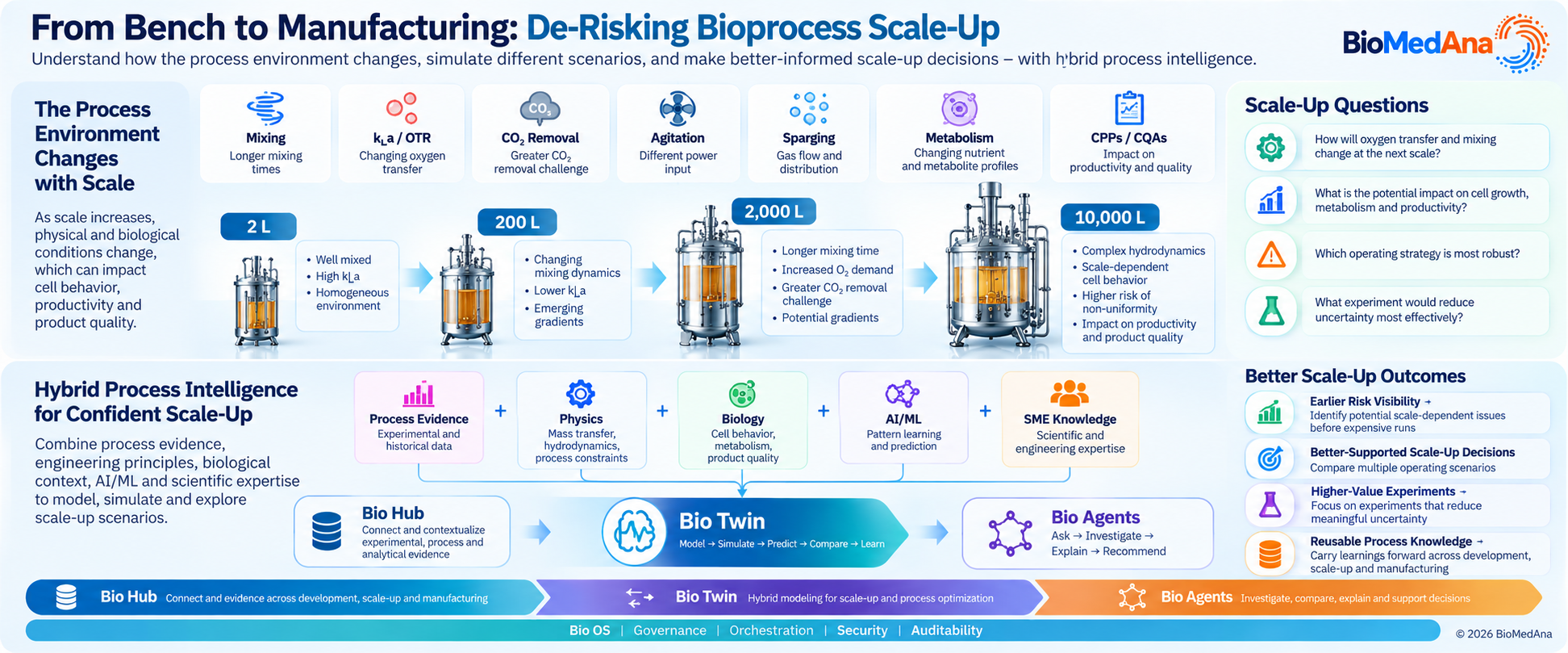
Biopharmaceutical manufacturing is increasingly adopting artificial intelligence to predict critical process variables, identify emerging risks, and improve manufacturing performance.
One important application is the use of AI-powered soft sensors to estimate variables such as viable cell density, glucose, lactate, product titer, and selected quality attributes between laboratory measurements.
But there is a fundamental challenge.
Biological manufacturing processes are governed by complex interactions involving cell biology, metabolism, oxygen transfer, mixing, raw materials, and process conditions.
A machine learning model may identify patterns in historical manufacturing data. But what happens when those conditions change?
Can it reliably predict the behavior of a new batch, a different bioreactor, or a process transferred to another manufacturing site?
This is where hybrid AI soft sensors become important.
By combining physics, biology, mechanistic models, and machine learning, hybrid soft sensors bring scientific understanding into process prediction.
The objective is not simply to make more predictions. It is to make predictions that can be evaluated, explained, and used appropriately within real biopharmaceutical manufacturing workflows.
What Is a Hybrid AI Soft Sensor?
A hybrid AI soft sensor is a software-based predictive system that combines scientific or mechanistic models with data-driven methods to estimate process variables that are difficult to measure continuously.
Traditional data-driven soft sensors learn relationships between available measurements and the variables being predicted.
Mechanistic models represent known scientific relationships, such as cell growth, nutrient consumption, oxygen transfer, or chromatography behavior.
Hybrid soft sensors combine these complementary approaches.
For example, a hybrid soft sensor predicting monoclonal antibody titer may use biological relationships to represent cell growth and product formation, while machine learning helps account for process-specific variability observed in historical batches.
This can provide a more scientifically grounded representation of the process than relying exclusively on statistical correlations.
However, hybrid modeling does not automatically guarantee greater accuracy. Its suitability must be demonstrated for the specific process and intended use.
- 01
Scientific model
Biology and physics describe cell growth, metabolism, mixing and oxygen transfer. - 02
Process evidence
Instrument signals, batch histories and reference assays anchor the model in observations. - 03
Hybrid estimate
Machine learning adapts the model to the process. The output includes available uncertainty and reference measurements.
Read the complete guide to soft sensors in biopharma.
Hybrid AI soft sensors at a glance
| Component | What it contributes |
|---|---|
| Biology | Cell growth, metabolism, nutrient consumption, productivity |
| Physics | Oxygen transfer, mixing, mass transfer, equipment behavior |
| Chemistry | Reaction behavior, adsorption, separation, purification |
| Process data | Actual operating conditions, batch histories, laboratory measurements |
| AI and machine learning | Patterns and process-specific relationships that may not be fully represented by mechanistic models |
| Hybrid modeling | Combines scientific relationships with learned behavior to support process estimation |
For biopharmaceutical manufacturers, the value lies in bringing scientific context to predictive process monitoring.
Why Is Machine Learning Alone Sometimes Insufficient for Bioprocessing?
Machine learning can be extremely useful for identifying relationships in manufacturing data.
However, biologics manufacturing presents challenges that can limit the reliability of purely data-driven approaches.
Biological processes are highly variable
Living cells respond dynamically to their environment.
Changes in nutrient availability, metabolic state, dissolved gases, media composition, and process conditions can influence cell growth and productivity.
Two manufacturing batches may follow similar operating setpoints but produce different biological outcomes.
A model trained only on historical correlations may not adequately represent the scientific reasons behind those differences.
Biopharmaceutical manufacturing often has limited datasets
Manufacturing batches and experiments are expensive.
For a given product, process, or manufacturing scale, the available dataset may contain relatively few representative runs.
This creates challenges for models that need large, diverse datasets to learn complex relationships.
Scientific models can help incorporate established knowledge that would otherwise need to be inferred entirely from data.
Manufacturing conditions change
Bioprocesses may change during scale-up, technology transfer, process optimization, or raw-material changes.
A model developed using one equipment configuration or operating range may not behave the same way under different conditions.
Physics- and biology-informed modeling can help represent some of these changes, although performance at the new conditions still needs to be evaluated.
Correlation is not the same as scientific explanation
A conventional machine learning model may identify that changing dissolved oxygen is associated with a change in product titer.
But that association alone does not establish why the relationship exists.
The underlying explanation may involve oxygen uptake, cell metabolism, mass-transfer limitations, or other interacting factors.
For scientists and MSAT teams, understanding the possible mechanisms behind a prediction is important when investigating process variability.
Manufacturing decisions require confidence
Soft sensor estimates may inform nutrient monitoring, harvest planning, purification performance, or process investigations.
An incorrect prediction can lead to wasted effort or inappropriate decisions.
Manufacturers therefore need more than a prediction value. They need evidence of accuracy, applicability, uncertainty, and model limitations.
The central challenge is not that machine learning is unsuitable for biologics. It is that predictive models must be evaluated in the scientific context of the process they represent.
How Do Physics and Biology Improve AI Soft Sensors?
Physics and biology provide scientific knowledge that can be incorporated into predictive models.
They help describe how a process is expected to behave and can provide useful constraints when historical data is limited.
Biology: Understanding cell growth, metabolism, and product formation
Cell culture and fermentation processes depend on biological relationships between cell growth, nutrient consumption, metabolic activity, and product expression.
For example, changes in glucose consumption and lactate production may reflect changes in cellular metabolism.
A biologically informed soft sensor can use relevant growth and metabolic relationships to help estimate process state.
This is particularly relevant for predicting viable cell density, metabolite concentrations, productivity, and selected biological performance indicators.
Physics: Understanding oxygen transfer, mixing, and scale-up
Bioreactor performance is influenced by physical processes such as gas-liquid mass transfer, mixing, and fluid dynamics.
These relationships become especially important during scale-up.
For example, a process transferred from a 2,000 L bioreactor to a 10,000 L vessel may experience differences in oxygen delivery, mixing behavior, and equipment dynamics.
A physics-informed model can incorporate relevant equipment and process relationships rather than relying solely on historical operating values.
That does not eliminate scale-up risk, but it can provide a stronger scientific basis for evaluating process behavior.
Chemistry: Understanding purification and product recovery
Downstream purification involves chemical and physicochemical interactions.
Chromatography performance depends on loading conditions, binding behavior, resin characteristics, flow rates, and buffer conditions.
Filtration performance depends on pressure, flow, membrane properties, and fouling behavior.
Mechanistic and hybrid approaches can represent these relationships when developing soft sensors for downstream processing.
Machine learning: Learning from real manufacturing data
Even the best mechanistic models cannot fully describe every aspect of biological manufacturing.
Machine learning can complement scientific models by learning additional relationships and process-specific effects.
Hybrid AI brings together what is scientifically understood and what can be learned from manufacturing data.
Traditional Machine Learning vs Mechanistic Models vs Hybrid AI Soft Sensors
Each approach has its advantages.
| Evaluation criterion | Traditional ML | Mechanistic models | Hybrid AI |
|---|---|---|---|
| Learns from historical data | Strong | Often used for calibration | Strong |
| Incorporates physics and biology explicitly | Not necessarily | Yes | Yes |
| Captures complex nonlinear patterns | Often | Depends on model detail | Potentially |
| Useful with limited data | Depends on model complexity | Sometimes | Potentially |
| Scientific interpretability | Model-dependent | Often stronger | Depends on architecture |
| Adaptation to process changes | Requires evaluation | Depends on assumptions | Requires evaluation |
| Can support real-time soft sensing | Yes | Yes | Yes |
There is no universally best approach.
For some applications, a well-calibrated statistical model may provide excellent performance.
For others, a mechanistic or hybrid model may be more suitable because scientific relationships are important or the available data is limited.
The right model is the one that provides reliable estimates for the intended process and decision.
Where Are Hybrid AI Soft Sensors Used in Biopharmaceutical Manufacturing?
Hybrid modeling can support soft sensor applications across upstream cell culture, microbial fermentation, downstream purification, and selected quality-monitoring workflows.
Product titer prediction in monoclonal antibody manufacturing
Product titer is an important measure of manufacturing productivity.
Because titer is often measured through offline laboratory analysis, manufacturing teams may have limited visibility into how product concentration evolves between samples.
A hybrid soft sensor may combine cell growth, productivity relationships, feeding history, metabolite trends, and process measurements to estimate product titer.
What this means for users: MSAT and Manufacturing teams can gain additional insight into productivity trajectories and compare current behavior with historical batches.
An estimated titer does not replace an analytical assay, but it may support earlier understanding of process performance.
Glucose and lactate prediction in cell culture
Glucose and lactate concentrations provide important information about nutrient availability and metabolic behavior.
Soft sensors may use Raman spectroscopy, available process measurements, and metabolic relationships to estimate concentrations between laboratory measurements.
Hybrid approaches can combine these signals with biological knowledge of nutrient consumption and metabolite formation.
What this means for users: Process Development and Manufacturing teams can gain more frequent visibility into metabolic trends and evaluate whether the process is following expected behavior.
Biomass and metabolic-state estimation in fermentation
Microbial fermentation processes can involve rapid changes in biomass, nutrient consumption, oxygen demand, and metabolic activity.
Mechanistic relationships can help represent growth and substrate consumption, while statistical models can capture additional process-specific behavior.
What this means for users: Scientists can gain more frequent insight into biomass and metabolism without depending exclusively on periodic offline measurements.
Oxygen uptake and bioreactor performance
Oxygen uptake and oxygen transfer are important considerations in both mammalian cell culture and microbial fermentation.
Soft sensors can combine suitable gas analysis, process measurements, and mass-transfer relationships to estimate relevant process indicators.
What this means for users: MSAT and process engineers can better assess oxygen demand and investigate changes in bioreactor performance.
These applications may also support process characterization and technology transfer.
Chromatography breakthrough and purification performance
Hybrid modeling is also relevant for downstream processing.
A chromatography soft sensor may combine binding relationships with column loading, flow rates, UV signals, and other process measurements to estimate breakthrough behavior.
What this means for users: Downstream process teams can obtain earlier information about column loading and purification performance, supporting more informed process evaluation.
Predicting selected quality-related risks
Product quality attributes can depend on complex biological and manufacturing relationships.
Potential soft sensor applications include selected glycosylation-related attributes, charge variant distributions, and impurity indicators.
These applications require appropriate analytical reference data, process-specific models, and careful validation.
What this means for users: Quality and MSAT teams may gain additional indicators of emerging process or quality risks, but predicted values must remain distinguishable from measured quality-control results.
See worked examples of titer, glucose and CQA prediction, including how a model trend can be displayed alongside offline assays.
Why Hybrid AI Matters for Process Development, MSAT, and Technology Transfer
The value of hybrid soft sensors extends beyond estimating individual variables.
Process Development: More insight from experimental data
Process Development teams need to understand how operating conditions influence biological outcomes.
Hybrid soft sensors can help connect observed process measurements with relevant growth, metabolic, or productivity relationships.
This can support interpretation of experimental results and evaluation of process behavior.
MSAT: Investigating batch variability
MSAT teams frequently investigate why one batch performs differently from another.
For example, two batches may have comparable pH and dissolved oxygen trajectories but different growth or productivity profiles.
Soft sensor estimates can provide additional information about biological state, while scientific models can help evaluate possible explanations.
This supports investigation and hypothesis generation rather than automatically establishing root cause.
Technology Transfer: Understanding changes across sites and scales
Technology transfer involves more than reproducing operating setpoints.
Differences in vessel geometry, oxygen transfer, mixing, process control, and operating conditions may influence performance.
Hybrid modeling can help incorporate relevant physical and biological relationships when comparing source-site and receiving-site behavior.
However, successful model transfer still requires assessment of performance under receiving-site conditions.
Manufacturing: Earlier insight into process behavior
Manufacturing teams benefit when biological information becomes available before the next laboratory result.
A qualified soft sensor can provide additional process estimates that help users monitor trends and identify conditions requiring review.
Are Hybrid AI Soft Sensors More Accurate and Reliable?
Hybrid soft sensors can provide advantages in selected applications, particularly when scientific knowledge complements limited process data. However, hybrid models are not automatically more accurate than conventional models.
Their performance depends on model assumptions, data quality, target variables, and representative validation data.
This distinction is supported by published research.
A 2025 study in Bioengineering evaluated a hybrid soft sensor combining Partial Least Squares regression with a model-based state estimator in microbial fermentation.
The researchers found improved estimation for certain variables, including L-phenylalanine, while other variables required further improvement.
The study demonstrates both the potential of hybrid modeling and the importance of evaluating each prediction independently.
For manufacturing users, the lesson is straightforward: select soft sensors based on demonstrated reliability, not simply the sophistication of the modeling technique.
How Can Manufacturers Evaluate Whether a Hybrid Soft Sensor Is Trustworthy?
Before relying on a hybrid soft sensor, users should ask several practical questions.
Has the model been evaluated against independent laboratory measurements?
Predictions should be compared against suitable reference data.
Does it perform across representative batches?
A model that performs well on training data may still struggle with new batches or operating conditions.
Are its scientific assumptions appropriate?
Physics- and biology-informed models should reflect the actual process being represented.
Does it communicate uncertainty and limitations?
Users should understand when the prediction may be less reliable.
Can it identify process conditions outside its evaluated range?
A prediction for a new cell line, equipment scale, or material configuration should not automatically be treated as equally reliable.
Can users review prediction history and model performance?
Traceability is especially important in regulated manufacturing environments.
For GMP-related applications, evaluation and lifecycle controls should be aligned with the intended use and associated risks.
Hybrid Soft Sensors and Digital Twins: How Do They Work Together?
Soft sensors and digital twins are complementary technologies.
A soft sensor estimates a variable that is difficult to measure continuously. A digital twin represents aspects of a process and may support simulation, prediction, and what-if analysis.
For example, a hybrid soft sensor may estimate the current product titer in a bioreactor.
A digital twin may use that estimate, together with mechanistic and process models, to evaluate possible future productivity trajectories under different operating conditions.
The combination can help manufacturing teams move from understanding the current process toward evaluating what may happen next.
The two technologies may share data and modeling components, but their intended purposes should remain clearly defined.
What Should You Look for in a Hybrid AI Soft Sensor Platform?
When evaluating software for biopharmaceutical soft sensing, manufacturers should consider more than the available ML algorithms.
The following capabilities are particularly important:
| Capability | Why it matters |
|---|---|
| Scientific modeling | Incorporates relevant biology, chemistry, and physics |
| Process-specific prediction | Supports the target modality and manufacturing workflow |
| Data integration | Uses process, PAT, laboratory, and historical batch data |
| Model performance visibility | Shows measured-versus-predicted values and reliability indicators |
| Explainability | Helps scientists interpret influential factors and model behavior |
| Uncertainty and applicability | Identifies limitations and potentially unreliable predictions |
| Digital twin integration | Connects estimates with simulation and scenario evaluation |
| Governance | Supports traceability, versioning, review, and controlled deployment |
Different bioprocess AI platforms emphasize different combinations of these capabilities.
Solutions such as Basetwo, DataHow, and BioMedAna operate in the broader scientific AI and bioprocess modeling space.
Manufacturers should compare solutions using their own processes, available data, operational needs, and applicable quality requirements—not simply published algorithm lists.
Use the soft sensor and digital twin platform comparison to turn these requirements into questions for a vendor evaluation.
How BioMedAna Combines Physics, Biology, and AI for Soft Sensing
BioMedAna is a modality-native AI platform for biopharmaceutical development and manufacturing.
Its scientific approach brings together biology, physics, chemistry, mechanistic modeling, process data, and AI/ML to support predictive bioprocess workflows.
Instead of treating soft sensors as isolated predictive models, BioMedAna connects them with process data, digital twins, scientific analysis, and governance through four platform components.
Bio Hub — Connected and Contextualized Process Data
Bio Hub connects relevant equipment measurements, process histories, PAT data, and laboratory results.
It preserves batch context, process phase, material information, and data lineage to support scientific interpretation of predictions.
Bio Twin — Mechanistic and Hybrid Scientific Models
Bio Twin provides modeling capabilities spanning mechanistic, kinetic, statistical, and ML approaches.
These capabilities support process-specific estimation, digital twin simulations, and evaluation of process scenarios.
Bio Agents — AI-Assisted Process Analysis
Bio Agents support scientific workflows such as batch comparison, process investigation, prediction review, and evidence-backed reporting.
Human experts remain responsible for scientific, manufacturing, and quality decisions.
Bio OS — Governance and Traceability
Bio OS provides the governance foundation for model and workflow traceability, identity, access control, approvals, and lifecycle management.
Together, these capabilities support the use of soft sensors within connected Process Development, MSAT, Technology Transfer, and Manufacturing workflows.
From Predictive Values to Scientific Process Intelligence
Consider an mAb titer soft sensor.
Predicting the current titer is valuable.
But the broader opportunity is to compare predicted and observed values, examine related growth and metabolic behavior, understand batch differences, and explore possible operating scenarios.
BioMedAna connects these activities within a common scientific AI environment.
This reflects an important principle: the value of soft sensors comes not only from what they predict, but from how those predictions improve process understanding and decisions.
Conclusion: The Future of Soft Sensors Is Scientific AI
Biopharmaceutical manufacturing is governed by interconnected biological, chemical, and physical processes.
Machine learning provides powerful capabilities for identifying patterns in manufacturing data.
Mechanistic models contribute scientific structure and known process relationships.
Hybrid AI soft sensors bring these approaches together to support more scientifically grounded estimation of difficult-to-measure variables.
Their success depends on choosing suitable applications, evaluating model performance, understanding limitations, and integrating predictions into real manufacturing workflows.
For Process Development, MSAT, Technology Transfer, and Manufacturing professionals, the opportunity is to gain earlier process insights without losing the scientific context behind them.
The future of bioprocess AI is not machine learning replacing biology and physics. It is machine learning working with scientific knowledge to create more useful, explainable, and trustworthy process intelligence.
Discover how BioMedAna combines scientific models, process data, digital twins, and AI to support predictive monitoring across upstream and downstream biopharmaceutical manufacturing.
References and further reading
- Narayanan, H., von Stosch, M., Feidl, F., Sokolov, M., Morbidelli, M., and Butté, A. Hybrid modeling for biopharmaceutical processes: advantages, opportunities, and implementation. Frontiers in Chemical Engineering, 2023.
- Hermann, L., and Kremling, A. A Hybrid Soft Sensor Approach Combining Partial Least-Squares Regression and an Unscented Kalman Filter for State Estimation in Bioprocesses. Bioengineering, 2025.
- U.S. Food and Drug Administration. PAT — A Framework for Innovative Pharmaceutical Development, Manufacturing, and Quality Assurance.
- BioMedAna. Bioprocess AI Glossary: CPP, CQA, PAT, Hybrid Models and More.
Frequently asked questions
What is a hybrid AI soft sensor?
A hybrid AI soft sensor combines scientific or mechanistic models with data-driven methods such as machine learning to estimate process variables that cannot be measured continuously. Applications include titer, cell density, metabolites, and purification performance.
Why are physics and biology important for soft sensors?
Physics and biology describe how processes behave, including oxygen transfer, mixing, cell growth, metabolism, and product formation. Incorporating these relationships can provide scientific context and help constrain predictions.
Are hybrid soft sensors better than traditional machine learning models?
Not always. Hybrid approaches may offer advantages, especially when scientific relationships are important or data is limited, but accuracy and reliability must be demonstrated using representative independent data.
Can hybrid AI soft sensors predict product titer?
Yes, hybrid soft sensors can estimate product titer using suitable process measurements, historical assay results, and relevant biological or mechanistic relationships. Their accuracy depends on the process and model evaluation.
Can hybrid soft sensors work with limited historical data?
Potentially. Mechanistic relationships can reduce reliance on learning every relationship from data alone. However, adequate representative data is still required to evaluate model performance and intended-use suitability.
Can hybrid soft sensors be used during bioprocess scale-up?
Yes. They may incorporate relevant physical and biological relationships when evaluating scale-dependent process changes. Models must still be assessed under the new manufacturing conditions before operational reliance.
What is the difference between a hybrid soft sensor and a digital twin?
A hybrid soft sensor estimates hard-to-measure variables using complementary modeling approaches. A digital twin represents aspects of a process and may simulate future behavior or alternative operating conditions. The two technologies can work together.
Can hybrid soft sensors be used in GMP manufacturing?
Yes, subject to appropriate intended-use assessment, qualification or validation, data integrity, traceability, lifecycle controls, and applicable quality-system requirements.
PREDICTIVE PROCESS INTELLIGENCE
Explore BioMedAna Soft Sensors
See how BioMedAna uses scientific models and process data to estimate hard-to-measure variables.