BPI 2026 SERIES ARTICLE 1 OF 6
AI in Cell Line Development: From More Experiments to Better Decisions
The next opportunity in cell line development isn't simply generating more data. It's connecting experimental evidence, scientific context and AI to make better decisions—and carrying that knowledge forward.
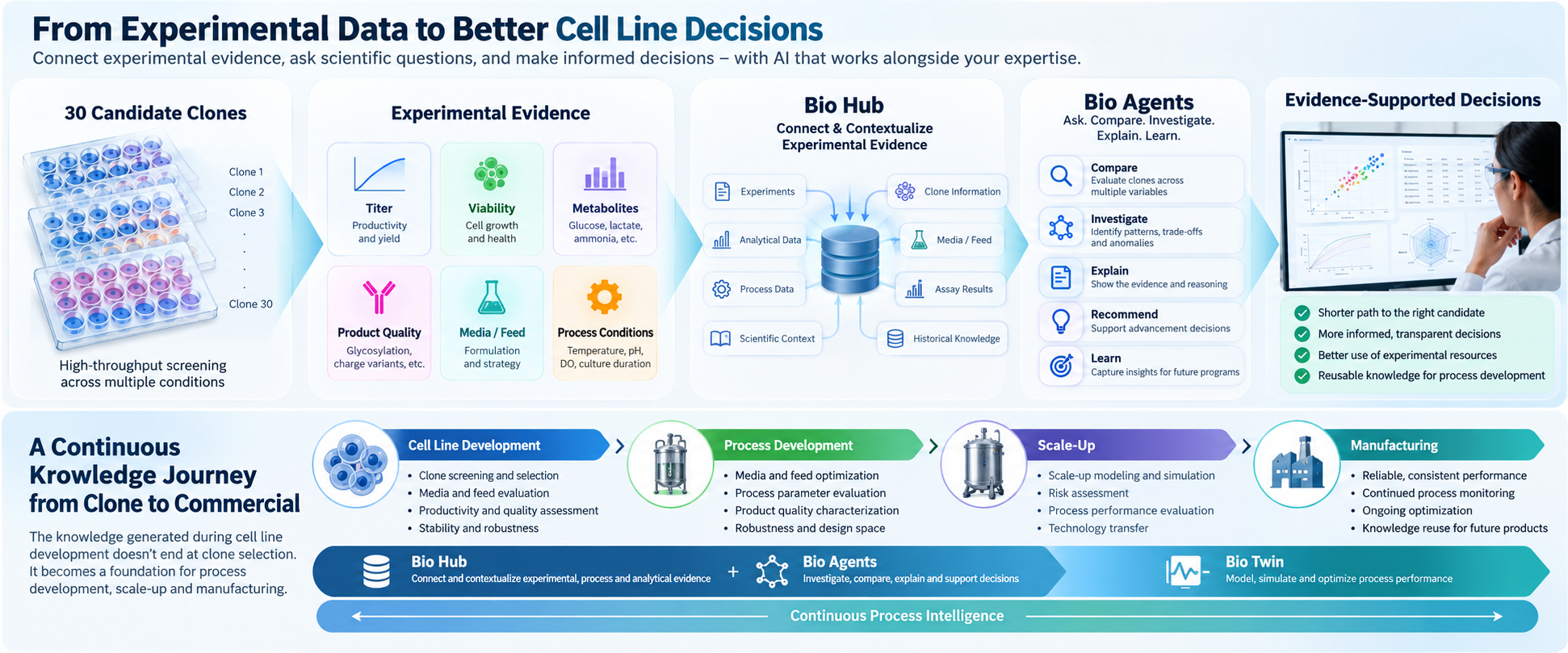
How is AI used in cell line development?
AI can support cell line development by connecting experimental data, comparing candidates across multiple variables, identifying patterns and anomalies, supporting clone-selection decisions, and preserving experimental knowledge for later process development. Rather than replacing scientific judgment, AI can help scientists evaluate more evidence and investigate relationships across experiments more efficiently.
Cell line development has changed dramatically.
High-throughput screening, automation, advanced analytics, improved expression systems and better characterization technologies allow development teams to evaluate more candidates and capture more information than ever before.
Yet an important challenge remains.
More data does not automatically mean better decisions.
Scientists still need to determine which clones deserve to advance, why one condition outperforms another, whether an observed result is meaningful or anomalous, and whether today's promising candidate will remain productive, stable and suitable as the process progresses.
The industry is increasingly focusing on this challenge. The 2026 BioProcess International Cell Line Development & Engineering program, for example, includes topics ranging from AI-enabled multivariate clone selection and automation to AI-driven prediction and data-enabled decision-making.
This points toward an important shift:
The next generation of cell line development will not be defined only by how many experiments we can run. It will be defined by how effectively we can learn from them.
Cell Line Development Is a Multivariable Decision Problem
For biologics, particularly monoclonal antibodies and other recombinant proteins, cell line selection is rarely about maximizing a single variable.
A promising candidate may need to demonstrate the right combination of:
- Productivity and titer
- Cell growth and viability
- Product quality attributes
- Metabolic behavior
- Stability
- Process robustness
- Media and feed response
- Manufacturability
Bring Us One Process Challenge
Have a cell line development or bioprocess challenge where experimental evidence exists but the answer is difficult to see?
Bring us one process challenge. We'll show you how BioMedAna would approach it.
CHO cells remain the dominant mammalian production platform for recombinant biologics, while continued advances in cell engineering, screening and expression technologies are aimed at improving productivity and consistency and reducing development timelines.
That creates a multidimensional decision.
The highest-producing clone at one point in time is not necessarily the best development candidate.
A slightly lower-producing clone with greater stability, more favorable product quality, better metabolic characteristics or greater robustness across operating conditions may ultimately be the stronger choice.
And the evidence needed to make that decision may exist across different systems, experiments and formats.
That is where the opportunity for AI becomes much more interesting.
The AI Opportunity Is Bigger Than Prediction
When people discuss AI in cell line development, the conversation often jumps immediately to predictive models:
Can AI predict the best clone?
It is an important question—but a narrow one.
Before prediction can create meaningful value, development teams need something more fundamental:
connected, contextualized and accessible experimental knowledge.
Imagine a scientist investigating why several clones behaved differently during screening.
Relevant evidence might include clone characteristics, culture conditions, media and feed strategies, growth curves, viability, metabolites, titer, product-quality measurements, analytical results, experiment notes and previous development knowledge.
The problem isn't necessarily that this information doesn't exist.
The problem is that the scientific context connecting it often does not exist in a form that can be easily interrogated.
An AI-native approach can begin by bringing that evidence together.
From Experimental Data to Experimental Intelligence
Consider an illustrative cell line development program.
A development team is evaluating 30 candidate clones across multiple media and feed conditions.
Each experiment generates measurements around:
- Cell growth
- Viability
- Titer
- Glucose and lactate behavior
- Ammonia
- Culture duration
- Product quality attributes
- Media and feed conditions
- Process parameters
Traditional analysis can certainly rank candidates by individual metrics.
But the scientist's actual questions are more sophisticated:
- Which clones perform consistently across conditions?
- Which candidates provide the best balance between productivity and quality?
- Are there common characteristics among the strongest performers?
- Which unusual results deserve investigation rather than exclusion?
- What happened in previous experiments under similar conditions?
- Which candidates should we carry forward—and what evidence supports that decision?
This is where a combination of connected data and intelligent agents can change the workflow.
Step 1: Connect the evidence
Bio Hub brings experimental and process information together while preserving scientific context.
Rather than treating a titer result, metabolite profile or assay measurement as an isolated data point, the information can remain connected to the clone, experiment, condition, media/feed strategy, analytical result and associated process history.
The objective is not another repository.
It is a connected evidence layer that allows scientists and AI systems to understand relationships across experiments.
Step 2: Ask scientific questions
Once evidence is contextualized, Bio Agents can help scientists interact with it using the questions they actually ask.
For example:
- Compare the top-performing clones across titer, viability and product quality.
- Identify clones that maintained strong productivity across multiple media conditions.
- Show experiments with similar lactate behavior and compare their outcomes.
- Which candidates demonstrate the strongest overall evidence for advancement, and what factors support that assessment?
Instead of manually finding, joining and interpreting information from multiple sources before analysis can begin, the scientist can start closer to the scientific question.
Step 3: Investigate, not just rank
The value becomes greater when AI helps scientists investigate relationships.
Suppose Clone 17 has one of the highest titers but exhibits an unfavorable quality trend under one feed condition.
Clone 24 produces slightly less protein but demonstrates more consistent viability, quality and metabolic behavior across multiple conditions.
A simple ranking might favor Clone 17.
A multivariable scientific assessment may lead to a different conclusion.
An intelligent system should therefore do more than return:
Clone 17 = #1.
It should help expose the evidence:
- Why did Clone 17 rank highly?
- Where does Clone 24 outperform it?
- Which variables drove the difference?
- How consistent are those relationships across experiments?
- What additional experiment would reduce uncertainty most effectively?
That last question is especially important.
The objective of AI should not simply be to produce an answer.
It should help scientists decide what they need to learn next.
AI Should Support Scientific Judgment, Not Hide It
For scientific applications, an unexplained recommendation has limited value.
If an AI system recommends advancing three clones, scientists should be able to interrogate the reasoning and underlying evidence.
That means preserving traceability between:
Question → Analysis → Evidence → Recommendation
This distinction matters.
AI in cell line development should not be positioned as an autonomous replacement for scientific expertise.
Its role is to help experts evaluate more evidence, identify relationships faster, challenge assumptions and make decisions with greater context.
The scientist remains responsible for interpreting the biology.
AI expands the amount of evidence the scientist can practically consider.
The Bigger Opportunity: Making Every Experiment Reusable
There is another consequence that may ultimately be even more valuable.
Cell line development generates knowledge that should influence later decisions.
But organizations often lose some of that context as programs move from one development stage to another.
- Why was a particular clone selected?
- Which alternatives were considered?
- Which media conditions produced unexpected behavior?
- Which metabolic patterns appeared during screening?
- Which trade-offs were accepted?
- Which experiments changed the team's understanding of the process?
These aren't merely historical details.
They become prior knowledge.
If that knowledge remains connected and accessible, subsequent teams don't have to rediscover it.
This changes the role of the experimental record.
Instead of documenting only what happened, it begins capturing what the organization learned.
From Cell Line Selection to Process Development
This is where the cell line story connects to the broader bioprocess lifecycle.
Selecting the candidate is not the end of the learning process.
The selected cell line moves into process development.
Media and feed strategies evolve.
Operating conditions are optimized.
Scale changes.
New process and analytical evidence becomes available.
Questions shift from:
Which clone should we advance?
to:
Under what conditions does this cell line perform best?
and eventually:
How will this process behave as we move toward manufacturing scale?
At this stage, connected experimental knowledge can begin feeding a Bio Twin.
BioMedAna's hybrid approach combines:
Physics + Biology + Process Data + AI/ML + Domain Knowledge
The objective is to progressively build an understanding of process behavior that can support simulation, optimization, scale-up and risk assessment.
The intelligence created during cell line development therefore doesn't need to disappear when cell line development ends.
It can become part of a continuous digital knowledge thread from early development toward manufacturing.
A Different Model for Bioprocess Intelligence
This leads to a broader architecture for AI-enabled bioprocess development.
- Bio Hub Connects and contextualizes experimental, process and analytical evidence.
- Bio Agents Help scientists interrogate evidence, investigate relationships, compare experiments and support decisions.
- Bio Twin Extends the intelligence toward modeling, simulation, optimization and scale-up.
- Bio OS Provides the governance, orchestration, security and auditability around the platform.
The objective isn't to replace the tools scientists already use.
It is to create an intelligence layer across them.
Because the real challenge in bioprocess development isn't simply collecting more information.
It is turning information into reusable scientific knowledge.
From More Experiments to Better Experiments
For years, an important goal in cell line development has been increasing throughput.
Run more candidates.
Generate more measurements.
Screen faster.
Those capabilities remain important.
But AI creates the possibility of asking a different question:
What if success were measured not by how many experiments we could run, but by how much we could learn from every experiment?
That shift has practical implications.
Better use of existing evidence can help teams identify stronger candidates earlier, focus experimental resources on the questions with the greatest uncertainty, investigate anomalies faster and carry development knowledge forward instead of repeatedly reconstructing it.
The future of cell line development may therefore be less about AI choosing the winning clone and more about something substantially more useful:
Giving scientists a continuously improving understanding of why a process behaves the way it does—and what they should learn next.
How does BioMedAna support cell line development?
BioMedAna supports cell line development through Bio Hub and Bio Agents. Bio Hub connects and contextualizes experimental, process and analytical evidence, while Bio Agents help scientists compare experiments, investigate relationships, identify anomalies and interrogate evidence using scientific questions. As a selected cell line moves into process development and scale-up, Bio Twin can extend this knowledge into modeling, simulation and process optimization. Bio OS provides governance, orchestration, security and auditability across the platform.
BioMedAna is an AI-native bioprocess intelligence platform connecting Bio Hub, Bio Agents and Bio Twin under the governance and orchestration of Bio OS.
Frequently asked questions
What is AI in cell line development?
AI in cell line development uses machine learning, advanced analytics, and intelligent agents to help scientists analyze experimental data and make better-supported development decisions. It can connect information across clone characteristics, growth, viability, productivity, metabolites, product quality, media, feed, and process conditions to identify patterns that may be difficult to evaluate manually. AI can support experiment comparison, anomaly investigation, multivariable analysis, and knowledge reuse, helping scientists learn more from each experiment while retaining scientific oversight of decisions.
How can AI help with clone selection?
AI can help with clone selection by evaluating candidates across multiple attributes rather than ranking clones on a single measure such as titer. It can compare productivity, viability, metabolic behavior, product quality, stability, media and feed response, and other relevant characteristics across experiments. AI can also identify trade-offs, patterns, anomalies, and consistency across conditions. This gives scientists a more complete evidence base for deciding which candidates should advance while allowing them to examine the data and reasoning supporting a recommendation.
What data can be used for AI-enabled cell line development?
AI-enabled cell line development can use experimental, biological, process, and analytical data generated throughout clone screening and characterization. Examples include cell growth and viability, titer and productivity, glucose, lactate and ammonia profiles, product quality attributes, media and feed conditions, culture duration, process parameters, assay results, clone characteristics, stability data, and experimental observations. Historical experiments and scientific knowledge can also provide valuable context. Connecting these sources allows AI to analyze relationships across experiments rather than treating individual measurements in isolation.
Can AI replace scientists in cell line development?
AI is better suited to augmenting scientific expertise than replacing scientists in cell line development. It can rapidly analyze large amounts of experimental evidence, compare candidates, identify patterns and anomalies, and help scientists investigate potential relationships. However, interpreting biological significance, evaluating uncertainty, determining appropriate experiments, and making development decisions still require scientific expertise. The most useful approach combines AI's ability to analyze and connect evidence with scientists' understanding of biology, process development, product quality, and the broader objectives of the development program.
How can cell line development data support process development and scale-up?
Cell line development data can provide valuable prior knowledge as a selected candidate moves into process development and scale-up. Information about growth, viability, metabolism, productivity, product quality, media and feed response, stability, and process sensitivity can help teams understand how the cell line behaves under different conditions. When this knowledge remains connected to subsequent process data, it can support media and feed optimization, process characterization, risk assessment, modeling, and scale-up decisions—creating a continuous knowledge thread from clone selection toward manufacturing.
BRING US ONE PROCESS CHALLENGE
See how BioMedAna would approach it.
Explore your process evidence, scientific context and decision needs with our bioprocess intelligence team.