INDUSTRY INSIGHTS · Protein engineering & experimental design
Which protein variants should earn the next assay batch?
The November 8 TALK preprint asks which accessible protein variants improve prediction on a different target set. BioMedAna examines the experiment a founder should fund next.
TALK preprint submitted:
A November preprint changes the batch selection question
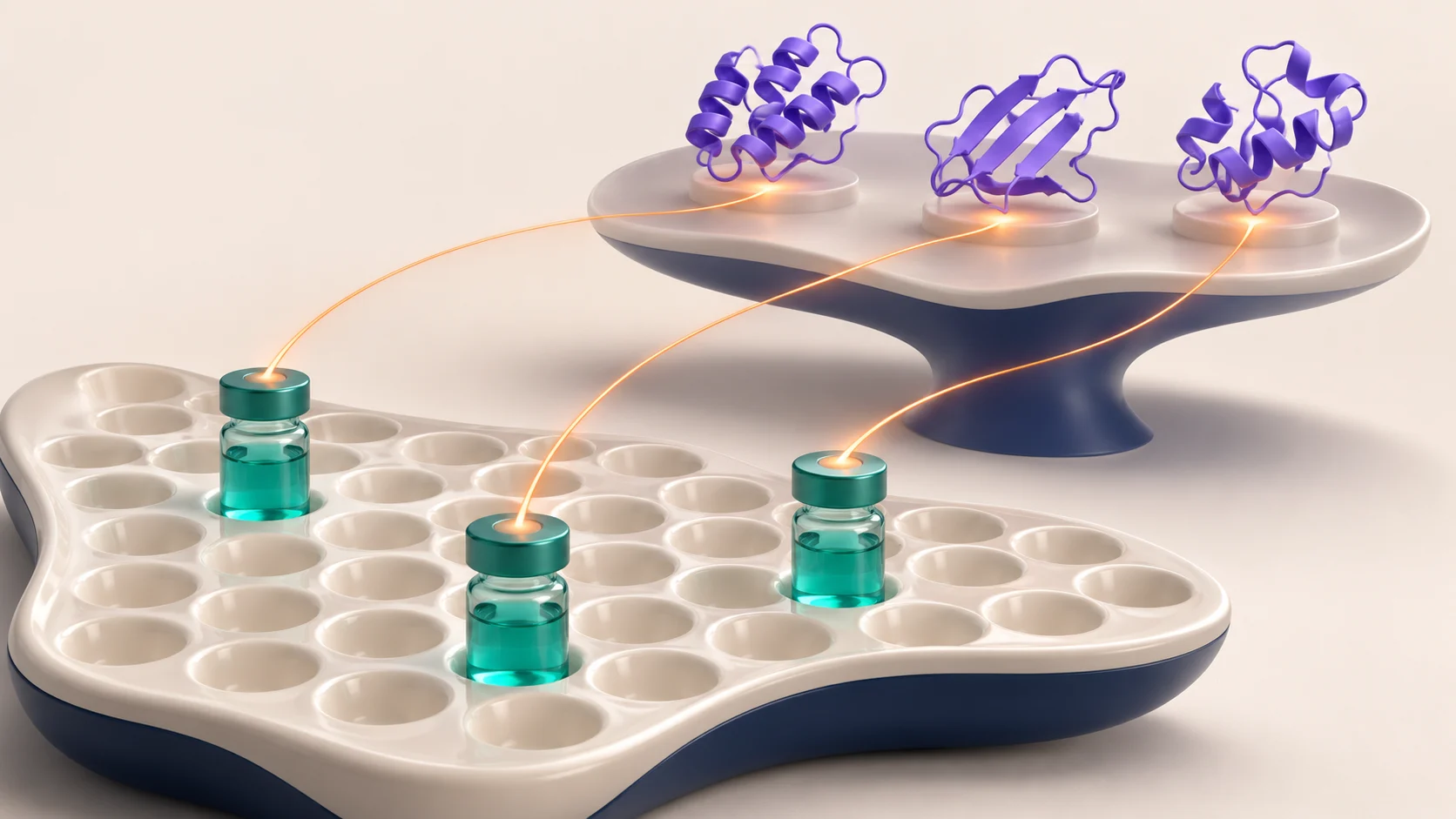
On November 8, 2026, Qiao Huang and colleagues submitted TALK, a method for selecting a single batch of protein variants to measure. The method distinguishes variants accessible to the experiment from variants for which the team ultimately wants better predictions. Its selection rule uses the modelled relationship between those sets and accounts for redundancy within the chosen batch.
The authors evaluate the method retrospectively using ProteinGym and FLIP protocols. They report improvements in prediction on their specified target sets under limited measurement budgets. The preprint describes a computational evaluation using existing assay data. It provides a reason to test the approach prospectively, while leaving open how a newly designed batch would behave in a particular biologics programme.
The paper links an accompanying code repository. That makes the implementation available for scrutiny, but comes from the same research team. We did not find an independent replication. The founder question we take from this work is about how to spend the next batch when the variants that are easiest to assay are different from the variants the programme needs to understand.
The target list is a scientific commitment
A team might have measurements for individual substitutions and want to predict combinations. The laboratory can obtain more single-substitution measurements reliably, while combination constructs need more effort. A method for allocating those affordable measurements needs to know which combinations matter. Otherwise it can improve a prediction metric over a broad landscape while leaving the programme’s important region poorly understood.
For a founder, this makes the target list part of the experimental brief. Which sequences belong on it? What property is being predicted? Which assay conditions define that property? Who can change the list after results arrive? A revised target list can be a sensible response to new biology, but it changes the question used to judge the batch.
We would preserve that list alongside the accessible set and their eligibility rules. A scientist reviewing the next round should be able to distinguish a changed design objective from evidence that the selection method worked. Natural-language protein design already raises the question of who owns the brief. Batch selection adds the need to retain what the model was being asked to learn about.
Before approving the batch, name the variants whose prediction needs to improve.THE BIOMEDANA LENS
A hypothetical fusion-protein programme with one batch left
Imagine a team engineering a therapeutic fusion protein. It can measure a panel of individual substitutions using an established assay, but its candidate shortlist contains combinations of substitutions. The team has funding for one more measurement batch before it chooses a smaller set of combination constructs for confirmation. This is a proposed scenario, and the TALK paper does not report this programme.
The scientist first records the combination sequences of interest and the assay property the model must predict. The laboratory then supplies the eligible individual substitutions and identifies those it can measure under comparable conditions. Some measurements may be expensive because they need a different preparation or assay run. That cost needs to be visible before the team calls two candidate batches equivalent.
One possible batch chases the strongest predicted individual variants. Another covers a broader set of changes that the model expects to teach it about the combination panel. A third is a simple random selection from the eligible pool. We would compare the approaches at the same budget, then evaluate prediction on combination measurements reserved from the selection process. Those held-out results answer whether the extra measurements helped the intended decision.
The scientist still needs parent controls and a way to identify uninterpretable assay results. The method selects variants for learning, while the laboratory determines whether each observation can support the planned comparison. If a measurement fails because material was unsuitable, recording only a low score can teach the model the wrong lesson.
The coupling assumption deserves a challenge
The difficult assumption is that the model’s relationship between accessible and target variants is informative enough to guide selection. If the representation makes two regions appear connected when their measured behaviour differs, the selected batch can be confidently misplaced. A model that is uncertain about an accessible sequence does not automatically know whether measuring that sequence will help elsewhere.
We would start by asking where the prediction task moves beyond the evidence already available. Does the target introduce combinations, new positions, different expression conditions or a changed measurement? Each move can alter the relevance of the data. The team should state which changes the pilot covers and which require another comparison.
A useful failure review follows the proposed batch through to the target predictions. If accuracy improves overall but the important combination family remains poorly ranked, retain both observations. The method may be suitable for a narrower use or need more information about that family. More candidate generation will not settle that question. The comparison needs measurements that can challenge the assumed relationship.
Keep selection and confirmation budgets visible
The next practical tradeoff is how much capacity to spend learning a landscape before pursuing a leading candidate. A small company may gain from a better predictor, but it also has a milestone that requires confirmation of molecular behaviour. Put those uses of assay capacity on the same planning sheet. It should be clear which slots test the model and which slots test a molecule.
We would compare the proposed allocation against a baseline the scientists already understand. Retain the same starting data and experimental capacity, and record what the selected batch causes the team to defer. A prediction improvement is more persuasive when it changes a programme decision that the team agreed mattered before the results were available.
The connected experimental record should include the selected sequence, reason for selection, actual material, conditions, measurement and processing version. A bioprocess data readiness review can expose missing identifiers or inconsistent units before they appear as an apparent selection failure. That is also where the team can record exceptions that affect comparability.
What we would pass on to another builder
Build the first interface around an actual batch review. Put the accessible set, target set and assay budget beside each other, then let the scientist inspect why a proposed measurement matters. The scientist should be able to identify duplicated information, unavailable constructs and conditions that make the proposed comparison impractical. A batch that cannot be executed as described is an incomplete recommendation.
Capture the decision to accept or revise the batch before the experiment starts. Later, compare what the model expected to learn with what the measurements allowed the team to conclude. A changed ranking, an unresolved family of variants and a failed assay all call for different next actions. Make those outcomes legible to the scientist deciding where the remaining budget goes.
For BioMedAna, the interesting product opportunity is to connect a learning objective to the experimental work and reviewed result. AI agents in scientific workflows can assemble the supporting context, while the scientific owner approves the tradeoff. The first pilot succeeds when the team can explain why it funded that batch and what evidence would make it choose differently next time.
A worked batch-allocation review
For the hypothetical fusion-protein programme, the review connects the affordable experiment to the prediction the team needs for its next decision.
| Review question | Evidence to retain | Decision in the example |
|---|---|---|
| What needs better prediction? | Fixed combination panel and assay property | Agree on the target before selecting single substitutions. |
| What can the lab measure? | Eligible constructs, assay conditions and costs | Remove variants that require an incomparable measurement. |
| What does each slot teach? | Selection rationale and redundancy review | Compare the learning batch against the current and random baselines. |
| Did learning transfer? | Held-out combination measurements | Hold advancement if the important family remains poorly predicted. |
The questions behind the headline
Does TALK demonstrate a new therapeutic protein?
The study reports retrospective prediction experiments. A biologics team would need prospective measurements to judge whether the batch helps its programme.
Why keep the target list fixed?
It lets the team judge the proposed batch against the question that justified spending the assay budget. If the target changes, record the change and review the comparison.
Can model uncertainty replace controls?
The experiment still needs evidence that the observations are interpretable. Model uncertainty and experimental controls answer different review questions.
Follow the evidence
- Huang et al. — TALK, arXiv preprint submitted November 8, 2026 ↗
- Authors’ TALK repository and reproducibility materials ↗
Original BioMedAna editorial analysis. The linked sources support the reported developments; examples, frameworks and product implications reflect our perspective.
Explore the underlying concepts
CONTINUE READING
More from the BioMedAna lens.
 Proteomics & experimental automation
Industrial proteomics needs a study design that can survive scale
Read perspective ↗ Antibody manufacturing & downstream processing
A clearer antibody harvest is only the first test
Read perspective ↗ Scientific AI & antibody engineering