INDUSTRY INSIGHTS · Proteomics & experimental automation
Industrial proteomics needs a study design that can survive scale
Biognosys launched Industrialized Discovery on November 10. BioMedAna examines pilot design, batch context and the evidence a founder needs before scaling proteomics.
Biognosys service launch announced:
The launch changes the scale question
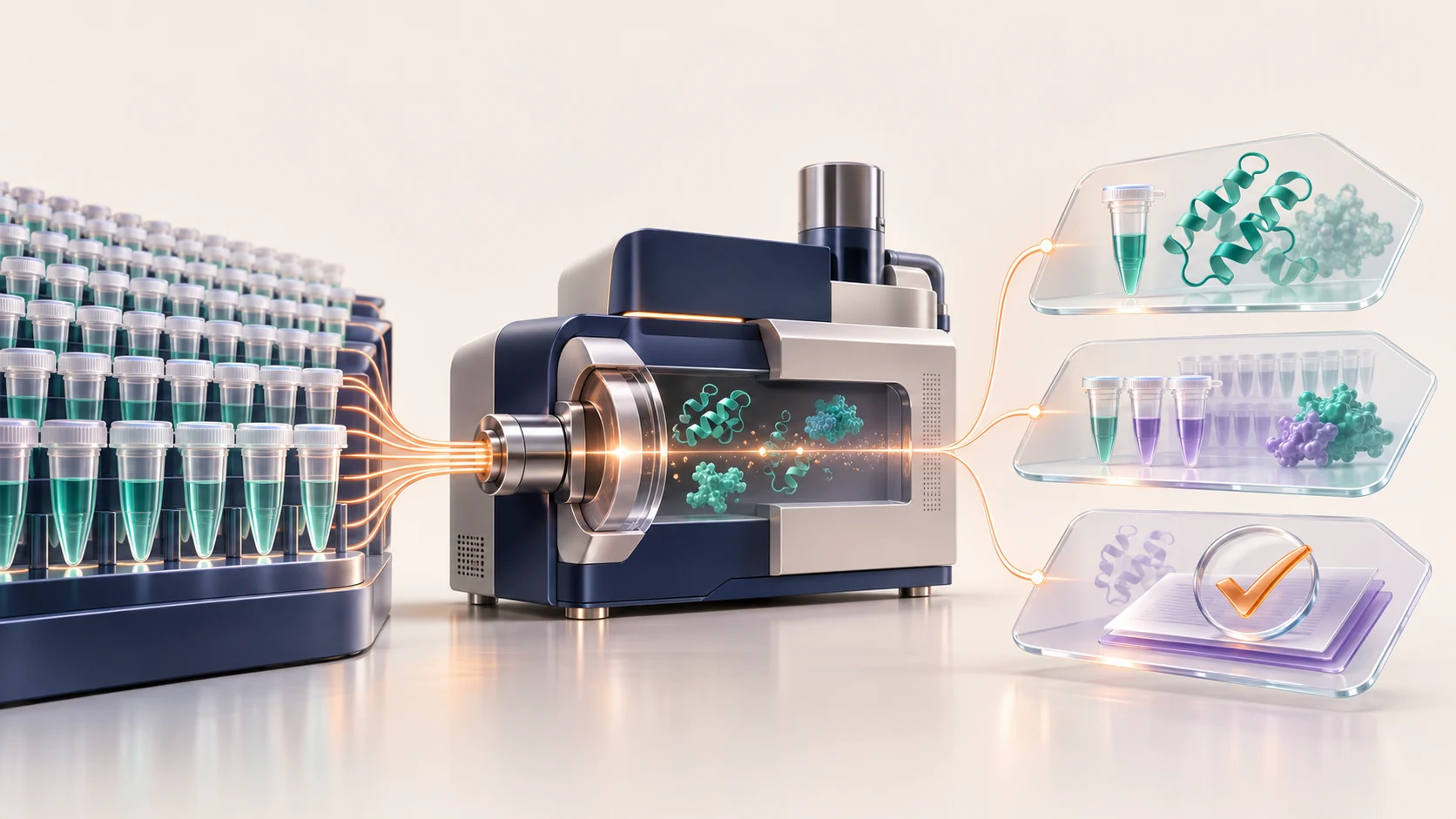
On November 10, Biognosys Group announced Industrialized Discovery, combining sample preparation, mass spectrometry and automated analysis as a scalable proteomics offering. Its published performance examples are company-reported. The announcement makes a timely operational question concrete: what must a small biologics team settle before buying a much larger measurement campaign?
Biognosys describes an integrated workflow using PreOmics preparation, Bruker timsTOF instruments and automated Spectronaut analysis with OmicsFlow. The company reports more than 10,000 protein identifications from 50,000 HEK-293 cells, alongside turnaround targets below three weeks for 100 samples and ten weeks for 1,000. These figures describe the company's offering and example conditions. They do not establish equivalent performance across sample matrices, complete quantification of every protein or suitability for a release assay. The release does not provide a programme-specific price that a founder can use as a universal cost assumption.
The commercial launch is the news hook. It is not evidence that every programme can reproduce the headline depth, price or timing. Novalix's event page corroborates participation in the launch and a planned case study, but does not provide an independent comparison. Our interpretation focuses on study design and the evidence a founder should require before expanding a pilot.
More rows can make the wrong comparison more convincing
Our view is that capacity creates a design obligation. A founder should be able to explain which decision the study supports before approving the sample count. Is the team comparing target biology, looking for a response marker or checking a mechanistic hypothesis? Those objectives can need different samples and confirmation work. An attractive throughput estimate does not choose among them.
Imagine that every responsive model is measured in one analytical batch and every nonresponsive model in another. If the batches differ, a later analysis has to disentangle that difference from the biology. More samples within the same arrangement do not supply the missing comparison. This is a hypothetical design risk, not a finding about the Biognosys workflow or any customer's data.
We would therefore take a proposed sample sheet into the investment discussion. Put biological groups, preparation dates, run allocation and controls beside each other. Ask whether a reviewer could still interpret the comparison if one batch needed repeating. Data readiness begins before the first file arrives.
Buy a comparison that can change a decision, not simply a larger matrix.THE BIOMEDANA LENS
A hypothetical antibody target programme
Consider a team deciding which surface target deserves the next antibody experiment. It has a small panel of biological models, existing response observations and budget for a larger proteomics study. The intended decision is to narrow the target shortlist for follow-up, not to declare clinical efficacy or manufacturing readiness.
The team first records the model identity, material preparation and treatment context for each proposed sample. It distinguishes a whole-cell measurement from a surface-enriched preparation. We would not treat these as interchangeable labels for target accessibility. The experiment should say what each measurement is meant to contribute and which uncertainty requires another assay.
For context, Champions Oncology describes matched molecular and response layers in its dataset and makes clear that coverage differs across layers. That is useful supporting context for asking which observations actually share a biological origin. Its dataset description does not independently verify the performance of the newly launched service. In our hypothetical programme, the sponsor would need its own record of those relationships instead of assuming every row has the same set of measurements.
Next, the scientist chooses a pilot that represents the important sample types and includes repeated material across the planned workflow. The review asks whether the measurements needed for the shortlist are sufficiently interpretable across that pilot. A large number of identifications elsewhere is useful context, but it cannot stand in for evidence on the target comparisons that will drive spending.
The team also reserves material and funding for confirmation. If the discovery profile proposes a candidate, a separate experiment must challenge the proposed interpretation. Otherwise the larger profiling campaign can consume the resources needed to learn whether its most interesting result matters. This is a proposed planning approach, not a claim that a particular number of samples or controls is universally sufficient.
Keep absence, exclusion and uncertainty separate
A useful delivery should make it possible to ask why an entry is unavailable. Was the material never measured? Did a sample fail an agreed quality check? Was the feature outside the reporting criteria? A blank cell without that distinction leaves the next scientist guessing. We would request the supplier's definitions rather than invent meanings after inspecting the matrix.
Before analysis, agree how exclusions will be reviewed and recorded. A team should be able to connect the delivered table to its sample inventory and understand which observations were omitted. Changes to processing should create a traceable version, with a reason for the change and a way to compare affected outputs.
These records also matter if the dataset later trains a model. The modelling owner needs to know whether a split tests new biology or largely repeats material and conditions already represented in training. We would define the intended generalisation test before choosing the split, then retain the relationship between samples. Calling the data AI-ready cannot resolve that scientific choice.
Make scale conditional on the pilot decision
We would negotiate a staged commitment. The first stage tests whether the proposed workflow produces a usable answer for the programme's sample types. The next stage expands only after a scientific review of the predefined questions. The supplier and sponsor should agree what happens when material is unsuitable, a run needs repeating or delivery requires a revised analysis.
There is a real tradeoff here. A tightly bounded pilot may leave some of the platform's breadth unexplored. A large initial campaign can expose broader patterns but commits money before the team understands the practical failure modes. The appropriate choice depends on the decision, available material and consequences of delay. The founder should see those costs alongside the quoted analytical price.
Set acceptance criteria around the comparison being purchased. Ask what evidence will make the team expand, revise or stop the study. Avoid changing those rules simply because the first delivery looks impressive. If the pilot changes the scientific question, record that change and review the new design before extending the order.
Advice for another builder
Build the review interface around the sample-to-decision relationship. A reviewer should be able to move from a proposed target to the relevant observations, material identities, processing version and unresolved limitations. A plot alone is rarely enough to explain why the next experiment should be funded.
Start with one decision meeting and watch where the scientist has to leave the system to reconstruct context. Fix that missing connection before adding another dashboard. A source file, an exclusion note and a reviewed interpretation have different roles; preserving those roles helps the next team question the conclusion without rebuilding the study.
For BioMedAna, the opportunity is to connect scalable experimentation to accountable scientific choices. The launch suggests that buying measurement capacity may become easier. The founder's remaining job is to buy a comparison that can change a decision, preserve what makes it interpretable and fund the experiment that could prove the interpretation wrong.
A worked proteomics pilot review
For the hypothetical antibody-target programme, make expansion conditional on the comparison the team needs. These are proposed decisions, not reported customer outcomes.
| Pilot question | Evidence to retain | Proposed disposition |
|---|---|---|
| What decision changes? | Target shortlist and planned follow-up | Fund profiling only when its role is explicit. |
| Are groups separated from batch allocation? | Sample sheet, run plan, repeated material | Revise a design that cannot distinguish them. |
| Can missing entries be interpreted? | Quality flags, exclusions, reporting definitions | Resolve ambiguous absence before modelling. |
| Does the pilot support this material? | Sample-specific outputs and reviewed exceptions | Expand conditionally, revise or stop. |
| Can the interpretation be challenged? | Retained material and confirmation budget | Reserve the next experiment before scaling. |
The questions behind the headline
Does the launch establish performance in every biologics sample?
No. Its specific performance examples are company-reported and should not be generalised beyond their conditions. The collaborator event page does not independently validate them.
Is this a release-testing recommendation?
No. This perspective concerns discovery study planning. Suitability for another intended use requires its own assessment.
What should a founder request first?
A programme-specific pilot proposal linking sample allocation, reporting criteria, exceptions and a reviewed expansion decision.
Follow the evidence
- Biognosys — Industrialized Discovery launch, November 10, 2026 ↗
- Novalix — November 12 launch participation; commercial collaborator, not independent validation ↗
- Champions Oncology — matched multi-omic dataset and coverage context ↗
Original BioMedAna editorial analysis. The linked sources support the reported developments; examples, frameworks and product implications reflect our perspective.
Explore the underlying concepts
CONTINUE READING
More from the BioMedAna lens.
 Protein engineering & experimental design
Which protein variants should earn the next assay batch?
Read perspective ↗ Antibody manufacturing & downstream processing
A clearer antibody harvest is only the first test
Read perspective ↗ Scientific AI & antibody engineering