INDUSTRY INSIGHTS · Antibody manufacturing & downstream processing
A clearer antibody harvest is only the first test
A November 2026 study reports early removal of host-cell impurities. BioMedAna explores how to test whether flocculation improves the whole antibody purification train.
Biotechnology Progress study published online:
What the November study found
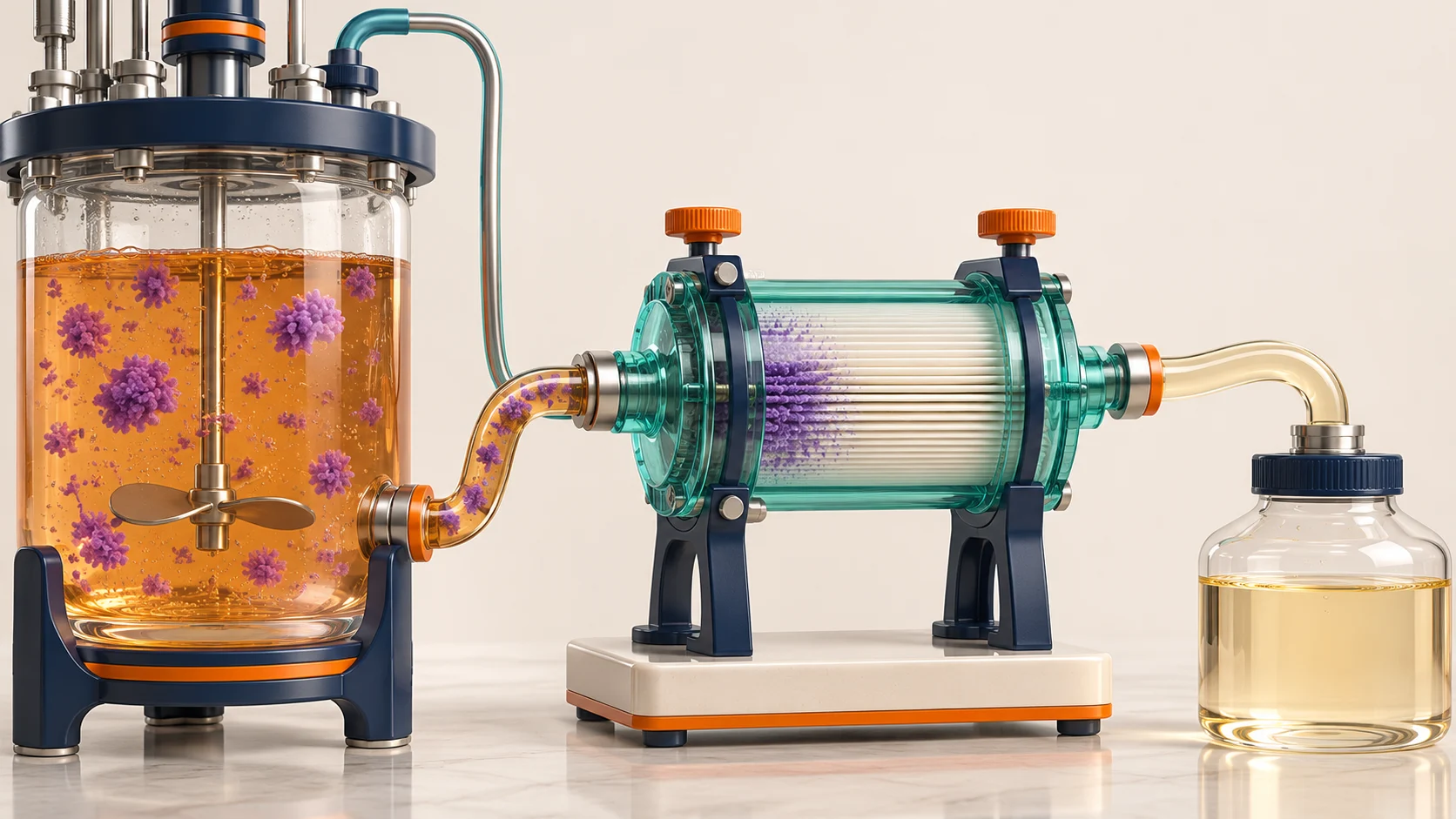
On November 2, 2026, Biotechnology Progress published a study by Anna-Carina Frank and colleagues on using cationic polymers during primary recovery of monoclonal antibodies. The researchers screened five flocculants with two antibodies, then compared the selected candidate, called Polymer X, with a commercial comparator across four antibodies. The work asks whether clarification can take some of the impurity burden out of the liquid before later purification steps begin.
The authors report more than 99% host-cell DNA reduction with Polymer X, antibody recovery above 95% for three of four antibodies, and reductions above 90% for selected high-risk host-cell proteins. These are results in the tested systems. The fourth molecule matters to a founder evaluating transfer: the recovery threshold was achieved in three cases. The study proposes that early removal could help simplify downstream purification. It does not demonstrate that a specific production polishing step can be retired.
BOKU’s project description frames flocculation as a way to collect cells and additional impurities during recovery. That provides context for why the experiment tracks molecular impurities alongside clarification. The project description comes from a participating institution and is not a separate replication.
The decision belongs at the capture inlet
The easiest thing to put on a slide is a photograph of clearer harvest. The decision a downstream scientist needs to make is whether the new feed is better for the next operation. Turbidity tells the scientist something about the suspension and helps compare solids removal. It gives no direct measurement of a specific soluble host-cell protein, antibody mass recovered, or the amount of added polymer reaching capture.
In a development review we would ask for mass as well as concentration. A lower antibody concentration after a treatment can reflect dilution, product loss, or both. Measure the total recovered volume and apply the assay to a representative sample. Compare mass recovered against the starting split. If some antibody is missing, investigate where it went before crediting the new harvest with a purification improvement.
This is a useful extension to bioprocess data contextualization. Keep the sample, the exact split, the recipe version and the process step attached to the observation. The capture team should be able to reconstruct which feed it received without reading a separate experimental notebook.
A clearer harvest earns a closer look. The feed delivered to capture earns the decision.THE BIOMEDANA LENS
A hypothetical split-harvest pilot
Imagine a process development group that has a reliable harvest procedure but sees variation in host-cell protein load at capture. The group wants to test an added flocculation step. It takes a single representative harvest, divides it into matched arms, runs the current clarification process on one arm and the proposed process on the other, and holds the comparison conditions as close as practical. The aim is to isolate the effect of the proposed treatment before exploring a wider recipe space.
The flocculated arm is clearer and shows a lower DNA concentration. Its recovered volume is also smaller. The team checks recovered antibody mass, evaluates the impurity load normalized to antibody, and looks at a targeted host-cell protein of concern if a suitable method is available. It also records dose, contact time, mixing and hold duration so a second scientist can reproduce the comparison. These are proposed pilot choices, not an account of the published experiment.
Now suppose the new feed improves filter throughput but produces a less predictable capture pressure profile. The process team has two observations that matter to different equipment owners. Preserve them as separate outcomes. Repeat the matched comparison with another representative harvest and investigate whether suspended material, added reagent or another feed difference could explain the change. Do not count the filtration gain as a net process improvement before understanding its consequence at capture.
Test the handoff before claiming a simpler process
A bench result can be real and still fail to transfer. A larger tank can give a different distribution of exposure during dosing. A pump or transfer line can change the solids arriving at the filter. Feed age and the condition of the incoming culture may also affect the comparison. Carry realistic challenge cases into the development plan, with the current process as a reference wherever practical.
The first milestone should be a stable handoff to capture with acceptable product recovery. Follow that with a separate decision about whether to change anything in polishing. The first decision asks if the harvest treatment is useful with the current downstream train. The second asks how the train performs with a change in its ability to clear impurities. Those decisions need different comparisons.
We would track residual polymer where relevant, using a method suited to the material and matrix. This makes an added processing aid visible in the same review as the impurities it helps remove. The next transfer packet can include the proposed operating range, how exceptions will be handled, and the evidence that still needs collecting. A digital thread for technology transfer is useful when the receiving site can tell which claims have been tested at its conditions.
What we would pass on to another builder
Build the comparison around a decision the harvest and capture teams share. For a first pilot, we would ask both teams to agree on the sample points, acceptable recovery and the conditions that would require further study before any promising result is in hand. An effective data readiness review should cover volumes, units, dilution factors and the identities of the samples that anchor each calculation.
Make the exceptions visible alongside the summary. A feed sample may be delayed, an assay may behave differently after the change in matrix, or one harvest may have a materially different starting load. Record the reason a comparison was held and the evidence that can reopen it. A software team can make that practical by keeping the raw observation, processed calculation and decision together while preserving their distinct roles.
The payoff is a review that still makes sense after the pilot scientist leaves the room. A receiving process engineer can see the evidence for the claimed improvement, which operations benefit, and where the conclusion stops. That is a better basis for spending another scale-up run than a slide of clean-looking vessels.
A decision table for the matched-harvest pilot
Apply the proposed checks to both arms before deciding whether the process is ready for the next experiment.
| Decision | Evidence | What to do in the example |
|---|---|---|
| Compare matched feeds | Common starting material and documented split volumes | Hold the comparison if different starting material makes the effect ambiguous. |
| Check recovery and impurity burden | Product mass and individual impurity results with assay context | Investigate a loss of recovered mass even when the filtrate looks clearer. |
| Challenge capture performance | Feed loading, pressure behavior and capture recovery | Repeat on a representative harvest before accepting the improvement. |
| Evaluate polishing separately | Impurity and product results across the whole train | Keep the existing polishing sequence in the first pilot. |
The questions behind the headline
Is clarity evidence of DNA clearance?
Use the turbidity result to assess clarification and a suitable DNA assay to assess DNA clearance. Each measurement supports a different claim.
Does the study justify dropping a polishing step?
It provides a reason to test a bounded process change. Any proposed simplification needs its own evidence across the downstream train.
Why normalize impurity by antibody?
It helps distinguish a cleaner product stream from a diluted stream or a treatment that removed valuable antibody with the impurity.
Follow the evidence
- Frank et al., Biotechnology Progress, November 2, 2026 ↗
- PubMed record and author abstract ↗
- BOKU University project background ↗
Original BioMedAna editorial analysis. The linked sources support the reported developments; examples, frameworks and product implications reflect our perspective.
Explore the underlying concepts
CONTINUE READING
More from the BioMedAna lens.
 Scientific AI & antibody engineering
An antibody design agent picked a winner. Should it go to the lab?
Read perspective ↗ Antibody engineering & lead decisions
Pythia designs antibodies that change receptor activity. What should a founder advance?
Read perspective ↗ Protein engineering & experimental specifications