BIOPROCESS INTELLIGENCE
Where Does AI Actually Create Value in Bioprocessing?
10 practical use cases from cell line development to commercial manufacturing—and a framework for deciding where to start.
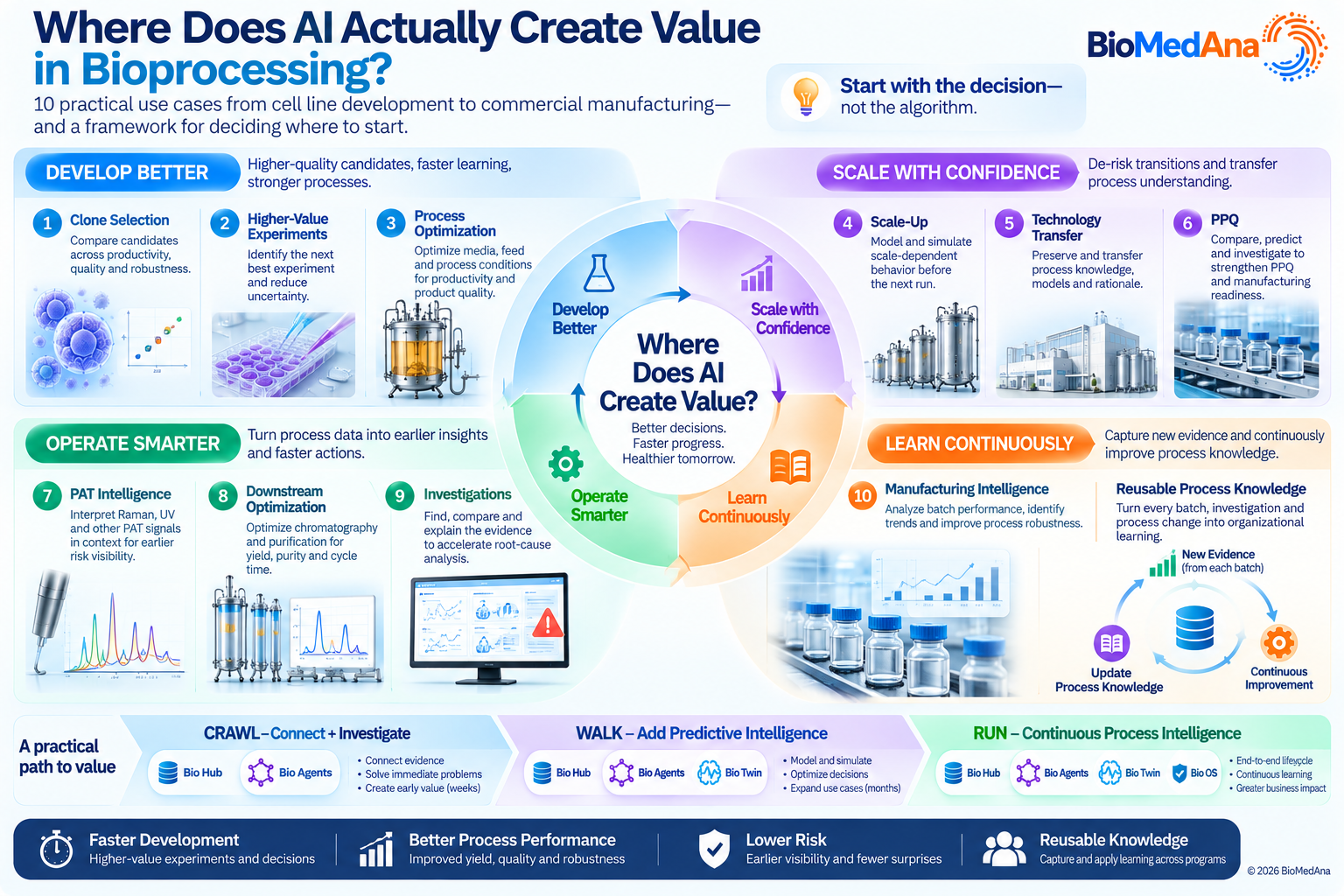
Where can AI create value in bioprocessing?
AI can create value across the bioprocess lifecycle by helping teams compare experimental evidence, optimize process conditions, design higher-value experiments, de-risk scale-up, optimize chromatography, interpret PAT data, accelerate investigations, preserve knowledge during technology transfer, support PPQ, and learn from manufacturing batches. The strongest opportunities typically combine an important decision, sufficient process evidence and the ability to act on the resulting insight. AI is most valuable when it improves a scientific or manufacturing decision rather than simply adding another analytical tool.
AI is becoming part of nearly every conversation about biopharmaceutical development and manufacturing.
But for bioprocess teams, the important question is no longer:
Can AI be applied here?
In many cases, it can.
The more useful question is:
Where can AI create enough scientific, operational or economic value to justify changing how we work?
That distinction matters.
A technically interesting model is not necessarily a valuable use case.
A chatbot connected to documents is not automatically process intelligence.
And a highly accurate prediction may have limited value if nobody can act on it.
The strongest AI opportunities tend to occur where three things come together:
An important decision + sufficient evidence + an opportunity to change the outcome.
That provides a practical framework for evaluating AI across the bioprocess lifecycle.
Start with the Decision, Not the Algorithm
Many AI initiatives begin backwards.
Teams ask:
Where can we use machine learning?
Or:
What can we do with generative AI?
A better starting point is:
Which decisions are expensive, slow, repetitive, uncertain or dependent on fragmented evidence?
Consider the difference.
Instead of:
Can we build a model of our cell culture process?
ask:
Can we identify process conditions that improve productivity without compromising product quality?
Instead of:
Can we build an AI agent for manufacturing?
ask:
Can we reduce the time scientists spend assembling evidence during an investigation?
Instead of:
Can we create a digital twin?
ask:
Can we evaluate scale-up scenarios before committing to an expensive large-scale run?
The technology comes second.
The decision and desired outcome come first.
1. Make Clone Selection More Evidence-Driven
Cell line development produces multidimensional evidence across candidate clones, media, feed conditions, growth, viability, productivity, metabolism and product quality.
The challenge is rarely identifying the clone with the highest titer.
It is selecting a candidate with the right overall combination of:
Productivity + Quality + Stability + Robustness + Manufacturability
AI can help teams compare candidates across many variables, identify patterns and trade-offs, and investigate why particular candidates perform differently.
Potential value: Better-supported candidate selection and more learning from every screening experiment.
This is where Bio Hub + Bio Agents can create value before a digital twin is even required.
2. Design Higher-Value Experiments
Bioprocess development is fundamentally experimental.
But not every experiment creates equal information.
Traditional DoE methods remain extremely valuable, but AI and process models can complement experimental design by helping scientists understand:
Where uncertainty is highest.
Which parameters appear most influential.
Which operating regions deserve additional exploration.
Which experiment could most reduce uncertainty.
Instead of asking:
What experiments can we run?
the question becomes:
Which experiment should we run next?
Potential value: Fewer low-information experiments and greater learning per experiment.
3. Optimize Media, Feed and Process Conditions
Upstream process development involves complex interactions among media composition, feed strategy, pH, temperature, dissolved oxygen, agitation, metabolites, growth, viability and productivity.
Optimizing these conditions manually becomes increasingly difficult as the number of variables grows.
AI and hybrid models can help teams evaluate multivariable relationships and explore potential operating conditions computationally.
Scientists can then focus experimental effort on the most promising regions.
Potential value: Faster process optimization and improved balance among productivity, quality and robustness.
4. De-Risk Scale-Up Before the Next Run
Scale-up is one of the most expensive points at which to discover that an assumption was wrong.
A process moving from:
2 L → 200 L → 2,000 L → 10,000 L
encounters changes in mixing, oxygen transfer, CO₂ removal, hydrodynamics and potentially biological behavior.
Hybrid digital twins can combine:
Physics + Biology + Process Data + AI/ML + SME Knowledge
to explore how those conditions may change across scales.
The objective is not to eliminate large-scale confirmation.
It is to arrive at that confirmation with stronger hypotheses.
Potential value: Earlier risk identification, fewer low-value scale-up iterations and better-supported scale transitions.
5. Optimize Chromatography and Downstream Processing
Downstream optimization involves its own complex trade-offs.
Changes in load conditions, pH, conductivity, flow, gradients and pooling boundaries can affect:
Recovery + Purity + Impurity Clearance + Product Quality + Cycle Time
AI and hybrid models can help teams analyze these relationships and compare potential operating scenarios.
PAT can add another layer by providing richer information about process behavior as purification occurs.
Potential value: Higher-value purification experiments, faster optimization and improved understanding of yield/purity trade-offs.
6. Turn PAT Signals into Earlier Process Intelligence
PAT generates signals.
Value comes from interpreting those signals in context.
Raman spectroscopy, UV, pressure, conductivity, pH and other measurements become more powerful when connected to historical process behavior, analytical outcomes and models.
AI can help teams identify patterns, detect deviations and investigate whether a changing signal is likely to matter.
That moves PAT from:
Measure
toward:
Measure → Interpret → Investigate → Decide
Potential value: Earlier visibility into changing process behavior and faster response to meaningful signals.
7. Accelerate Investigations and Root-Cause Analysis
This may be one of the most immediately practical AI opportunities.
When something unusual happens, scientists often spend substantial time simply assembling the evidence.
Process historian.
LIMS.
Batch records.
PAT.
Previous investigations.
Development reports.
Equipment information.
Analytical results.
AI agents operating over contextualized evidence can help answer:
When did the behavior begin?
What changed beforehand?
Which historical batches behaved similarly?
Which parameters differ most?
Have we investigated something similar before?
Potential value: Less time finding and assembling evidence, allowing SMEs to spend more time evaluating scientific hypotheses.
This is a particularly strong Bio Hub + Bio Agents use case.
8. Preserve Process Knowledge During Technology Transfer
Technology transfer often moves documents more effectively than it moves scientific reasoning.
The receiving team needs to understand not only:
What is the process?
but:
Why is the process designed this way?
AI can make connected development evidence interrogable.
Teams could trace:
Parameter → Experiment → Analysis → Decision → Rationale
while hybrid models can help evaluate receiving-site conditions.
Potential value: Faster knowledge transfer, earlier identification of transfer risks and less dependence on individual institutional memory.
9. Strengthen PPQ and Manufacturing Readiness
By PPQ, substantial process knowledge already exists.
Development evidence.
Characterization.
Scale-up learning.
Models.
Engineering runs.
Risk assessments.
AI can help connect that prior knowledge with emerging manufacturing evidence.
When a PPQ batch behaves unexpectedly, teams can immediately compare it with what was learned during development and transfer.
Potential value: Faster interpretation of PPQ behavior and stronger continuity between development and manufacturing.
10. Learn from Every Manufacturing Batch
Commercial manufacturing should not be the end of process learning.
Every batch provides new evidence.
AI can help compare current performance with historical behavior, identify emerging trends and preserve learning from investigations and process changes.
This creates a continuous loop:
Batch → Evidence → Investigation → Learning → Updated Process Knowledge → Next Batch
Over time, the organization's understanding of the process becomes richer.
Potential value: Earlier trend visibility, faster investigations and continuously reusable manufacturing knowledge.
Not Every AI Use Case Is Equally Valuable
This is where I would introduce a BioMedAna framework that we can reuse commercially.
Before selecting an AI use case, evaluate five questions.
1. Decision Value
How important is the decision?
Does it affect development time, experiment cost, batch success, yield, quality, capacity or manufacturing risk?
2. Evidence Availability
Do we have enough relevant historical, experimental, process or analytical evidence?
If not, can the required evidence realistically be generated?
3. Decision Frequency
How often is the decision made?
A modest improvement applied hundreds of times may create more value than a large improvement applied once.
4. Ability to Act
Can the organization actually do something differently based on the insight?
Prediction without action has limited value.
5. Time to Value
Can the use case demonstrate meaningful value in weeks or months rather than requiring a multi-year transformation?
Those five dimensions give organizations a much better way to prioritize AI than starting with technology.
Crawl → Walk → Run
Not every organization should begin with a digital twin.
And not every problem requires one.
A practical adoption path is:
CRAWL — Connect + Investigate
Bio Hub + Bio Agents
Connect evidence and solve immediate information problems.
Examples:
Batch comparison
Scientific Q&A
Experiment comparison
Investigation support
Knowledge retrieval
These can often create value without requiring predictive models.
WALK — Predict + Optimize
Bio Hub + Bio Agents + Bio Twin
Add modeling where prediction or simulation materially improves a decision.
Examples:
Process optimization
Scale-up
Chromatography optimization
PAT interpretation
Operating-window evaluation
RUN — Continuous Process Intelligence
Hub + Agents + Twin + OS
Connect development and manufacturing into a continuously learning system.
Examples:
Predictive operations
Cross-stage knowledge reuse
Manufacturing intelligence
Continuous process verification support
Advanced decision support
This sequencing is important.
Organizations do not need to solve everything before creating value.
Where Should You Start?
If I were turning this article into a practical executive recommendation, I would use a simple 2 × 2:
Horizontal axis:
Ease / Time to Value →
Vertical axis:
Scientific / Business Impact ↑
The upper-right quadrant becomes:
START HERE
Likely candidates include:
Investigation intelligence
Historical experiment comparison
Knowledge retrieval
Process optimization
Scale-up decision support
depending on the organization's available evidence and immediate priorities.
More sophisticated capabilities can follow once the connected evidence foundation exists.
The Architecture Should Expand with the Use Case
This is why BioMedAna is structured as a platform rather than a single AI application.
Bio Hub
Connect and contextualize the evidence.
Bio Agents
Investigate, compare, explain and support decisions.
Bio Twin
Model, simulate, predict and optimize.
Bio OS
Govern, orchestrate, secure and audit the intelligence.
A team can begin with Hub and Agents.
Add Twin when the decision requires simulation or prediction.
And use OS across the architecture to provide governance and orchestration.
The objective isn't to deploy every capability on day one.
It is to deploy the minimum intelligence required to materially improve a valuable decision.
The Best AI Use Case Is Not Necessarily the Most Sophisticated
This may be the most important lesson.
An advanced digital twin that takes months to develop may be enormously valuable for the right scale-up problem.
But an agent that saves scientists hours during every investigation could also create substantial organizational value.
AI maturity should therefore not be measured by:
How sophisticated is our model?
A better question is:
How much better are the decisions we can now make?
That is ultimately where AI creates value in bioprocessing.
Not in the algorithm.
Not in the dashboard.
Not in the chatbot.
But in the distance between:
Evidence → Understanding → Decision → Outcome
If AI meaningfully shortens that distance, it is creating value.
Bring Us One Process Challenge
Not sure where AI could create the most value in your bioprocess organization?
Bring us one process challenge. We'll show you how BioMedAna would approach it—and whether it needs connected data, agents, a hybrid twin, or some combination of the three.
Request a Process Intelligence Session ↗
About BioMedAna
BioMedAna is an AI-native bioprocess intelligence platform. Bio Hub connects and contextualizes scientific, experimental, process and manufacturing evidence. Bio Agents help teams investigate, compare, explain and support decisions. Bio Twin combines physics, biology, process data, AI/ML and domain knowledge to model, simulate and optimize process behavior. Bio OS provides governance, orchestration, security and auditability across the platform.
Frequently asked questions
What are the most practical AI use cases in bioprocessing?
Practical AI use cases in bioprocessing include comparing cell-line candidates, designing higher-value experiments, optimizing media and process conditions, supporting scale-up, optimizing chromatography, interpreting PAT data, accelerating investigations, preserving knowledge during technology transfer, supporting PPQ, and analyzing manufacturing trends. The most valuable use cases are not necessarily the most technically sophisticated. They typically address an important scientific or operational decision, have sufficient supporting evidence, and allow teams to act on the resulting insight in a way that improves development, manufacturing, quality, or process understanding.
How can AI reduce bioprocess development time?
AI can reduce bioprocess development time by helping scientists learn more from existing experiments and prioritize which experiments to perform next. It can compare historical evidence, identify influential process parameters, explore multivariable relationships, simulate potential operating conditions, and highlight areas of uncertainty. AI agents can also reduce time spent manually finding and assembling information from different systems. Rather than eliminating experimentation, AI can help teams conduct higher-value experiments, investigate results faster, and carry accumulated knowledge forward into optimization, scale-up, and technology transfer.
Where should a biopharma company start with AI?
A biopharma company should start with a clearly defined scientific or operational problem rather than selecting an AI technology first. Strong initial use cases often combine meaningful business or scientific impact, accessible data, frequent or costly decisions, and the ability to demonstrate value relatively quickly. Examples can include comparing historical experiments, accelerating investigations, connecting fragmented process evidence, or supporting process optimization. Organizations can begin with connected data and AI agents, then introduce predictive models or digital twins when simulation, prediction, or optimization is necessary to improve the decision.
Does every bioprocess AI use case require a digital twin?
No. Many valuable bioprocess AI use cases do not require a digital twin. Connecting fragmented process evidence, comparing experiments or batches, searching scientific knowledge, investigating deviations, identifying patterns, and summarizing supporting evidence can often be addressed using connected data and AI agents. A digital twin becomes particularly valuable when teams need to model process behavior, simulate scenarios, predict potential outcomes, optimize operating conditions, or evaluate scale-dependent effects. The appropriate technology should therefore be determined by the scientific decision being addressed rather than starting with a requirement to build a digital twin.
How should biopharma companies measure ROI from AI?
Biopharma companies should measure AI ROI against the scientific or operational outcome the use case is intended to improve. Relevant measures can include development cycle time, experiments avoided or prioritized, investigation time, scale-up iterations, batch performance, yield, process robustness, technology-transfer effort, time spent finding evidence, and speed of decision-making. ROI should also consider the value of preserving and reusing process knowledge across programs. Rather than measuring success by model accuracy or AI adoption alone, organizations should ask whether AI measurably improves time, cost, risk, process performance, or decision quality.