BIOPROCESS INTELLIGENCE
From Process Development to PPQ: Building a Digital Thread That Preserves Process Knowledge
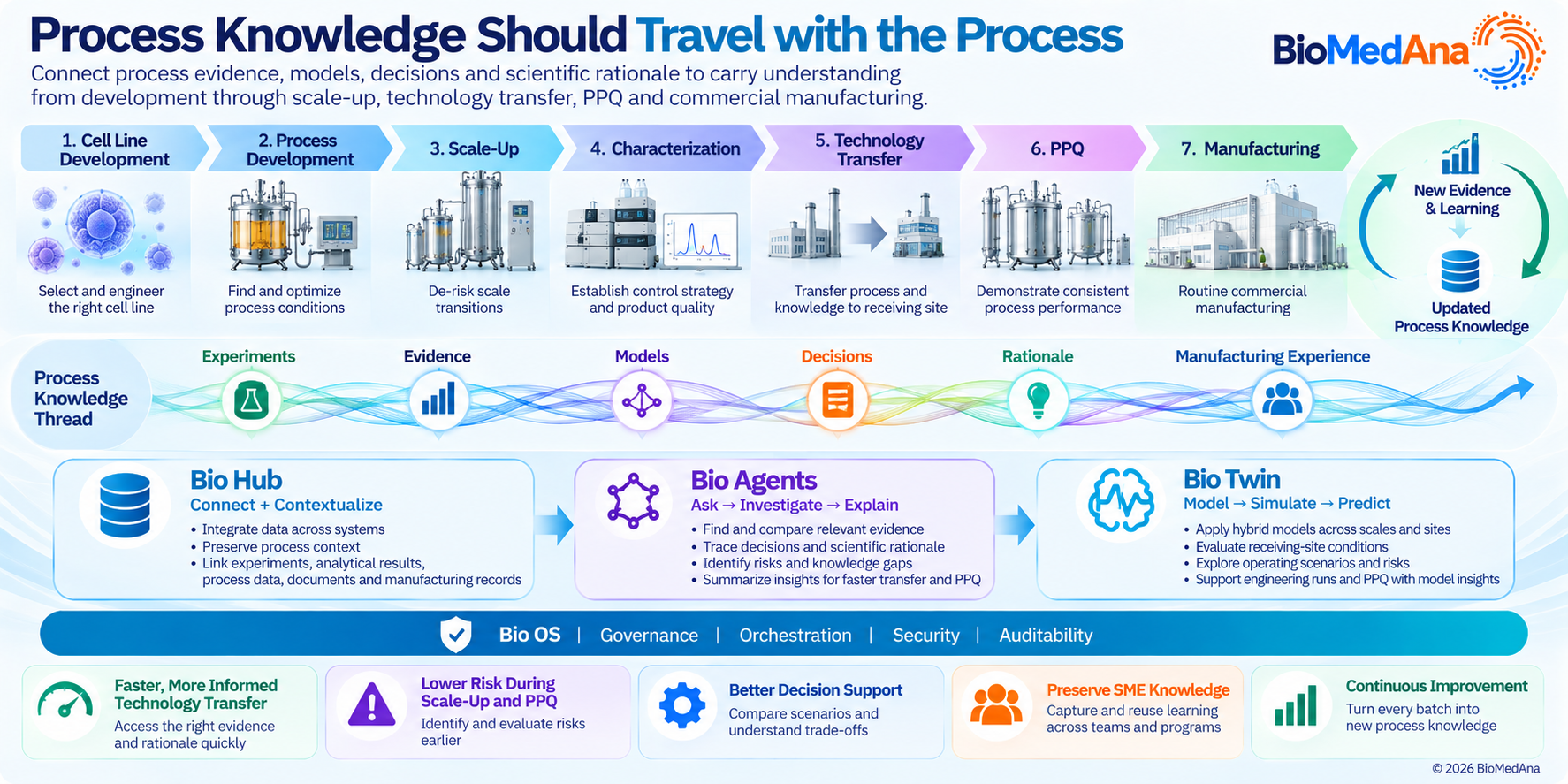
Technology transfer should move more than documents. Connecting process evidence, models, decisions and scientific rationale can help teams carry process understanding from development through scale-up, transfer, PPQ and commercial manufacturing.
How can AI support bioprocess technology transfer?
AI can support bioprocess technology transfer by helping teams connect development data, process parameters, analytical results, models, decisions and scientific rationale into an accessible knowledge layer. AI agents can help receiving teams interrogate this evidence, compare historical runs and investigate why operating ranges or control strategies were selected. Hybrid process models can also help evaluate receiving-site conditions and potential scale-dependent risks. AI supports—not replaces—scientific, engineering, quality and manufacturing expertise during technology transfer and PPQ.
A bioprocess accumulates enormous amounts of knowledge before it ever reaches commercial manufacturing.
Experiments establish relationships between process parameters and biological behavior.
Development teams identify operating ranges.
Scale-up studies reveal which conditions remain robust as equipment and physical environments change.
Analytical work establishes relationships between process behavior and product quality.
Scientists learn which parameters matter, which interactions deserve attention and where uncertainty remains.
By the time a process reaches technology transfer, the organization may understand the process extremely well.
And yet much of that understanding can be surprisingly difficult to transfer.
The reason is simple:
Process knowledge is larger than the documents used to describe it.
Technology transfer packages can contain specifications, process descriptions, batch records, development reports, risk assessments and analytical methods.
Those documents are essential.
But they do not always preserve the complete reasoning behind the process:
Why was this operating range selected?
Which experiments established it?
What alternatives were evaluated?
Which parameters proved sensitive?
What assumptions were made during scale-up?
What previous failures taught the development team?
What evidence connects a process parameter to a quality outcome?
When that context becomes difficult to access, the receiving team may inherit the process without inheriting all of the knowledge behind it.
That is the opportunity for a digital process knowledge thread.
Technology Transfer Is Really Knowledge Transfer
It is tempting to think of technology transfer as moving a process from:
Development Site → Manufacturing Site
But physically transferring the process is only one part of the challenge.
What actually needs to move is:
Process definition + Scientific understanding + Historical evidence + Decisions + Rationale + Risk knowledge
Consider a monoclonal antibody process developed through hundreds of experiments.
The final manufacturing recipe might specify:
- Temperature
- pH
- Dissolved oxygen
- Agitation
- Feed strategy
- Culture duration
- Harvest criteria
- Chromatography conditions
- Filtration parameters
But those values represent the end of a scientific journey.
Behind each parameter may be experiments, models, observations, failed conditions, trade-offs and scientific decisions.
A manufacturing recipe tells you what to do.
Process knowledge helps explain why.
That difference becomes especially important during technology transfer and PPQ.
The Traditional Digital Thread Can Still Be Fragmented
A development program may generate information across:
ELNs → spreadsheets → laboratory systems → historians → LIMS → modeling tools → reports → risk assessments → batch records → MES
All of those systems can be digital.
But that doesn't necessarily create a digital thread.
A true digital thread requires the relationships among the evidence to remain intact.
For example:
Experiment 142
↓
identified sensitivity to a particular parameter
↓
which informed a scale-up study
↓
which changed the proposed operating range
↓
which affected a control strategy
↓
which became part of the transferred process
↓
which was subsequently evaluated during PPQ.
If those relationships are distributed across six systems and twelve documents, the knowledge exists—but retrieving it becomes difficult.
The opportunity is to make that chain explicit and interrogable.
From Documents to Connected Process Evidence
This is where Bio Hub becomes foundational.
Rather than treating development reports, process data, analytical results and manufacturing records as isolated artifacts, Bio Hub can contextualize them around the process.
That can connect:
Experiments
Process parameters
Analytical measurements
CQAs
Models
Scale-up studies
Risk assessments
Manufacturing batches
Investigations
Scientific conclusions
Now imagine a receiving-site scientist asking:
Why is this parameter range 6.8–7.1?
Instead of searching through reports and asking members of the development team, the system could help trace:
Parameter → Experiments → Results → Model → Decision → Supporting Evidence
That is a very different form of technology transfer.
The Digital Thread Should Preserve Decisions, Not Just Data
This is one of the most important distinctions.
Organizations already retain enormous amounts of data.
What is often harder to retain is:
Why a decision was made.
Consider an illustrative upstream development program.
The team evaluates three feed strategies.
Strategy A produces the highest peak titer.
Strategy B produces slightly lower titer but better viability and more consistent product quality.
Strategy C performs well at bench scale but becomes less robust during scale-up.
The development team selects Strategy B.
Months later, the receiving manufacturing organization sees the selected feed strategy.
But unless the underlying evidence remains connected, they may not easily see:
Why Strategy B won.
A digital process thread should preserve:
Question → Evidence → Analysis → Alternatives → Decision → Rationale
That turns historical development activity into reusable organizational knowledge.
Scale-Up Knowledge Should Travel with the Process
Blog #2 discussed why scale-up is not simply making the same process bigger.
Mixing, oxygen transfer, CO₂ removal, hydrodynamics and other physical conditions can change with scale.
Those lessons become extremely important during technology transfer.
Imagine that a process has progressed through:
2 L → 200 L → 2,000 L
and is now being transferred to another manufacturing environment.
The receiving facility may have different:
- Vessel geometry
- Agitation characteristics
- Gas-delivery systems
- Control capabilities
- Sensor configurations
- Equipment constraints
The question therefore isn't simply:
Can the receiving site run the recipe?
It is:
Can the receiving site reproduce the process environment that matters to the biology?
This is where Bio Twin can extend the digital thread.
The models and scale-up knowledge created during development do not need to disappear once development is complete.
They can become part of the transferred process intelligence.
From “Transfer the Recipe” to “Transfer the Model”
Consider the difference.
Traditional transfer
Development process
↓
Documentation
↓
Receiving site
↓
Engineering runs
↓
Adjustment
↓
PPQ
Intelligence-enabled transfer
Development evidence
Process knowledge
Scale-up learning
Hybrid models
↓
Receiving-site conditions
↓
Scenario simulation
↓
Risk identification
↓
Focused confirmation
↓
PPQ
The second approach doesn't eliminate engineering or qualification runs.
It potentially makes them more informed.
Before executing at the receiving site, teams can ask:
How does this equipment differ from the development environment?
Which parameters are most sensitive to those differences?
Which operating conditions should we investigate first?
What does the model predict?
Where is uncertainty highest?
This moves technology transfer from document handoff toward knowledge-assisted transfer.
Bio Agents Can Make the Transfer Package Interrogable
A technology-transfer package can contain hundreds or thousands of pages.
The problem isn't necessarily that information is missing.
The problem can be finding the right information at the right moment.
Bio Agents can provide a different interface to that knowledge.
A receiving team might ask:
Which experiments support the current agitation range?
What scale-up risks were identified during development?
Show all evidence associated with lactate accumulation.
How did product quality change across the 200 L and 2,000 L runs?
Which deviations during development are relevant to this process parameter?
What assumptions were used in the scale-up model?
The agent should not invent an answer.
It should help navigate the connected evidence and make the supporting information visible.
That distinction matters.
The objective is not AI-generated process knowledge.
It is AI-assisted access to process knowledge.
Then Comes PPQ
Process Performance Qualification represents a critical stage in the transition toward routine commercial manufacturing.
By this point, the organization has accumulated knowledge from:
Development → Characterization → Scale-Up → Technology Transfer → Engineering Runs
PPQ should not be disconnected from that history.
Imagine a PPQ run begins showing behavior that differs from expectations.
The question shouldn't begin with:
Where should we look?
The system should already understand:
What normal looked like during development.
Which parameters historically mattered.
What the models predicted.
What happened during engineering runs.
Which risks were previously identified.
Which process-quality relationships were established.
That context can dramatically improve the quality of an investigation.
From PPQ to Continued Process Verification
The digital thread should not stop after PPQ.
Commercial manufacturing generates new evidence.
Each batch tests what the organization believes it knows about the process.
Over time, teams may observe:
- New sources of variability
- Equipment-related differences
- Raw-material effects
- Changing process relationships
- Emerging trends
- Previously unseen interactions
That creates an important loop:
Development Knowledge
↓
Technology Transfer
↓
PPQ
↓
Commercial Manufacturing
↓
New Evidence
↓
Updated Process Knowledge
This is where a static technology-transfer package becomes inadequate.
Process knowledge should evolve as the process evolves.
One Connected Knowledge Thread
The architecture becomes straightforward.
Bio Hub
Connect the evidence
Experimental data, process data, analytical results, documents, manufacturing data and historical knowledge.
Bio Agents
Interrogate the knowledge
Ask questions, compare evidence, investigate relationships and surface supporting rationale.
Bio Twin
Carry the process model forward
Simulate receiving-site conditions, evaluate scale-dependent behavior and explore operating scenarios.
Bio OS
Govern the intelligence
Maintain orchestration, security, traceability and auditability across data, models and agents.
Together, they create something more valuable than another repository.
They create a living process knowledge layer.
What Changes for the Receiving Team?
Imagine receiving a process and being able to ask:
Why was this parameter range selected?
And immediately trace the answer back to the supporting development evidence.
Or:
What happens if our equipment cannot reproduce this exact operating condition?
And evaluate potential scenarios through a process model.
Or:
Have we seen this PPQ behavior before?
And compare it with development, scale-up and engineering evidence.
Or:
Which parameter should we investigate first?
And see the historical evidence and model relationships supporting the recommendation.
That is a fundamentally different transfer experience.
The Goal Is Not More Documentation
Biopharmaceutical development already produces substantial documentation.
The opportunity isn't simply to generate more.
It is to preserve the relationships among evidence, models, decisions and outcomes so that knowledge remains useful after the people who originally created it have moved to the next program.
The progression should be:
Data
↓
Evidence
↓
Understanding
↓
Decision
↓
Rationale
↓
Reusable Process Knowledge
That knowledge should travel with the process from development through manufacturing.
From Process Development to Commercial Manufacturing
The strongest digital thread does not begin at technology transfer.
It begins much earlier.
Cell Line Development
↓
Process Development
↓
Scale-Up
↓
Process Characterization
↓
Technology Transfer
↓
PPQ
↓
Commercial Manufacturing
At every stage, the organization learns something.
The challenge is making sure that learning is not lost at the transition to the next stage.
Because ultimately, successful technology transfer is not about transferring a process description.
It is about transferring enough process understanding that another team can reliably reproduce, operate and continue learning from the process.
That is the opportunity for connected bioprocess intelligence.
Bring Us One Technology Transfer Challenge
Preparing a biologics process for technology transfer, PPQ or manufacturing?
Bring us one process challenge. We'll show you how BioMedAna can connect the evidence, models and scientific rationale behind it.
Request a Process Intelligence Session ↗
About BioMedAna
BioMedAna is an AI-native bioprocess intelligence platform. Bio Hub connects and contextualizes scientific, experimental, process and manufacturing evidence. Bio Agents help teams investigate, compare, explain and access process knowledge. Bio Twin combines physics, biology, process data, AI/ML and domain knowledge to model, simulate and optimize process behavior. Bio OS provides governance, orchestration, security and auditability across the platform.
Frequently asked questions
What is technology transfer in biopharmaceutical manufacturing?
Technology transfer in biopharmaceutical manufacturing is the structured transfer of a product and its manufacturing process from one organization, team, site, or scale to another. It typically includes process parameters, analytical methods, specifications, equipment requirements, control strategies, development knowledge, and supporting documentation. Effective technology transfer goes beyond transferring a manufacturing recipe. It should provide the receiving team with sufficient process understanding and scientific rationale to reproduce the process reliably, manage known risks, and maintain product quality as the process moves toward commercial manufacturing.
What is PPQ in biopharmaceutical manufacturing?
Process Performance Qualification (PPQ) is a stage of process validation used to demonstrate that a commercial manufacturing process can reproducibly perform as intended under defined operating conditions. PPQ builds on knowledge generated during process development, characterization, scale-up, and technology transfer. During PPQ, process performance and product-quality data are evaluated to confirm that the manufacturing process and its control strategy can consistently produce acceptable product. The resulting evidence supports the transition toward routine commercial manufacturing and subsequent continued process verification.
How can AI support bioprocess technology transfer?
AI can support bioprocess technology transfer by helping teams connect and interrogate development data, analytical results, process parameters, scale-up studies, models, decisions, and scientific rationale. AI agents can help receiving teams find relevant evidence, compare historical runs, investigate process relationships, and understand why particular operating ranges or control strategies were selected. AI can also help identify knowledge gaps and previously observed risks. Its role is to make accumulated process knowledge easier to access and apply while scientific, engineering, quality, and manufacturing experts retain responsibility for transfer decisions.
What is a digital thread in biomanufacturing?
A digital thread in biomanufacturing connects data, evidence, models, decisions, and process knowledge across the bioprocess lifecycle. It can link cell line development, process development, scale-up, characterization, technology transfer, PPQ, and commercial manufacturing rather than treating each stage as an isolated information environment. A digital thread preserves relationships between experiments, process parameters, analytical results, models, risks, and decisions, allowing teams to understand not only what process conditions were selected but also why they were selected and what evidence supports them.
How can digital twins support technology transfer and PPQ?
Digital twins can support technology transfer and PPQ by providing computational representations of relevant process behavior that can be carried forward from development into manufacturing. Hybrid digital twins can combine process data with engineering principles, biological understanding, AI/ML, and subject-matter expertise to evaluate receiving-site conditions, compare operating scenarios, and identify potential scale or equipment-related risks. They can help teams prioritize higher-value confirmation activities and interpret observed process behavior. Digital twins complement rather than replace engineering runs, qualification activities, experimental confirmation, and appropriate validation.