BIOPROCESS INTELLIGENCE
Beyond Dashboards: What AI-Native Biomanufacturing Actually Looks Like
Connecting process data is only the beginning. The next generation of digital biomanufacturing must turn scientific and manufacturing evidence into context, predictions, recommendations and continuously reusable process knowledge.
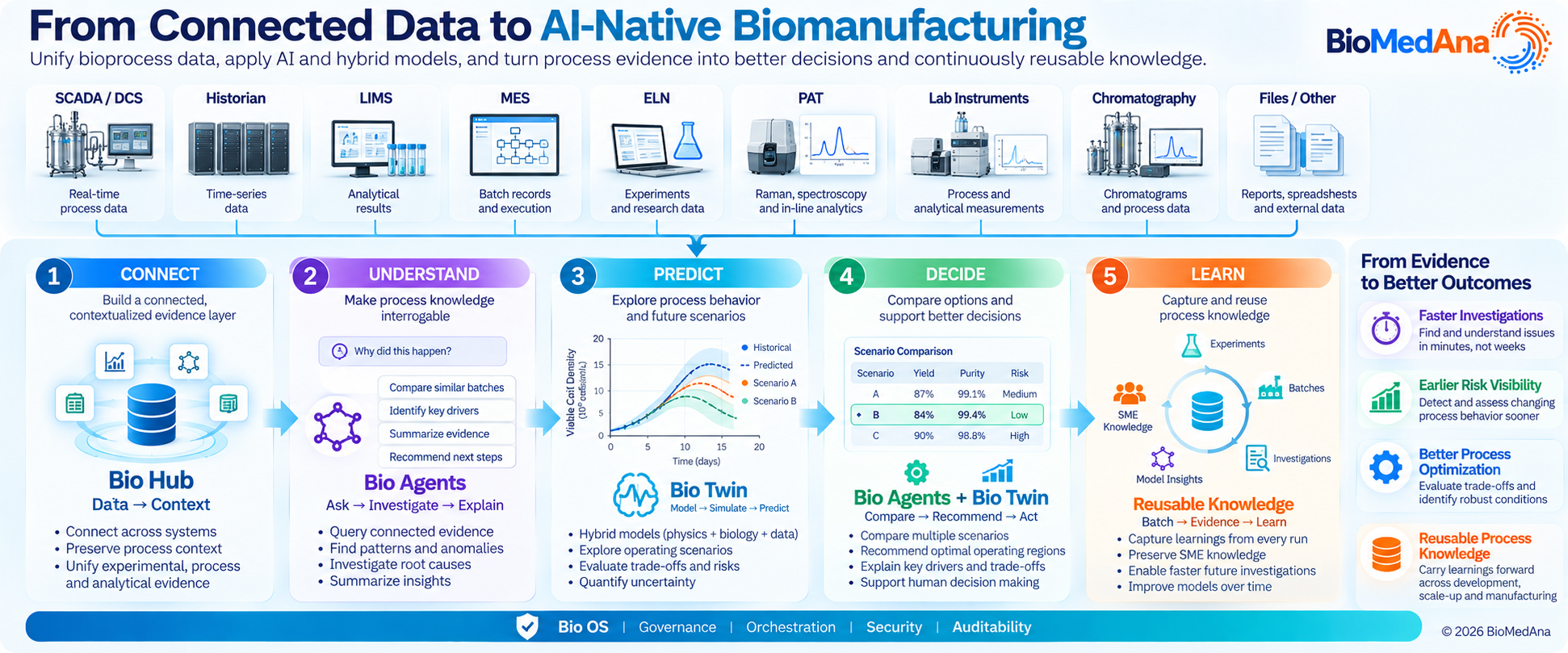
What is AI-native biomanufacturing?
AI-native biomanufacturing is an approach in which connected process and scientific data, AI agents, process models and digital twins work together as part of the manufacturing architecture rather than as isolated tools. It can help teams contextualize process evidence, investigate variability, predict potential outcomes, compare operating scenarios and preserve knowledge across batches. Human experts remain responsible for appropriate scientific and manufacturing decisions, while governance, security and auditability provide controls around the use of AI.
Biopharmaceutical companies have spent years digitizing manufacturing.
Paper records have moved into electronic systems.
Equipment generates increasingly large volumes of data.
Historians capture process signals.
LIMS manages analytical results.
MES manages manufacturing execution.
PAT technologies provide increasingly timely information about process behavior.
Dashboards make more of that information visible.
Yet an important question remains:
Has making more data digital actually made the process more intelligent?
Often, the answer is only partially.
A scientist may be able to see a dissolved oxygen trend faster.
An engineer may have access to more historical batches.
A manufacturing team may receive more alerts.
But when something changes, people still need to determine:
What happened?
Why did it happen?
Have we seen it before?
What could happen next?
What should we do?
That gap between digital data and decision intelligence is where the next stage of biomanufacturing begins.
Digital Manufacturing Is Not the Same as Intelligent Manufacturing
Digitization solves an important problem:
Make information available electronically.
Digitalization goes further:
Use digital technologies to improve workflows and processes.
But AI-native biomanufacturing introduces another objective:
Continuously turn process evidence into understanding and better-supported decisions.
That distinction matters.
A dashboard can show that viable cell density is declining.
An intelligent system should help investigate:
When did the change begin?
What else changed around the same time?
Have similar patterns appeared in previous batches?
Which process parameters are associated with the behavior?
What does the process model predict could happen next?
The difference is not another visualization.
It is the ability to move from:
See → Understand → Predict → Decide → Learn
Why Biomanufacturing Data Remains Fragmented
A biologics process can generate evidence across dozens of systems.
Consider only a few:
- Bioreactor and equipment data
- SCADA and historians
- PAT systems
- Chromatography systems
- LIMS
- MES
- ELNs
- Laboratory instruments
- Process-development datasets
- Analytical results
- Batch records
- Quality systems
- Scientific reports
- Spreadsheets
- SME knowledge
Each system may perform its intended function extremely well.
The problem appears when scientists need to answer questions that cross those systems.
Imagine investigating a manufacturing deviation.
The relevant evidence might involve a bioreactor signal from the historian, an assay result from LIMS, a feed change recorded elsewhere, PAT data, previous development experiments and observations contained in a scientific report.
No individual system contains the complete process story.
The process is connected. The data often isn't.
This is why simply adding AI on top of fragmented information has limitations.
AI needs context.
Architecture Must Come Before Intelligence
This is one of the most important principles for AI in biomanufacturing.
Before asking:
Which AI model should we deploy?
organizations should ask:
Can the system understand how our process evidence relates?
A temperature measurement is not merely a number.
It belongs to:
A batch → a unit operation → a piece of equipment → a process stage → a product → a time point → an operating condition
An analytical result has similar context.
So does a chromatography trace.
So does a Raman spectrum.
So does an experiment.
When those relationships are preserved, data becomes substantially more useful to both humans and AI.
This is why BioMedAna begins with Bio Hub.
Level 1: Connect and Contextualize the Evidence
Bio Hub creates a connected evidence layer across development and manufacturing.
It can connect information through industrial interfaces and systems including OPC-UA, OPC-DA, SQL, APIs, SCADA and files, while preserving scientific and process context.
The objective isn't to replace every source system.
It is to make evidence from those systems usable together.
Consider the difference between:
DO = 35%
and:
Dissolved oxygen reached 35% during production Batch 247, in the 2,000 L bioreactor, during a specific process phase, following a feed event, alongside a change in OUR and metabolite behavior.
The first is data.
The second begins to become process evidence.
That contextual layer is foundational because every subsequent AI capability depends on it.
Level 2: Make Process Knowledge Interrogable
Once evidence is connected, scientists should not have to know which database contains the answer or manually assemble every dataset before asking a scientific question.
This is where Bio Agents become useful.
Imagine asking:
Compare this batch with the previous ten successful batches.
Or:
What changed before viability began declining?
Or:
Show previous experiments with similar lactate behavior.
Or:
Summarize the evidence associated with increased aggregate formation.
Or:
Which process parameters changed outside their typical historical relationships?
The agent's role isn't simply to generate prose.
It is to navigate connected evidence, perform appropriate analyses and help scientists investigate the process.
That creates a different interface to manufacturing knowledge:
Ask → Investigate → Compare → Explain → Recommend
Level 3: Move from Explanation to Prediction
Historical evidence tells us what happened.
Manufacturing teams also need to understand:
What could happen next?
This is where process models and Bio Twin become important.
A digital twin can represent relevant aspects of process behavior using combinations of:
Physics + Biology + Process Data + AI/ML + SME Knowledge
The exact combination depends on the problem.
For upstream processing, the model might consider relationships among oxygen transfer, metabolism, feed strategy, growth and productivity.
For chromatography, it may explore relationships between load conditions, pH, conductivity, gradient, flow, yield and impurity clearance.
The objective isn't to model every molecule.
It is to create a useful computational representation capable of supporting a decision.
BPI's 2026 digital program reflects this movement toward predictive analytics, advanced process control, mechanistic models and digital twins.
Level 4: Turn Predictions into Decision Intelligence
Prediction alone isn't the end goal.
Suppose a model predicts declining productivity.
The scientist still needs to know:
Why?
How confident are we?
Which variables matter most?
What alternatives exist?
What action is appropriate?
This is where the combination of Bio Twin + Bio Agents becomes particularly powerful.
The Twin can simulate potential process behavior.
Agents can help interrogate the model, evidence and alternatives.
For example:
Which parameters are driving the predicted change?
Compare three potential operating strategies.
Which scenario provides the strongest balance between yield and robustness?
What historical evidence supports this recommendation?
What additional measurement would reduce uncertainty most?
That is a much more useful definition of AI-native manufacturing than simply putting a chatbot beside a historian.
Level 5: Learn from Every Batch
Perhaps the most important capability is also the easiest to overlook.
The system should learn.
Every experiment creates evidence.
Every scale transition creates evidence.
Every batch creates evidence.
Every investigation creates evidence.
Every deviation teaches something about the process.
But if that learning remains buried in reports, spreadsheets, emails or individual experience, the next team may have to rediscover it.
An AI-native architecture should help turn:
Process experience → reusable process knowledge
Consider a deviation investigation.
The organization identifies the root cause, evaluates supporting evidence and implements corrective action.
Six months later, a similar pattern begins appearing in another batch.
An intelligent manufacturing environment should not treat that as an entirely new problem.
It should be able to surface:
We've seen something similar before.
That is where AI starts becoming organizational process memory.
The AI-Native Biomanufacturing Stack
This creates a useful way to think about the architecture.
Bio Hub — Evidence
Connect + Contextualize
Bring experimental, process, analytical and manufacturing information into a connected evidence layer.
↓
Bio Agents — Intelligence
Ask + Investigate + Explain
Allow scientists and engineers to interrogate evidence and accelerate investigations.
↓
Bio Twin — Prediction
Model + Simulate + Predict
Explore process behavior, operating scenarios, risks and potential outcomes.
All governed by:
Bio OS — Governance
Orchestrate + Secure + Audit
Provide governance, security, auditability and orchestration across data, models and agents.
The architecture isn't:
Hub → Twin → Agents → OS
as four disconnected products.
It is:
Evidence + Models + Agents operating together under governance.
From Monitoring to Predictive Operations
Consider a synthetic manufacturing example.
A 2,000 L mAb production batch begins showing an unusual metabolic pattern.
Traditional digital workflow
Dashboard detects change.
↓
Scientist investigates historian.
↓
Analytical data is retrieved.
↓
Previous batches are manually compared.
↓
SMEs discuss possible causes.
↓
Additional analysis is performed.
↓
Potential explanation emerges.
All of those activities may be digitally enabled.
But much of the reasoning remains manually assembled.
Now consider an AI-native workflow.
Connected intelligence workflow
Bio Hub recognizes the process context and connects the current evidence with historical batches.
↓
Bio Agents compare similar runs and identify when process behavior began diverging.
↓
Bio Twin evaluates potential process trajectories and alternative operating scenarios.
↓
The scientist interrogates the evidence and model:
What changed?
Have we seen this before?
What are the likely drivers?
What could happen next?
Which response appears most appropriate?
↓
The decision and subsequent outcome become new process knowledge.
This doesn't remove the scientist.
It changes how quickly the scientist can reach the evidence that matters.
AI-Native Does Not Mean Fully Autonomous
There is a temptation to equate AI-native manufacturing with autonomous manufacturing.
They are not the same.
Biopharmaceutical manufacturing operates within rigorous quality and regulatory environments.
Decisions have different levels of risk.
An AI system summarizing historical evidence is different from one recommending an operating adjustment.
And a recommendation is different from automatically changing a GMP process.
A practical AI-native architecture therefore needs graduated levels of human oversight, validation, governance and auditability.
The near-term opportunity is not necessarily:
AI runs the plant.
It is:
AI helps scientists and engineers understand the plant faster and make better-supported decisions.
Why Governance Cannot Be Added Later
As AI becomes more involved in scientific and manufacturing workflows, governance becomes part of the architecture rather than an afterthought.
Teams need to understand:
What data was used?
Which model generated the prediction?
Which agent performed the analysis?
What evidence supported the recommendation?
Who reviewed the result?
What action was taken?
That is why Bio OS is important.
AI-native biomanufacturing needs not only intelligence but also orchestration, security, traceability and auditability around that intelligence.
One Architecture Across the Bioprocess Lifecycle
The same architecture can support multiple stages.
Cell Line Development
Compare experimental evidence and support candidate decisions.
Process Development
Investigate relationships and optimize conditions.
Scale-Up
Combine physics, biology and data to explore scale-dependent behavior.
Downstream Processing
Connect PAT, chromatography and analytical evidence.
Technology Transfer
Carry process understanding into the receiving environment.
Manufacturing
Monitor, investigate, predict and continuously learn.
The specific scientific questions change.
The underlying architecture does not.
That is important because process knowledge should not reset every time a program crosses an organizational boundary.
Beyond Dashboards
Dashboards remain useful.
Historians remain useful.
LIMS remains useful.
MES remains useful.
PAT remains useful.
Digital twins remain useful.
AI agents remain useful.
The opportunity isn't to replace all of them with one new application.
It is to create an intelligence architecture connecting the evidence and capabilities already distributed across the bioprocess lifecycle.
The progression becomes:
Connected Data
↓
Contextualized Evidence
↓
Scientific Intelligence
↓
Predictive Intelligence
↓
Decision Intelligence
↓
Reusable Process Knowledge
That is what AI-native biomanufacturing should ultimately enable.
Not another dashboard.
Not another isolated AI model.
Not another chatbot.
But a continuously improving understanding of the process—and a faster path from evidence to better-supported decisions.
Bring Us One Bioprocess Challenge
Have process data across multiple systems but still spend too much time assembling evidence before you can answer a scientific or manufacturing question?
Bring us one process challenge. We'll show you how BioMedAna would approach it.
Request a Process Intelligence Session ↗
About BioMedAna
BioMedAna is an AI-native bioprocess intelligence platform combining Bio Hub, Bio Twin and Bio Agents, governed and orchestrated through Bio OS. It connects scientific, experimental, process and manufacturing evidence and applies hybrid modeling and agentic AI to help bioprocess teams investigate, simulate, predict and make better-supported decisions from development through manufacturing.
Frequently asked questions
What is digital biomanufacturing?
Digital biomanufacturing is the use of connected data, digital systems, analytics, models, and automation to improve how biological products are developed and manufactured. It can connect information from bioreactors, historians, SCADA, LIMS, MES, PAT, laboratory instruments, and analytical systems to provide a more complete view of process behavior. More advanced approaches extend beyond data collection and visualization by using AI and process models to support investigations, predictions, optimization, and knowledge reuse across development, scale-up, technology transfer, and manufacturing.
How is AI used in biomanufacturing?
AI can be used in biomanufacturing to analyze process and analytical data, compare batches, identify patterns and anomalies, investigate deviations, predict process behavior, and support process optimization. AI agents can also help scientists interrogate complex datasets using scientific questions, while machine-learning and hybrid models can evaluate relationships between operating conditions and outcomes such as productivity, yield, purity, and product quality. The objective is not simply to automate analysis, but to help scientists and engineers move more efficiently from process evidence to better-supported decisions.
What is the difference between a dashboard and process intelligence?
A dashboard primarily helps users see what is happening by displaying process measurements, trends, alerts, and key performance indicators. Process intelligence goes further by connecting those signals with historical batches, analytical results, process context, models, and scientific knowledge. This can help teams investigate why something happened, whether similar behavior occurred previously, what could happen next, and which options should be evaluated. Dashboards remain valuable, but process intelligence adds contextual analysis, prediction, investigation, and decision support around the information being displayed.
Why does AI need contextualized bioprocess data?
AI needs contextualized bioprocess data because an individual measurement has limited meaning without knowing where, when, and under what process conditions it was generated. A dissolved oxygen value, for example, becomes more informative when connected to the batch, bioreactor, process phase, feed events, agitation, gas flow, cell behavior, and analytical outcomes around it. Context allows AI to evaluate relationships across process and scientific evidence rather than treating measurements as isolated data points, improving the usefulness and interpretability of analyses, investigations, models, and recommendations.
Can AI autonomously control biologics manufacturing?
AI can contribute to monitoring, prediction, decision support, and potentially advanced process-control strategies in biologics manufacturing, but autonomous control requires considerably more than an AI model. The intended use, process risk, model performance, validation, data integrity, system controls, regulatory requirements, and human oversight all need to be considered. A practical near-term application is often human-in-the-loop intelligence, where AI helps scientists and engineers detect changes, investigate evidence, evaluate potential outcomes, and recommend options while appropriately authorized personnel retain responsibility for manufacturing decisions.