INDUSTRY INSIGHTS · Product health & verification
From periodic review to continuous insight: who owns the exception?
Continuous insight in Pharma 4.0 needs people, review capacity and an inspectable scientific basis for every exception and next action.
ISPE Annual Meeting & Expo · October 18–21, 2026
The signal: faster review creates a new operating burden
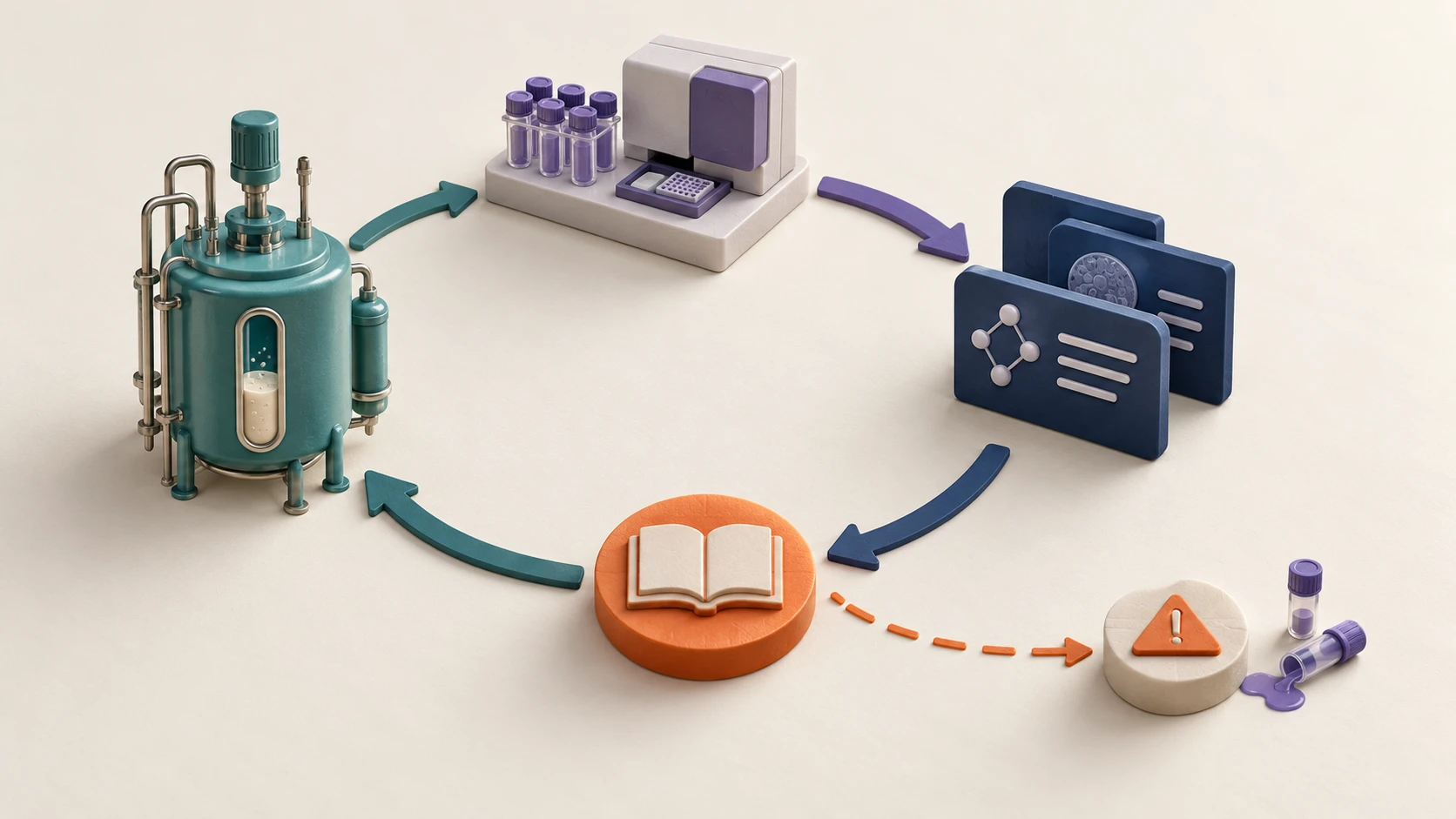
The ISPE programme covers distinct topics in computerized-system verification and technical product health. They create related operating questions, but different evidence and approval responsibilities. This article examines what happens after a signal appears: who interprets it, what evidence they need and how the next action is owned.
FDA's process-validation guidance describes a lifecycle that includes continued process verification. It is relevant background for drug manufacturing; a continuous dashboard does not by itself establish ongoing process control or eliminate existing obligations. Our framework here concerns the design and evaluation of an exception-handling workflow. [2]
Continuous insight needs an organization able to respond
Pharma 4.0 connects resources, people, process and information so that the organization can learn and act. A more frequently refreshed dashboard creates value only when a named role can interpret the signal, reconcile missing evidence and route the next action. Review capacity and exception ownership are therefore design inputs. [4]
Distinguish a statistical signal, a missing laboratory result and an established operational limit breach. They require different evidence and escalation. Keep urgent quality routes intact, nominate a delegate and review recurring exceptions as a process-improvement opportunity. A red status shared with everyone can still be owned by nobody.
A signal is useful when an accountable team can inspect the scientific basis and act through its quality processes. Faster analysis without review capacity is an unfinished operating model.THE BIOMEDANA LENS
Three monitoring questions need different conclusions
Computerized-system assurance asks whether a system remains suitable and controlled for its intended use. Its evidence can include changes, access, audit trails, incidents and training. Manufacturing continued process verification asks whether the process continues to perform as intended, using a product- and process-specific monitoring approach. Technical product-health analysis brings together a wider set of process, quality, transfer and other product risks to prioritize attention.
These activities can share data and an exception workflow. Their conclusions are not interchangeable. A system-health status does not prove the manufacturing process is in control, and an AI product-risk score does not approve batch disposition.
Define the evidence, decision owner, escalation route and retained conclusion for each lane. Where continuous evidence supports a system's controlled-state assessment, document which activities it covers and which still require periodic human judgment. A refreshed dashboard supports that assessment; it does not replace a reproducible record and authorized conclusion.
A hypothetical product-health alert is only the beginning
Imagine a monitoring tool flags an unusual relationship between a process trajectory and a later quality result. The alert might reflect a meaningful process change, a revised analytical method, a sample mapping issue or an artifact of the analysis. The operational task is to determine what the observation supports and which next step is justified.
Sending the same notification to many people does not assign responsibility. The receiving role needs a concise packet: affected runs, relevant baseline, data freshness, comparison method, known changes and the reason for the alert. The packet should identify whether the signal is an observation, a prediction or a hypothesis requiring investigation.
Define the exception before tuning the threshold
Start by asking what event deserves attention and what the reviewer can do about it. A statistical deviation, a data-quality exception and an operational limit breach need different dispositions. Combining them into a single red status may create urgency while concealing the action the team actually needs to take.
Our proposed exception taxonomy includes investigate, clarify data, observe with a defined review point and escalate through an established process. The taxonomy should reflect the team's actual responsibilities. A new label is useful only if it changes routing, evidence requirements or the next decision. Keep the original signal and the review rationale when the disposition changes.
Prevent the baseline from moving silently
A changing reference population can change which runs appear unusual. Document inclusion rules, product and process versions, assay context and exclusions. If a model adapts, the organization should know which version generated each historical alert. Otherwise a later reviewer may be unable to reproduce why the system called attention to a run.
Test an analytical-method update and a shift in production mix. Ask whether the workflow distinguishes a change in measurement context from a change in process behavior. A stable software pipeline can still produce a misleading comparison when its reference population no longer answers the intended question. The decision about comparability needs a scientific owner.
Design for missing and late information
Many signals arrive before the complete evidence is available. A workflow should represent that state rather than silently mixing current historian data with outdated laboratory records. A later result may strengthen or weaken the initial interpretation. Retain the history so the reviewer can see what was known when each decision was made.
For a source outage, decide whether the output pauses, narrows its scope or continues with an explicit limitation. Test recovery as well as failure. Backfilled data should not create the appearance that an earlier recommendation had evidence it did not possess at the time. The chronology belongs in the decision record.
Measure action quality and review capacity
Track the proportion of material exceptions reviewed within the agreed workflow, time spent clarifying records, repeated alerts with the same unresolved cause and the completeness of dispositions. Also inspect cases the system missed. The absence of alerts can mean stable operation, poor sensitivity or incomplete data; the interface should not force the user to assume which explanation applies.
Avoid treating fewer alerts as automatic improvement. A threshold can reduce noise by hiding an important change. Conversely, more alerts can overwhelm the same reviewers and lengthen the queue. Evaluate the interaction between signal generation and expert capacity, including the workload imposed on scientific, quality and data teams.
BioMedAna: connect the signal to the science behind it
BioMedAna can bring contextualized records, engineering calculations, reaction-kinetics models and mechanistic/data-driven hybrid models into an AI-assisted investigation workflow. The review should identify whether an alert came from a measured observation, an explicit calculation, a statistical/model comparison or a generated interpretation. Those outputs have different evidence requirements.
An agent can prepare the packet and coordinate the permitted analytical steps; the scientific services supply inspectable calculations and model outputs. The receiving team still needs to assess source freshness, relevant model scope, contradictory evidence and the appropriate quality route. The differentiator is the complete evidence-to-science-to-action path, maintained by people who own its operation.
An exception-to-action review
An original BioMedAna working framework. Adapt the decisions and evidence to the actual process, people and intended use.
| Decision | Evidence to retain | Acceptance question |
|---|---|---|
| Detect | Signal, baseline and data freshness | What kind of exception is this? |
| Interpret | Relevant changes and competing explanations | What can the observation support? |
| Route | Accountable role and decision deadline | Who owns the next action? |
| Learn | Disposition, follow-up and missed cases | Did the workflow improve the review? |
The questions behind the headline
Does continuous monitoring replace periodic reviews?
That conclusion cannot be inferred from an agenda title or a dashboard. Determine the applicable process, controls and evidence for the intended use.
Is an anomaly the same as a root cause?
No. It is a reason to investigate with relevant context and competing explanations.
What should happen when data arrive late?
Preserve the chronology, identify what was available for the earlier decision and reassess explicitly when the evidence changes.
Follow the evidence
- ISPE 2026 Annual Meeting & Expo - live agenda, accessed 21 October 2026 ↗
- FDA - Process Validation: General Principles and Practices, final, January 2011 ↗
- FDA - Data Integrity and Compliance With Drug CGMP, final, December 2018 ↗
- ISPE - Pharma 4.0 operating model: organizational, cultural, process and resource dimensions ↗
Original BioMedAna editorial analysis. The linked sources support the reported developments; examples, frameworks and product implications reflect our perspective.
Explore the underlying concepts
CONTINUE READING
More from the BioMedAna lens.
 Antibody engineering & lead decisions
Pythia designs antibodies that change receptor activity. What should a founder advance?
Read perspective ↗ Protein engineering & experimental specifications
Pinal turns words into protein candidates. The experimental brief still needs an owner.
Read perspective ↗ Protein engineering & design decisions