09 / mAb / CHO development
Balancing mAb titer and quality from the next experiment to scale-up
Editorial date
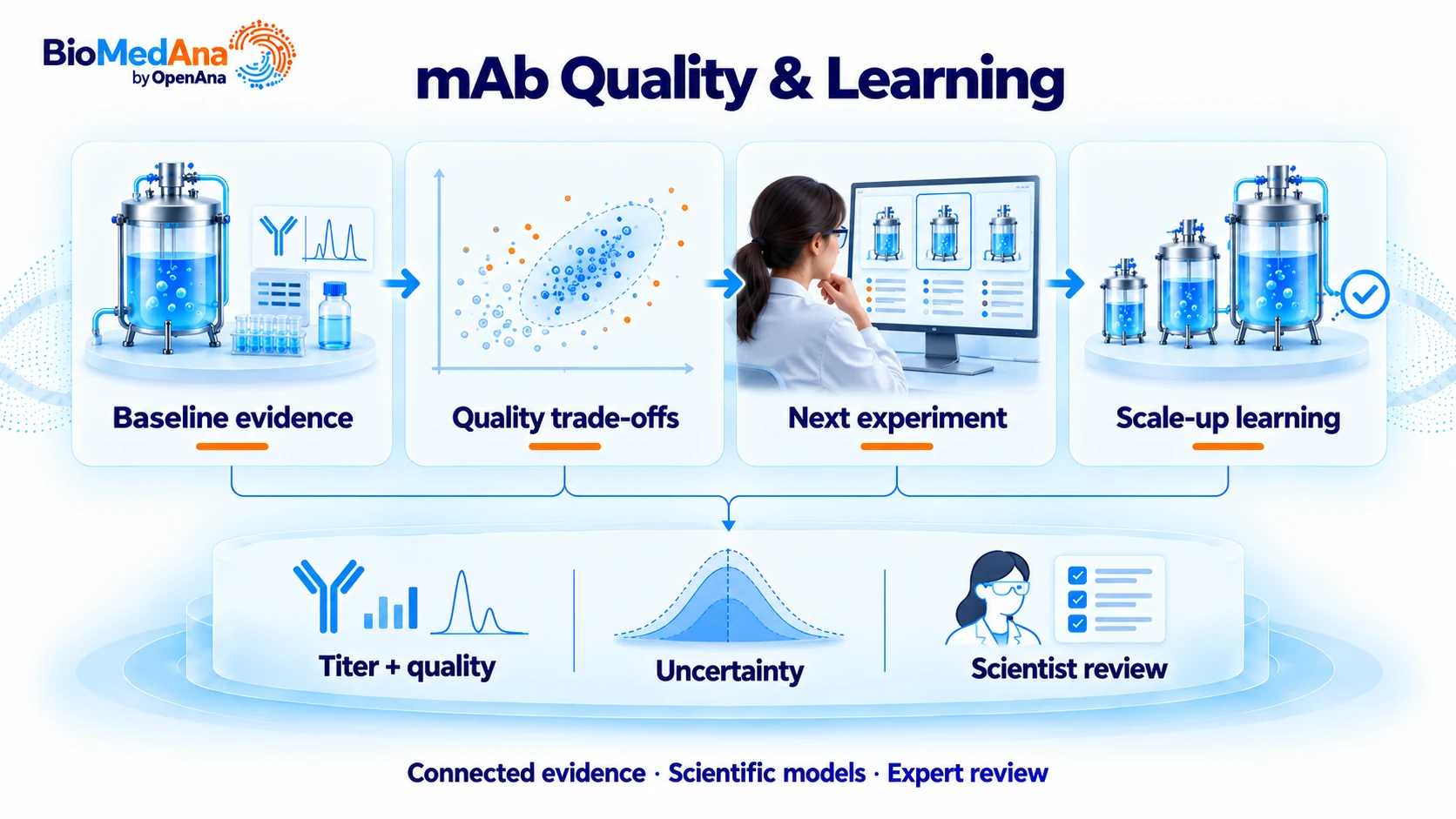
Follow a CHO fed-batch development decision from strong titer and variable quality through experiment selection, a pilot-scale surprise and a targeted confirmation plan.
Proposed enterprise workflow · Source-linked analysis · Expert review
THE ENTERPRISE OBJECTIVE
A defined question.
A shared evidence basis.
Choose the next experiment that improves product-quality understanding while preserving useful productivity, then determine which conclusions remain credible as the process moves to a different scale. Process development owns experiment selection; MSAT and engineering own the scale-up evidence; the program sponsor owns the dependent milestone.
The titer is strong. The development decision is still unresolved.
A CHO fed-batch mAb program has reached a useful productivity baseline at 2 L. The immediate pressure is to choose the next experiment and progress toward larger-scale work. One team sees a process that is ready to advance because the titer is attractive. Another sees inconsistent quality and asks whether selecting the highest-producing condition would lock a fragile process into the scale-up plan.
That disagreement matters commercially. Culture capacity, analytical turnaround and the next pilot slot are shared resources. Another broad screen may consume the available window without isolating the quality question. Advancing too early can move the same uncertainty into a more expensive campaign. The useful objective is to make the next run informative enough to change the development decision.
| Webinar case input | Value presented | What the team must resolve |
|---|---|---|
| Development scale | 2 L CHO fed-batch | Establish a product/process-specific baseline before extrapolating. |
| Harvest titer | 5.2 g/L | Protect useful productivity while investigating quality variability. |
| Harvest viability | 88% | Interpret the trajectory and sample timing, rather than treating an endpoint as the complete culture history. |
| Runs within the glycan target | Approximately 70% | Determine the attribute, target definition, assay basis and causes of the inconsistent case pattern. |
| Aggregation | 1.4–2.3% in the case narrative | Check matched analytical methods and sample stages before assigning a process mechanism. |
These values anchor the webinar story. They do not establish a validated process specification or an enterprise performance benchmark. The decision needs both the scientific context behind each result and a clear account of what the next experiment can distinguish.
Reconstruct the quality question before ranking experiments.
The investigation starts with the selected process version, not every available run. Hub provides the run context and source-linked evidence needed to compare the relevant culture histories with their analytical results. Different clones, media versions, sampling stages or assay methods remain distinguishable. The team records why a run is included, excluded or retained only as supporting context.
Process development then compares the trajectories behind apparently similar harvest titers. Viable-cell density, viability, glucose, lactate and operating events help the reviewer ask whether the quality pattern is associated with a different culture history. Temperature, pH, feed and osmolality are candidate explanatory variables from the deck; their presence in a plot does not by itself prove a causal driver.
Analytical reviewers reconcile the quality evidence on the same basis. A glycan target needs a defined attribute and method. Aggregation requires the relevant sample stage and handling context. A measurement difference should be investigated as a measurement difference before it is turned into a biological explanation. Unmatched quality results remain a gap in the decision pack.
The next experiment must separate competing explanations
The team now asks a sharper question: which feasible experiment can preserve a useful productivity region while testing the quality uncertainty? The answer depends on whether quality changes track a controllable process condition, a correlated change in culture history, or an unresolved analytical difference. A study that repeats the strongest titer signal without distinguishing those explanations adds less decision value.
BioMedAna helps carry the cohort, comparisons and source context into that review. The working output is an experiment rationale with the variables being challenged, the observations needed and the interpretation that would follow each result. Scientific owners agree the actual protocol and acceptance basis through their established development route.
HOW BIOMEDANA FITS
From source context
to a reviewable decision.
- 01
Hub: assemble a comparable development history
Connect run identity, process version, culture trajectories, sample stage and analytical context. Use reviewed mappings and matched comparisons to establish which observations can support the question. Keep the original source and exclusions available to the reviewer.
- 02
Twin: compare performance and evidence limits
Use an appropriately fitted project model to explore supported scenarios and relevant engineering constraints. Compare productivity with observed quality evidence. A model output is used only for an endpoint and operating region supported by its evaluation.
- 03
Agents: accelerate the investigation handoff
Use source retrieval, comparisons and report tools to assemble the evidence, competing explanations and questions for review. The scientist checks the synthesis and chooses the experiment; the recommendation does not authorize an equipment or process change.
- 04
Review: retain the result and the next question
Record the selected experiment, its rationale and the result that would change the decision. Compare new observations with the retained prediction before revising the process strategy or model. Expansion to a new scale returns through an explicit review.
Select a useful experiment, then look for a robust region.
The webinar compares three experiment choices. A pursues the strongest predicted productivity, B explores a less understood region, and C balances performance with learning about quality. This makes the intelligence useful at a decision point: the team can challenge why an experiment deserves capacity, rather than accepting a ranked list without its rationale.
| Candidate | Reason to consider it | Question before selection |
|---|---|---|
| A: productivity-led | May improve the titer objective. | Does the quality evidence support that region, and could an attractive endpoint conceal a fragile process? |
| B: exploration-led | May discriminate a poorly understood response. | Is the expected learning relevant to the next gate, and is the experiment feasible within agreed constraints? |
| C: balanced learning | Tests the quality question while preserving useful productivity. | Will the measurements separate the competing explanations and support the next decision? |
The case narrative chooses C and moves from a single maximum-titer point to a balanced operating region. It presents a 5.4–5.5 g/L titer band with more consistent glycan performance and a lower-risk aggregation region. Those are reported case-story outputs, rather than a claim of an independently established improvement.
For an implementation, a next-experiment score must disclose its basis. A heuristic combining modeled objective scores and input novelty is different from a fitted Bayesian acquisition function. Likewise, a qualitative quality response is different from a product-qualified CQA prediction. The project review must establish which method is in use, how it was evaluated and which claims it can support.
The resulting operating region is a candidate for confirmation. The review considers neighboring conditions, repeatability, uncertainty and engineering feasibility. A high score at one point is insufficient if a small change in an input reverses the ranking or moves the scenario outside the evidence.
The same setpoints do not guarantee the same cell experience.
The next act changes the scientific question. The webinar takes the selected development region through 50 L confirmation and into a 500 L pilot setting. In its narrative, quality variability reappears even though the nominal recipe looks familiar. The decision is no longer simply which development condition performs best; it is whether that condition represents a comparable biological environment at the next scale.
The investigation now considers scale-dependent exposure hypotheses: mixing, local substrate gradients, gas transfer, carbon-dioxide accumulation and the difference between a probe average and a cell’s local history. These remain hypotheses unless appropriate engineering and experimental evidence support them. A conventional process trajectory cannot independently reconstruct spatial gradients or establish which cells experienced them.
The deck’s 2,000 L prediction target makes the handoff explicit. Titer transfer and quality transfer are separate questions. A reassuring productivity scenario cannot resolve glycan or aggregation uncertainty when the quality model lacks relevant calibration. The useful next action is a targeted study that tests the scale mechanism before it becomes an unsupported manufacturing assumption.
| Knowledge category | Case interpretation | Next action |
|---|---|---|
| Transfer | Some development patterns may remain useful at the next scale. | Retain their evidence and test their relevance against new observations. |
| Adapt | Feed/metabolism relationships and gas-transfer sensitivity may change with equipment. | Compare the receiving equipment basis and evaluate the supported model adjustment. |
| Relearn | Large-scale exposure effects, site/equipment influences and final quality confirmation remain uncertain. | Choose a discriminating physical study and independently assess its results. |
BioMedAna contributes the connected evidence and scenario comparison. MSAT chooses the confirmation question; engineering owns the vessel and transfer assumptions; analytical and Quality owners establish the applicable evidence and review route. The output is a justified next study, with a record of what would advance, revise or stop the scale-up plan.
What your team reviews.
A development-to-scale-up decision pack: selected run cohort, matched analytical results, titer/quality trade-offs, experiment rationale, pilot-scale hypotheses, model applicability, transfer/adapt/relearn map and an owned confirmation study. Each recommendation retains the evidence and model version used to make it.
Scope and interpretation
Adapted from the technical mAb webinar case. Its reported case values describe that development narrative and are not presented as independently verified client outcomes. Project-specific quality prediction and experiment ranking require suitable data and evaluation; scientific review determines the next physical study.
This scenario describes a proposed enterprise workflow. Deployment-specific integration, review and model behavior require verification. Business and process impact are evaluated against an agreed baseline and measured outcomes.
Explore the modality ↗Measure better experiment selection and a clearer scale-up handoff.
The business case begins with the work required to reach an agreed decision. Record the current effort to find comparable runs, reconcile quality results, assemble a review packet and explain why a proposed study is necessary. Include the analytical and review work that follows the recommendation; a faster screen is not valuable if it creates a longer reconciliation cycle.
| Value question | Baseline | Evidence of progress | Owner |
|---|---|---|---|
| Investigation effort | Time to assemble a matched process/quality cohort. | A source-linked cohort and fewer unresolved reconciliation questions at review. | Data steward and development lead |
| Experiment value | Rationale and unresolved questions behind current study choices. | Whether the selected study distinguishes the hypotheses relevant to the next gate. | Process development |
| Scale-up risk | Open engineering and quality assumptions before the pilot/manufacturing decision. | Which assumptions the confirmation study resolves and which remain. | MSAT and engineering |
| Program consequence | Asset windows and milestones dependent on the decision. | Documented change to the study or program plan; financial benefit assessed separately. | Program sponsor |
Success can mean advancing a supported candidate, revising a weak model or holding an unsupported conclusion before consuming a major run slot. The case does not establish a numerical reduction in experiments, timeline or cost. Those outcomes require a measured baseline and the subsequent work in the intended program.
Carry the evidence into the next run and the next model version.
A staged scientific handoff
- 01
Agree the decision boundary
Select one product/process version, the quality question and the upcoming development gate. Name the scientific and analytical owners and define what a useful answer must change.
- 02
Reconstruct the baseline
Review source context, matched samples, methods, trajectory coverage and cohort exclusions. Resolve the evidence gaps that could reverse the proposed experiment ranking.
- 03
Review the experiment and scenario basis
Retain candidate comparisons, model/source versions, uncertainty and the reason for selection. Agree the actual physical study through the established scientific route.
- 04
Evaluate the new evidence
Compare the result with the retained expectation. Update the model and operating-region rationale only after review; use the new evidence to define the next scale question.
The learning loop has an accountable transition at each step. New observations may support the prior recommendation, contradict it or reveal an applicability boundary. Each outcome remains useful when its evidence is retained. Reuse across another clone, equipment configuration or site requires a fresh assessment of what transfers and what must be learned again.
START WITH YOUR PROCESS QUESTION
Turn the evidence
into a reviewable next step.
Bring your program context, available evidence and the decision your team needs to make.