BIOMEDANA TWIN / SINGLE-USE TO STAINLESS STEEL
Evaluate a 2,000 L single-use to 10,000 L stainless-steel scale-up
Editorial date
Connect the development baseline, vessel engineering and product-quality evidence to decide which large-scale scenario deserves physical confirmation.
Engagement basis: Project-specific CHO fed-batch process model, equipment assessment and staged scientific validation
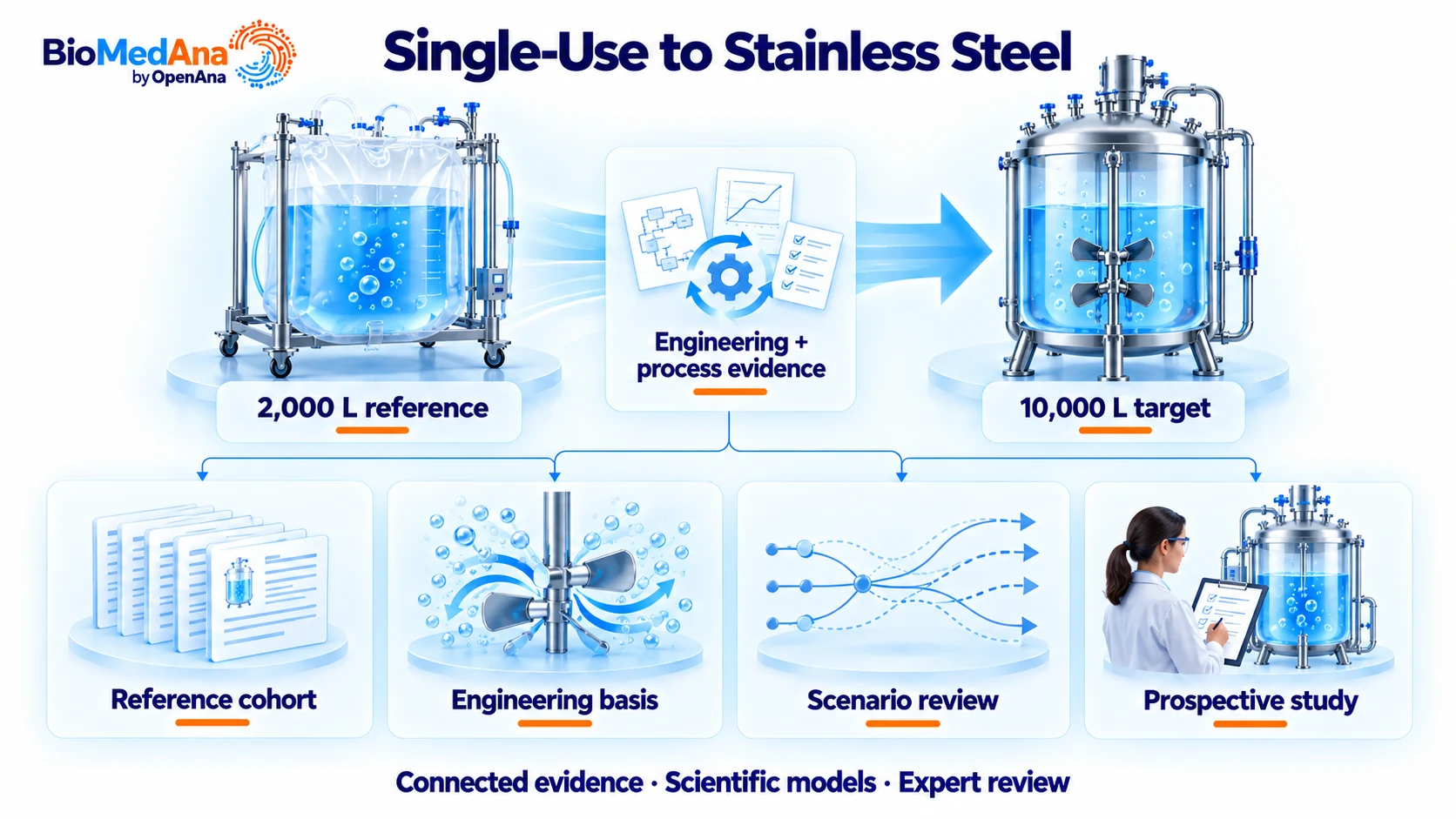
A fivefold increase in volume creates a different engineering question.
A biologics program is evaluating a move from a 2,000 L single-use production basis to a 10,000 L stainless-steel vessel. The larger asset offers an important planning opportunity, but the team must decide which operating scenario merits the next physical run. The case begins before that commitment, when the cost of an unsupported assumption is still avoidable.
The disagreement is practical. Process development wants to preserve a productive culture strategy. Engineering sees different vessel geometry, mixing and gas-transfer behavior. MSAT must turn both views into an executable study and explain the remaining uncertainty to the program sponsor. Matching nominal setpoints may preserve the recipe description while changing the environment experienced by the cells.
The business risk spans more than one batch. Capacity reservations, material commitments, analytical work and downstream planning can all depend on the scale-up decision. A long list of simulations does not resolve that dependency unless it identifies which candidate deserves testing and why. The required output is a reviewable study choice with explicit limits.
This use case adapts the scientific question and validation pathway from a supplied technical presentation. It develops the decision workflow without treating the presentation’s demonstration outputs as observed manufacturing performance. The reference scale and target equipment are the starting context; the actual prediction basis must come from the intended process.
Which receiving-vessel scenario has enough support to take into an engineering study, and what must be measured before committing the next manufacturing slot?
Compare a small set of feasible receiving-vessel scenarios against an explicit reference process, identify which assumptions could reverse the preferred choice, and define a prospective study that tests those assumptions. The decision pack supports engineering study selection; it does not declare manufacturing readiness.
Who owns the decision
MSAT and process development, supported by process engineering, modeling, analytical/Quality reviewers and the program sponsor
Establish the reference, then challenge the receiving-vessel assumptions.
First, the team determines whether the 2,000 L reference is stable enough to model. Completed runs are compared within the relevant product and process version, with culture trajectories, analytical methods and sample timing intact. Different campaign conditions do not become a common baseline solely because the files share column names. The review records which evidence is comparable and what remains unresolved.
Second, engineering constructs an equipment crosswalk. Geometry, working volume, impeller and sparger configuration, agitation, gas strategy and the available transfer measurements are reviewed for both systems. Power per volume, tip speed and oxygen-transfer estimates answer specific engineering questions. Their correlation assumptions and measurement basis remain visible, particularly where a plausible change could alter the scenario ranking.
Third, the biological and quality evidence is connected to that basis. Growth, viability, metabolism and productivity can respond differently to an equipment change. Quality attributes may have a different prediction boundary again. A model that reproduces titer has not thereby demonstrated that it can reproduce glycosylation, charge or aggregation behavior.
Finally, the team defines the intended model question and evaluation design before fitting. Hold out complete runs or appropriately separated cases rather than leaking measurements from the same run across training and testing. Examine error by the decision-relevant endpoint and operating region. If the historical evidence does not cover the proposed change, record the extrapolation and identify the independent evidence needed.
BioMedAna provides the common evidence and scenario context for this sequence. The reviewed cohort, engineering basis and model version travel with the comparison. A reviewer can trace why a candidate was considered and which assumption prevents a stronger conclusion, instead of reconstructing that reasoning from disconnected exports.
Start with a baseline your team can challenge.
| Evidence | What the team brings | How it informs the decision |
|---|---|---|
| Reference process | Completed 2,000 L runs with process versions, trajectories, feeds, sample timing, deviations and harvest outcomes. | Establish repeatability and determine what the reference actually demonstrates. |
| Equipment and engineering | Geometry, impellers, sparger, working volume, agitation, gas strategy and relevant measured transfer/mixing evidence for both systems. | Separate equipment facts, correlations and unresolved scale assumptions. |
| Biological response | Matched viable-cell density, viability, glucose, lactate, ammonia and other relevant observations. | Evaluate growth, metabolism and productivity on a comparable time basis. |
| Product-quality evidence | Matched glycan, charge or other product-specific attributes, with analytical method and sample context. | Define which quality conclusions can be observed or modeled and which remain unqualified. |
WHAT BIOMEDANA DOES / WHAT YOUR TEAM DECIDES
Connect the evidence.
Compare the scenarios.
- 01
Hub: reconstruct the reference
Connect committed process and quality evidence to run, scale, equipment and process-version context. Review mapping, units, time basis and exclusions before building a model-ready cohort.
- 02
Engineering: compare what changes
Use the available vessel information and relevant Twin calculations to examine power per volume, tip speed, oxygen-transfer basis and other agreed constraints. Keep measured values separate from estimates and specialist analyses.
- 03
Twin: evaluate supported scenarios
Compare the reference and receiving scenarios with a suitable fitted project model. Retain model version, calibration basis, uncertainty and the intended outputs. Unsupported quality or spatial predictions remain explicit evidence gaps.
- 04
MSAT: choose the prospective test
Review the scenario trade-offs, engineering feasibility and missing evidence. Select a physical study and its acceptance basis, then compare the new observations with the retained forecast before wider reliance.
Compare feasible alternatives without confusing a score with a recommendation.
The presentation describes varying the receiving-vessel conditions and comparing their effects. For an actual study, candidates must first satisfy the agreed equipment and process boundaries. The comparison then asks whether each alternative preserves useful process behavior, introduces a different constraint or needs evidence the model cannot provide. No operating recipe is inferred from a presentation slider.
| Alternative | What is compared | What would change the answer |
|---|---|---|
| Reference-like strategy | A receiving scenario designed to preserve selected features of the known process. | A different engineering environment or unsupported quality response may invalidate the apparent similarity. |
| Engineering-adjusted strategy | A feasible candidate addressing the specific transfer or mixing constraint identified in the crosswalk. | Changes in biological response, another engineering constraint or uncertain input values may offset the expected benefit. |
| Evidence-first strategy | A targeted measurement or physical study before selecting a receiving scenario. | Prefer this path when missing equipment or process evidence could reverse the ranking. |
Uncertainty needs an operational interpretation. If modest changes in an estimated input change the preferred scenario, the output should identify that sensitivity and the evidence needed to resolve it. If a quality endpoint is unsupported, a favorable process forecast cannot silently fill the gap. The ranking informs the scientific review; it does not replace it.
A decision pack with an owned next step.
A receiving-vessel decision pack: reference-run cohort, equipment crosswalk, measured/estimated engineering inputs, scenario assumptions, evaluated model outputs, uncertainty, quality evidence, acceptance criteria and an owned prospective confirmation plan.
| Review finding | Evidence interpretation | Next action |
|---|---|---|
| Advance a candidate | Its engineering basis is feasible and its modeled outputs are supported for the intended question. | Approve the next study through the established route; retain prediction and acceptance criteria before the run. |
| Revise the comparison | A missing measurement, a changed input or uncertain quality endpoint could reverse the preference. | Obtain the discriminating evidence and rerun the retained scenario comparison. |
| Hold the inference | The target operating region or requested output is outside the supported evidence. | Scope the required model extension or physical work before making that prediction. |
Validate a decision-relevant forecast before widening the operating claim.
The first evidence gate is retrospective: can the candidate model reproduce independently withheld process behavior well enough for the intended decision? Evaluate the endpoints separately, compare suitable baselines and review systematic failure cases. A strong overall score can still conceal a weak region or an endpoint that matters to the scale-up choice.
The second gate is prospective. Retain the prediction, input assumptions, intended measurement and acceptance basis before the physical run. The study then supplies an independent comparison between the forecast and the observed behavior. A discrepancy is investigated for its cause and impact on applicability before the model is revised.
The decision can advance, change or pause. A supported candidate becomes an engineering-study plan with clear measurements. An unstable ranking becomes a request for the discriminating equipment or process evidence. An unsupported quality inference becomes a separate development question. Each path gives the sponsor a concrete next action and an explanation for its effect on planning.
BioMedAna’s role is to connect that chain: process evidence, equipment assumptions, model version, scenario comparison and review. MSAT owns the study rationale; engineering owns the vessel basis; the model owner owns evaluation and applicability; analytical and Quality functions retain their established responsibilities. A completed scenario comparison is not the same event as an approved manufacturing change.
Assess the decision, the model and the program consequence separately.
Before introducing the workflow, record how the team currently assembles the reference process, reconciles equipment inputs and reaches an agreed study decision. Include the time spent responding to reviewer questions and repeating comparisons after an assumption changes. That is the appropriate baseline for evaluating the connected evidence workflow.
| Value question | Baseline to record | Evidence of progress | Owner |
|---|---|---|---|
| Evidence assembly | Effort to reconcile reference runs, equipment information and quality context. | Time to a reviewed comparison and the number of consequential gaps still open. | Data steward and MSAT |
| Scientific support | Current model/baseline accuracy for each intended endpoint. | Held-out and prospective error, applicability and failure cases. | Model owner |
| Study usefulness | Unresolved assumptions behind the receiving-vessel choice. | Which assumptions the selected physical study can discriminate. | MSAT and engineering |
| Program consequence | Asset window, material and dependent milestone commitments. | Documented change in the study or program plan after review; financial impact evaluated separately. | Program sponsor |
The expected business value is a better-supported commitment of scarce capacity, with the rationale retained when new evidence arrives. The use case makes no claim of a measured titer gain, avoided batch, shorter PPQ program or realized saving. Those outcomes must be assessed from the subsequent program evidence and an agreed comparison basis.
Use evidence gates from the first assessment through the next campaign.
A staged scientific handoff
- 01
Define the scientific question
Agree the product/process version, reference and receiving equipment, intended outputs and the upcoming decision gate. Identify the data, engineering and analytical owners.
- 02
Prepare and challenge the evidence
Assess completeness, comparability and coverage. Reconcile source context and engineering assumptions before agreeing that the data are suitable for modeling.
- 03
Build and evaluate the comparison
Compare candidate modeling approaches, withheld runs, feasible scenarios and sensitivity. Review which outputs have enough support to justify prospective work.
- 04
Test prospectively and retain the result
Agree the run-specific prediction and acceptance basis before execution. Compare observations, review applicability and authorize only the supported next use.
Timing follows the evidence, data access and availability of an appropriate run. The presentation’s phased roadmap provides an adoption sequence rather than a guaranteed deployment duration. A narrow retrospective result can justify a next study without authorizing routine reliance across the entire manufacturing program.
After the prospective review, the retained evidence becomes a process memory for the next campaign. New equipment information, process versions or a wider operating region trigger another applicability review. Reuse means carrying forward the justified parts of the prior work while preserving the questions the next run still needs to answer.
Define success before relying on the model.
Evaluate time to a reviewed study decision, baseline prediction error by endpoint, sensitivity of scenario ranking, unresolved engineering/quality assumptions and prospective agreement. Record the asset and program consequences separately from model performance.
Implementation and scientific boundary
Vessel size does not establish predictive applicability. A well-mixed culture model and engineering correlations do not resolve spatial gradients, certify a quality attribute or demonstrate comparability, PPQ readiness or product release. Spatial exposure or product-specific quality questions require their own appropriate model and independent evidence. The existing CHO project-data workflow is fed-batch; other process modes require separate assessment.
This use case defines a proposed workflow, its evidence and its decision path. It does not report measured customer outcomes. Acceptance criteria, model suitability and operating authority are agreed for the intended deployment.
START WITH YOUR DECISION
Make the next study
specific to your process.
Bring the available evidence, the model question and the people who will act on the result.