INDUSTRY INSIGHTS · Biologics stability & kinetic modelling
Advanced kinetic modelling: what a stability prediction must prove
Andrew Huth and Warren Roche on AKM: shelf life, temperature excursions and release limits—and the evidence needed for biologics stability decisions.
ISPE Annual Meeting & Expo · October 18–21, 2026
Two presentations, complementary questions
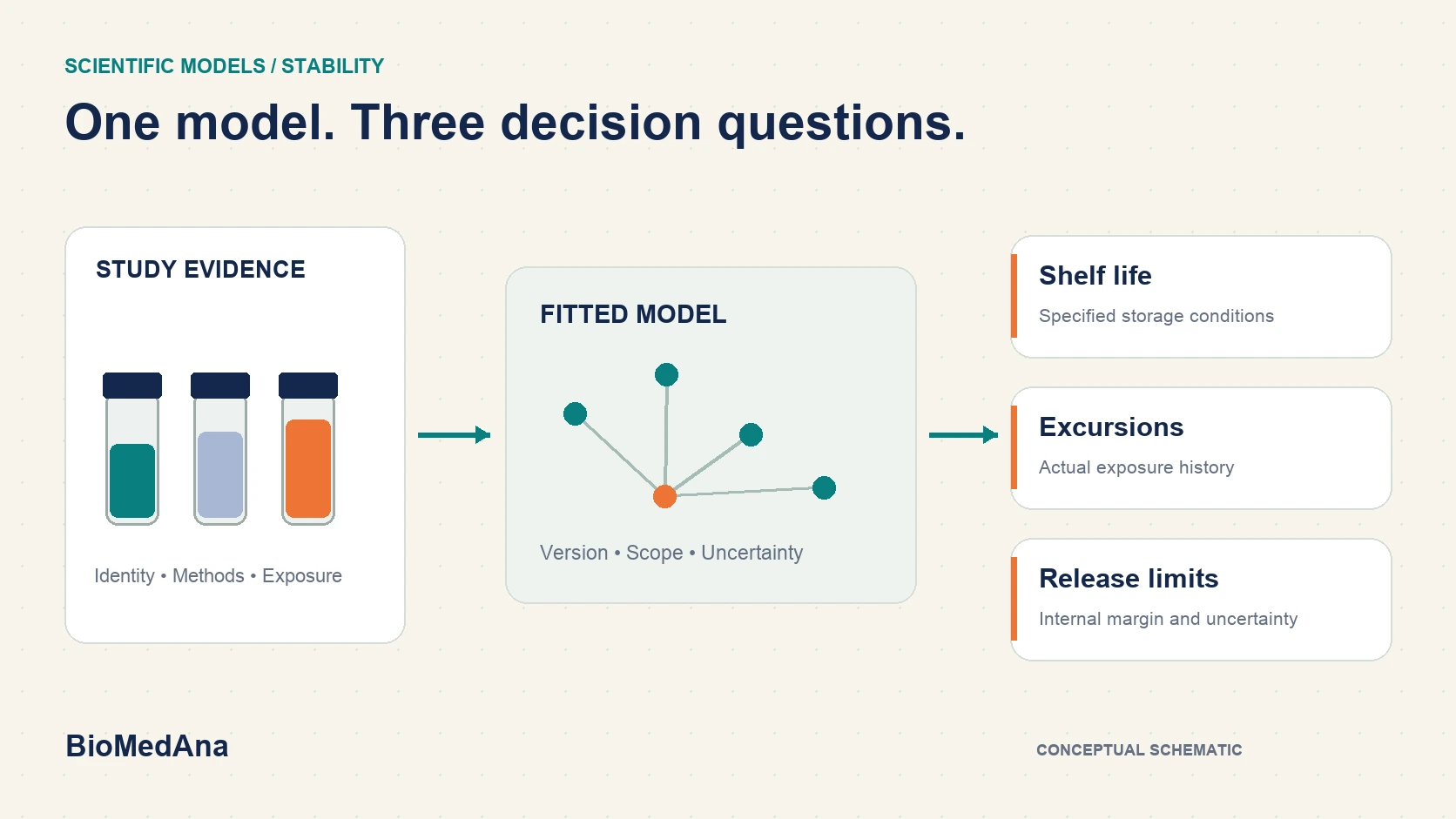
At the 2026 ISPE Annual Meeting & Expo, Andrew Huth’s “Stability Modeling for Biotherapeutics and Vaccines” and Warren Roche’s “Advanced Kinetic Modeling: New Era of Stability Analysis” examined how accelerated stability data can inform later product-quality decisions. Huth brought an MSAT and lifecycle perspective; Roche organized the discussion around three outputs: shelf-life estimation, temperature-excursion assessment and internal release limits. [1]
Huth’s material goes further into study design, candidate kinetic models, held-out observations and verification as real-time data accrue. Roche makes the receiving questions especially clear. Both draw on overlapping published research, including Huelsmeyer and colleagues’ 2023 study and Evers, Clénet and Pfeiffer-Marek’s 2022 work. These are complementary explanations, not two independent validations of the same claim. [2, 3]
This article is an original synthesis of the supplied attendee handouts and the public sources below. It does not reproduce the presentation graphics or treat speaker-reported regulatory experiences as a general authorization.
What AKM fits—and what it does not establish
Advanced kinetic modelling, or AKM, fits a mathematical description of how a selected stability-indicating attribute changes with time and conditions. Measurements at several temperatures help estimate temperature dependence; the model can then be evaluated for the storage or exposure question of interest. A familiar building block is the Arrhenius relationship, k(T) = A × exp(−Ea/(R × T)), with absolute temperature in Kelvin. That relationship is one part of a model, not a complete stability assessment.
A critical nuance in Huth’s deck is that a kinetic fit can be phenomenological: it describes the observed degradation course without establishing the underlying molecular mechanism. The 2023 paper makes this distinction explicit. A fitted two-step equation does not, by itself, prove that exactly two molecular pathways caused the change. [2]
That distinction affects transfer. Different concentration, formulation, container, assay or temperature conditions may change the observed behavior. More severe stress is useful only when its relevance to the intended prediction is justified; a good fit under one set of conditions does not establish applicability everywhere.
The same equation can inform different questions. The evidence and authority must match the decision being made.THE BIOMEDANA LENS
One model can inform three different decisions
Shelf life asks how the relevant quality attributes are expected to evolve under specified storage conditions relative to justified acceptance criteria. The shelf-life-limiting attribute matters: accurately modelling one measured property does not establish that every required quality attribute remains acceptable.
An excursion assessment asks about a particular time–temperature history. It needs the product’s state before exposure, the exposure record and the conditions after it. A model evaluated for constant storage is not automatically evaluated for a changing temperature profile. Retain the history rather than assuming that an average temperature captures its effect.
An internal release limit asks what starting value or margin would support an end-of-shelf-life objective under the chosen model and uncertainty assumptions. This is distinct from the registered specification and from the authority to release a batch. A proposed internal margin, a model output and an approved specification are different records. Roche’s examples illustrate the question; their numerical thresholds should not be transferred to another product.
Design the study around the claim you want to test
Start with the product, attribute, method and intended decision. Preserve batch, formulation, concentration, container and assay identities alongside the time and temperature records. Replicates and suitable sampling help distinguish variability from a change in the degradation trajectory. The conditions and observations must contain enough information for the proposed model’s complexity.
Candidate models can differ in reaction order and the number or form of fitted contributions. Criteria such as AIC, AICc or BIC can help compare them, but model-selection scores are not an independent test of future prediction. Predeclare how the selected model will be challenged, which observations are kept out of fitting and what result would restrict its use.
Huth’s study-design examples are useful starting points for discussion, not universal sample-size rules. The suitable design depends on product knowledge, analytical capability, the observed behavior and the consequence of the receiving decision.
Make the uncertainty and the independent test interpretable
A confidence interval for a mean response and a prediction interval for a future observation answer different questions. Before using a band to support a decision, state what it covers: parameter uncertainty, measurement variability, batch differences or some combination. A narrow interval conditional on an inadequate model does not resolve uncertainty about the model itself.
The 2022 Evers study provides a useful example of the evidence sequence: early predictions for a therapeutic peptide were later compared with experimentally measured long-term and in-use results. Its scope was the formulations, packaging and attributes studied; it is not a guarantee for other products. [3]
Keep the fitted inputs and subsequent observations distinguishable. When new real-time measurements become available, check the predictions made before those measurements existed. If new data are used to revise the model, retain the earlier version and describe that revision separately from evidence that independently tests the revised model.
A hypothetical excursion shows the handoff that matters
Imagine a biologic shipment with a documented temperature excursion and an existing kinetic model. The first task is to reconcile product and batch identity, formulation, container, prior storage, logger history and the model’s evaluated conditions. If the actual exposure falls outside those conditions, present that limitation rather than extending the curve silently.
The scientific return should identify the affected attribute, the model and input versions, the predicted change, the uncertainty represented and the evidence supporting use for this exposure. It should also identify quality questions the model does not answer. A missing logger interval or an unresolved analytical-method change becomes an owned evidence gap.
The model owner supplies the computation and limits; the relevant scientific and analytical reviewers assess its applicability; Quality retains disposition authority under the established process. Supply-chain colleagues need a clear held, restricted or approved operational status from the authorized owner. The model output itself is not that authorization.
This scenario is illustrative. It does not provide a product-specific excursion limit, release instruction or claim of avoided batch loss.
Read the ICH Q1 direction with its current status attached
As checked on 23 October 2026, FDA’s consolidated Q1 stability guidance is still identified as a June 2025 draft, not for implementation. EMA’s current page identifies the ICH Q1 text as a Step 2b draft with consultation closed. Neither status should be described as final adoption. [4, 5]
Annex 2 of the draft discusses enhanced stability modelling, intended use, validation and verification, risk management and lifecycle maintenance. It encourages consultation with authorities on submission expectations. This is a direction of travel for scientifically justified models, not permission to replace every real-time study or apply one accepted case to every product. Applicable current requirements and a particular submission strategy still need their own assessment. [6]
The Pharma 4.0 opportunity is the operating handoff
Stability modelling connects analytical development and QC, MSAT, regulatory strategy, Quality and supply operations. Its value depends on whether those teams can use the same product identity, evidence cut-off, model version and decision boundary. A faster computation helps only if the organization can review the result and act on an authorized conclusion.
The practical improvement can be earlier identification of a stability risk, a better targeted study or a more efficient review of an exposure question. Measure those outcomes against the existing workflow. Include the cost of generating data, resolving assay context, evaluating the model and maintaining it as new observations arrive. A conference example does not establish the benefit for your process.
APM in action: how we implement kinetic modelling in BioMedAna Twin
BioMedAna Twin implements a Reaction kinetics workspace for Chemical / Small-Molecule API projects. Its project-data path builds a model from committed reaction records, initial charge, reagent-addition schedules and time-resolved concentration assays. The numerical service integrates an explicit reaction network with Arrhenius temperature dependence and batch or semi-batch balances; it returns species trajectories, conversion, selectivity, theoretical reaction yield and impurity progression.
Calibration fits selected kinetic parameters and reports residuals, parameter uncertainty and identifiability. The project workflow groups exact duplicate campaigns and holds out a distinct campaign; the estimator rejects overlapping training and validation run IDs. In Hybrid, a Gaussian-process correction is retained only when held-out evaluation shows lower error than the mechanistic baseline. These are inspectable calculations and comparisons underneath the AI-assisted experience.
In practice, a scientist can compare a recorded baseline with a changed temperature or addition schedule, inspect the predicted product–impurity tradeoff and choose the next experiment to test it. Our APM in action walkthrough follows that workflow step by step. This is implemented reaction modelling; adapting it to a biologics stability decision still requires the appropriate attribute-specific model, experimental evidence and intended-use evaluation.
A stability prediction’s evidence-to-decision record
An original BioMedAna working checklist for an MSAT, analytical, Quality and regulatory review. It is not a universal acceptance protocol.
| Question | Evidence to retain | Decision boundary |
|---|---|---|
| Intended use | Attribute, product, formulation/container and receiving question | Shelf life, excursion support and internal release limits are distinct uses. |
| Data meaning | Batch/sample identity, method versions, units and time–temperature history | Resolve missing or incomparable evidence before pooling results. |
| Model basis | Equations, fitted parameters, temperature units, selection rationale and version | A good empirical fit does not prove a molecular mechanism. |
| Independent evaluation | Reserved or later observations, predefined metrics and applicability range | Separate fitting, testing and revision; identify unsupported conditions. |
| Uncertainty | Meaning and evaluation of the intervals and relevant sources of variability | A nominal confidence level is not a product-release guarantee. |
| Operating conclusion | Reviewer, authorized disposition, remaining gaps and monitoring/change plan | A model result informs the established decision route; it does not approve itself. |
The questions behind the headline
Does advanced kinetic modelling require an LLM?
No. AKM can use explicit kinetic equations, parameter fitting and statistical evaluation. Language models may assist with authorized information work; they do not supply evidence of stability prediction accuracy.
Does a fitted kinetic model prove the degradation mechanism?
No. A phenomenological model can describe the observed course without establishing the molecular pathways. Its predictive applicability still needs evidence.
Can an internal release limit replace the registered specification?
A model-derived internal margin and a registered specification are different. Any change or batch decision follows the applicable scientific, quality and regulatory process.
Is the revised consolidated ICH Q1 final?
The FDA and EMA pages checked on 23 October 2026 identify draft status. Recheck the primary source and applicable requirements before relying on a regulatory interpretation.
Follow the evidence
- ISPE 2026 Annual Meeting & Expo agenda; attendee presentations by Andrew Huth and Warren Roche reviewed 23 October 2026 ↗
- Huelsmeyer et al. — A universal tool for stability predictions of biotherapeutics, vaccines and in vitro diagnostic products (Scientific Reports, 2023) ↗
- Evers, Clénet and Pfeiffer-Marek — Long-Term Stability Prediction for Developability Assessment of Biopharmaceutics Using Advanced Kinetic Modeling (Pharmaceutics, 2022) ↗
- FDA — Q1 Stability Testing of Drug Substances and Drug Products; draft, June 2025; status checked 23 October 2026 ↗
- EMA — ICH Q1 stability guideline, current version identified as Step 2b draft; checked 23 October 2026 ↗
- ICH Q1 draft, Annex 2 — Stability Modelling, including enhanced modelling and lifecycle considerations; FDA-hosted copy ↗
Original BioMedAna editorial analysis. The linked sources support the reported developments; examples, frameworks and product implications reflect our perspective.
Explore the underlying concepts
CONTINUE READING
More from the BioMedAna lens.
 Antibody engineering & lead decisions
Pythia designs antibodies that change receptor activity. What should a founder advance?
Read perspective ↗ Protein engineering & experimental specifications
Pinal turns words into protein candidates. The experimental brief still needs an owner.
Read perspective ↗ Protein engineering & design decisions