04 / Recombinant proteins
Preserving protein activity through enterprise purification
An expression-to-purification investigation that separates recovered protein mass from retained biological activity.
Proposed enterprise workflow · Source-linked analysis · Expert review
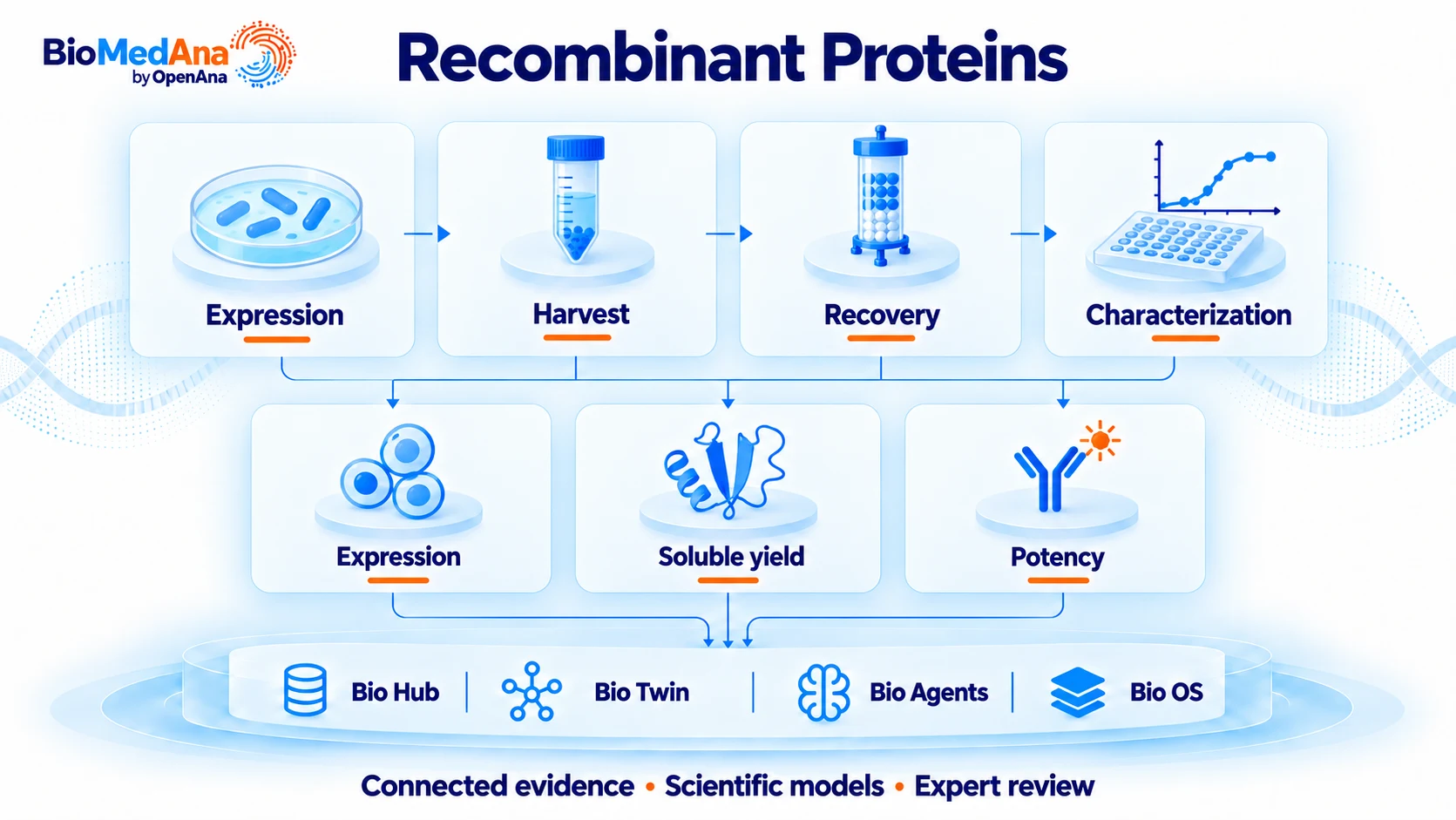
THE ENTERPRISE OBJECTIVE
A defined question.
A shared evidence basis.
Determine where mass recovery and activity recovery diverge, separate analytical artifacts from process-associated changes, and prioritize a confirmation study that protects the intended product function.
Across sites, programs and functions
A program project assembles approved campaign exports across expression, harvest, purification and characterization. Construct, host, process version, fraction, pool and assay identities remain attached to the measurements. Comparable product programs may reuse a reviewed method, but their activities and specifications are not pooled. Separate projects retain their authorized scope; the operating model does not require automatic cross-company access or a portfolio-wide data federation.
Continuity as new campaigns arrive
New campaigns are reconciled to the reviewed source layout and stage definitions. A change to an activity assay, reference standard or protein-quantity method requires analytical review before a historical trend is extended. Source values remain visible beside the derived stage-recovery measures.
Reconstruct the incident before ranking performance
Initial signal
The technical question is a divergence between acceptable protein-mass recovery and lower activity in selected final pools. The investigation starts with one product and a matched purification train, then examines the stage where mass and functional responses cease to track together.
Enterprise complexity
Campaigns may use different assay versions, sample matrices and hold histories. An expression result can refer to total protein while a purified-product result refers to a target-specific assay. A portfolio average would hide both the analytical differences and the location of a loss.
Decisive comparison
Match samples by product, campaign, stage and pool. Compare total recovered mass, total measured activity and specific activity on reviewed bases. Keep non-comparable matrices or assay versions separate until the laboratory establishes a sound comparison.
| Evidence domain | Decision it supports |
|---|---|
| Expression and harvest | Separates expression output from downstream performance. |
| Fractions and pools | Locates recovery changes within the train. |
| Activity and quantity assays | Establishes the specific-activity calculation basis. |
| Product characterization | Prevents purity alone being interpreted as retained function. |
The comparison is scoped by business and scientific context. Data volume is not used as a proxy for comparability, relevance or evidence quality.
HOW BIOMEDANA FITS
From source context
to a reviewable decision.
- 01
Define the product and purification cohort
Use Run Registry and project context to select the construct, host, process version and train. Connect harvest streams, purification stages and available fraction/pool evidence; retain exclusion reasons for incompatible campaign records.
- 02
Reconcile assays and material accounting
Use Imports and Mapping Studio for identities, units and source fields. Analytical reviewers establish the protein-quantity basis, activity units, dilution corrections, matrix effects and reference-standard comparability before stage calculations are used.
- 03
Compare mass and activity through the train
Use Analyze/Workbench on the committed measurements and supported formula results. Compare matched stage input/output mass and total activity. Review fraction/pool boundaries and hold intervals around an apparent divergence rather than assigning the final result to expression alone.
- 04
Save a function-focused decision pack
Save stage comparisons, assay qualifications, candidate loss points and the proposed confirmation plan in a project report. Use report review for scientific feedback. Forecasting is optional and only usable when the particular activity response is supported by its evaluated model.
Keep protein quantity, purity and activity distinct
Mass and activity are different measures
Protein quantity measures content; an activity assay measures a defined functional response. Specific activity is activity per mass on compatible measurement bases. Purity, recovered mass and activity cannot substitute for one another.
Stage recovery needs comparable accounting
Mass recovery compares target-product mass entering and leaving the same stage. Activity recovery compares total activity, not simply the activity concentration. Include volumes, dilutions, sampling and pooling boundaries. Check that assay response and matrix permit the comparison.
A change in specific activity is a question, not a mechanism
An apparent loss can reflect target quantification, matrix interference, reference drift or a process-associated change. Review orthogonal characterization and assay suitability before inferring denaturation, proteolysis or a different structural mechanism.
Keep prediction eligibility response-specific
A model suitable for protein mass is not automatically suitable for activity or potency. If held-out evaluation does not support the intended functional response, use the measured investigation and a confirmation study rather than publishing a modeled activity optimum.
| Evidence layer | Meaning in the decision |
|---|---|
| Observed | What source measurements and recorded events establish. |
| Interpreted | The explanation consistent with those observations. |
| Predicted | A result under declared model assumptions. |
| Confirmed | The predeclared criterion is met in follow-up evidence; causal interpretation depends on study design. |
A focused conclusion and a confirmation plan
Interpret the evidence through explicit decision paths, then confirm the hypothesis with the agreed study.
| Evidence pattern | Interpretation | Next decision |
|---|---|---|
| If mass recovery remains stable while activity recovery falls at a matched stage. | A functional or analytical effect needs investigation at that stage. | Review assay suitability and stage/hold evidence. |
| If the divergence changes after method or matrix reconciliation. | Part of the apparent process signal was analytical. | Retain the comparable result and record the correction. |
| If a residual activity pattern tracks a defined hold or pooling condition. | A bounded process hypothesis remains. | Confirm it with matched quantity and functional assays. |
The decision output is a stage-specific view of protein mass and functional activity, with analytical qualifications visible. The team can distinguish an expression shortfall, a purification recovery issue and a potential function-associated loss. The next study targets the unresolved stage or condition using an agreed assay basis.
| Confirmation element | What the next study establishes |
|---|---|
| Confirmation question | Does the candidate stage/hold condition change retained activity on a comparable assay basis? |
| Control variables | Construct/product, source material, train version, assay/reference and matrix basis. |
| Responses | Recovered target mass, total activity, specific activity and relevant characterization. |
| Decision boundary | Advance on the declared product-function and quality objectives; retain negative results. |
| Enterprise reuse | Reuse the reviewed stage definitions and assay metadata for later compatible campaigns. |
What your team reviews.
Protein activity investigation pack: stage mass/activity accounting; fraction and pool context; assay/reference basis; candidate loss points; and a function-focused confirmation plan.
Scope and interpretation
Recovered protein mass does not establish retained biological activity. Activity-specific forecasting requires its own evaluated model.
This scenario describes a proposed enterprise workflow. Deployment-specific integration, review and model behavior require verification. Business and process impact are evaluated against an agreed baseline and measured outcomes.
Explore the modality ↗Make the method repeatable across the enterprise
Product and expression ownership
Maintain construct, host, process-version and harvest-stream definitions for the selected program.
Purification ownership
Own stage boundaries, fraction/pool membership, volume accounting and hold records.
Analytical review
Own quantity/activity methods, reference standards, matrix suitability and interpretation of functional results.
Program and deployment ownership
Agree project permissions, source delivery and report responsibilities; qualify each intended model response separately.
Rollout gates and evidence requirements
- 01
Reconstruct a campaign
Reconcile stage, mass, activity and assay identity on historical evidence.
- 02
Confirm the hypothesis
Evaluate the specified stage or hold condition with new matched measurements.
- 03
Review the divergence
Have purification and analytical teams agree which comparison is scientifically usable.
- 04
Reuse across campaigns
Extend the method to compatible trains without pooling unlike products or assays.
Operating-model requirements are deployment-specific. Validate role/access behavior, reviewer workflows, retention, model governance and source delivery for the intended environment; this scenario does not assert certification or production readiness.
Measure functional evidence and investigation efficiency
The enterprise value is a shared explanation of where product mass and function diverge, so expression, purification and analytical teams work on the right question.
| Value dimension | How to evaluate it |
|---|---|
| Investigation focus | Time to locate the relevant stage and resolve analytical uncertainty. |
| Functional accounting | Coverage of matched mass/activity evidence and unresolved assay gaps. |
| Method reuse | Later campaigns using reviewed stage, pooling and assay definitions. |
| Measured output | Prospective retained activity and quality after an adopted change, with attribution recorded. |
A credible benefit assessment
Choose a baseline period and comparable investigation or campaign scope. Record how elapsed time, review effort or process response is measured. Separate improvement in data preparation from improvement in scientific interpretation, and separate both from any measured manufacturing result. Include adverse, inconclusive and unchanged outcomes.
What leadership receives
A defined investigation scope; a common evidence basis for the participating teams; a documented conclusion with remaining uncertainty; and a confirmation plan with owners. Portfolio expansion follows demonstrated reuse and the required deployment checks, rather than an assumption that one successful analysis establishes every use case.
START WITH YOUR PROCESS QUESTION
Turn the evidence
into a reviewable next step.
Bring your program context, available evidence and the decision your team needs to make.