07 / RNA & oligonucleotides
Balancing oligonucleotide purity and recovery across synthesis campaigns
A synthetic ASO-focused use case connecting sequence/process context, impurity characterization and purification pooling.
Proposed enterprise workflow · Source-linked analysis · Expert review
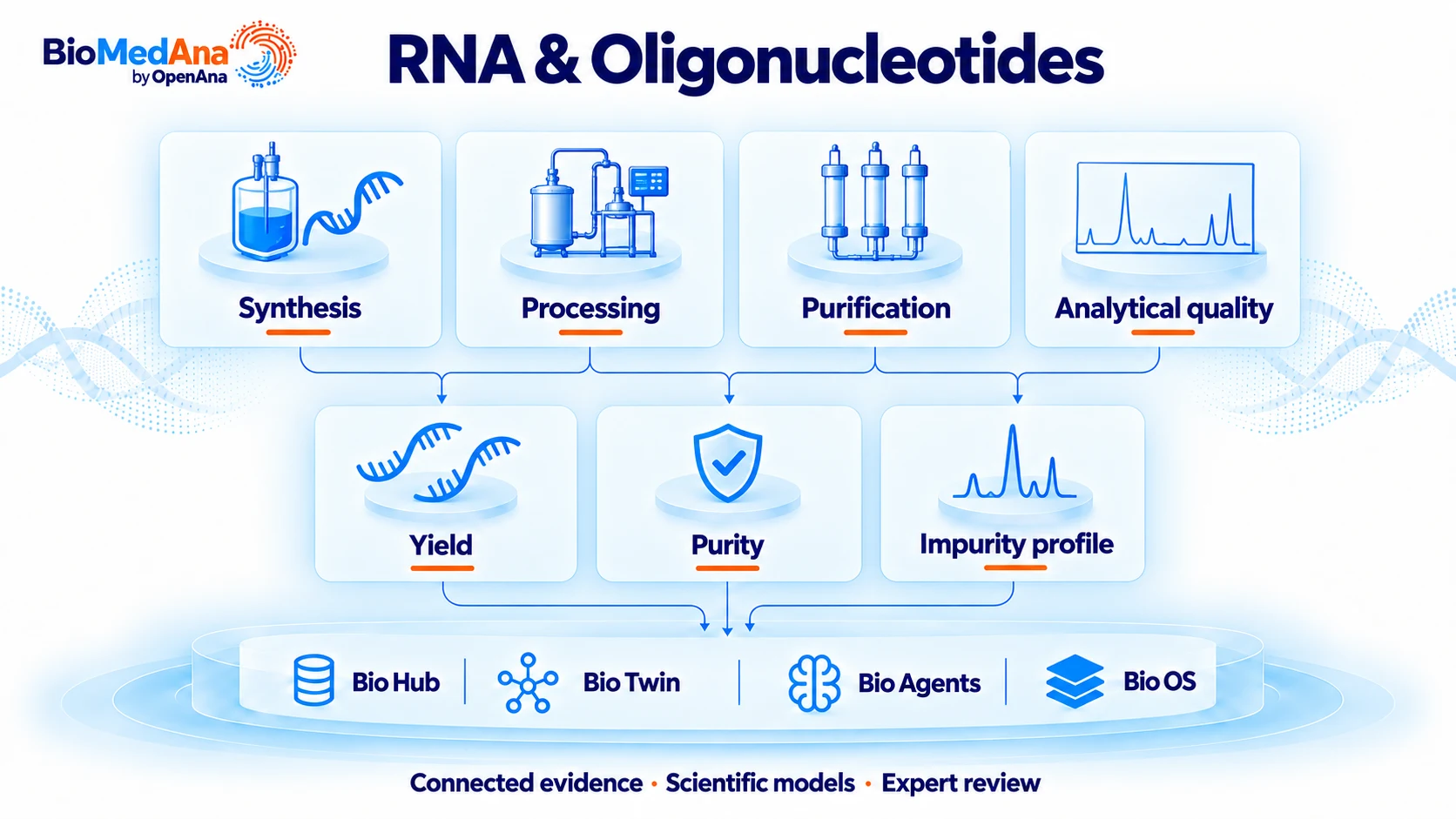
THE ENTERPRISE OBJECTIVE
A defined question.
A shared evidence basis.
Determine whether the limiting question lies in synthesis, impurity characterization or purification pooling, then select a confirmation study on a sequence- and method-specific basis.
Across sites, programs and functions
An authorized program project assembles approved exports for a chemically synthesized antisense oligonucleotide, including sequence/chemistry, process version, reagent lots and purification evidence. Sequence variants remain distinct. The data contract can be reused across compatible products but does not presume cross-project aggregation. The broader website category includes RNA: this use case covers synthetic ASOs, not in-vitro-transcribed mRNA or an LNP formulation workflow.
Continuity as new campaigns arrive
New campaigns retain sequence, modification and method versions alongside the source records. Impurity labels, peak assignments and response bases require analytical review when methods change. Partner files enter the agreed project scope with reviewed mappings; site access and source delivery are deployment-specific.
Reconstruct the incident before ranking performance
Initial signal
The program asks why favorable synthesis monitoring does not consistently translate into the desired isolated-product outcome, or why a higher-purity pool yields less material. The comparison starts with the same sequence/chemistry and an agreed process boundary.
Enterprise complexity
Campaigns differ in reagent lots, process versions, analytical methods and pooling conventions. An impurity label can group distinct species, while mass or UV-based quantity may use different water, salt or assay bases. A network comparison must first establish what the numbers represent.
Decisive comparison
Follow synthesis evidence into crude characterization and then the fraction/pool decision. Establish the impurity-identification and quantity bases, compare compatible material and retain the fractions excluded from the proposed pool as part of the trade-off evidence.
| Evidence domain | Decision it supports |
|---|---|
| Sequence and chemistry | Keeps unlike synthesis contexts separate. |
| Synthesis and crude evidence | Distinguishes an in-process indicator from isolated product outcome. |
| Fractions and pools | Defines the purification recovery/purity trade-off. |
| Identity, impurity and quantity | Prevents one chromatographic purity figure standing in for the entire quality assessment. |
The comparison is scoped by business and scientific context. Data volume is not used as a proxy for comparability, relevance or evidence quality.
HOW BIOMEDANA FITS
From source context
to a reviewable decision.
- 01
Define the sequence/process cohort
Use program and Run Registry context for sequence identity, modification pattern, process version and material lots. Keep sequence changes and conjugation stages separate unless the scientific comparison explicitly covers them.
- 02
Reconcile synthesis and analytical records
Use Imports and Mapping Studio for run/sample/fraction identities and units. Analytical review establishes peak/impurity assignments, identity evidence, purity method and product-quantity basis before derived yield is interpreted.
- 03
Compare crude and pool outcomes
Use the oligonucleotide workspace and Analyze/Workbench where supported data are available. Compare the crude result, characterized fractions and candidate pool on compatible bases. Record which product and impurity evidence changes with the pool boundary.
- 04
Save a synthesis-versus-pooling decision
Save the cohort, impurity/method basis, fraction selection, quantity accounting and unresolved questions in a report. Plan a targeted synthesis or purification experiment. Do not assume a qualified mRNA/ASO prediction model from the presence of a modality screen.
Keep sequence, impurity evidence and recovery together
A cycle indicator is not isolated yield
Stepwise synthesis indicators can guide a question but do not establish isolated full-length product recovery. Review crude characterization and the subsequent process steps. Any cumulative estimate must state its assumptions and cannot replace product measurement.
Impurity identity needs suitable evidence
Chromatographic retention or nominal length alone does not establish impurity identity. Use the relevant orthogonal characterization and method suitability. Distinguish synthesis-related sequence variants and other process/product-related species where the evidence supports it.
Purity and quantity require declared bases
Area percent is not automatically mass percent or molar fraction. Product mass, assay, salt/water basis and molecular identity affect yield interpretation. Retain the analytical response basis and material boundary when comparing campaigns.
Pool trade-offs are sequence-specific
A pooling decision can change product recovery and the impurity profile differently. Review candidate fractions, total quantity and product-specific quality objectives together. This synthetic-ASO workflow must not be generalized to mRNA synthesis, capping, dsRNA control or LNP encapsulation.
| Evidence layer | Meaning in the decision |
|---|---|
| Observed | What source measurements and recorded events establish. |
| Interpreted | The explanation consistent with those observations. |
| Predicted | A result under declared model assumptions. |
| Confirmed | The predeclared criterion is met in follow-up evidence; causal interpretation depends on study design. |
A focused conclusion and a confirmation plan
Interpret the evidence through explicit decision paths, then confirm the hypothesis with the agreed study.
| Evidence pattern | Interpretation | Next decision |
|---|---|---|
| If a favorable synthesis indicator does not carry through to crude/final product evidence. | The monitoring signal is insufficient to establish the limiting mechanism. | Review the relevant synthesis and downstream stages separately. |
| If a narrower pool improves an impurity result while lowering recovered product. | The decision is a purity/recovery trade-off on the reviewed assay basis. | Compare candidate pools against predeclared quality objectives. |
| If the campaign ranking changes after quantity/method reconciliation. | Some apparent difference came from incompatible response definitions. | Retain the comparable cohort and resolve the analytical basis. |
The decision output separates the synthesis question from the purification-pool question and the analytical uncertainties. Reviewers agree which sequence/process cohort can be compared, which impurity evidence matters and how recovery is calculated. The next study targets the limiting stage instead of treating a single purity or cycle-efficiency number as overall process success.
| Confirmation element | What the next study establishes |
|---|---|
| Confirmation question | Does the selected synthesis/pool change improve the declared product-quality/recovery balance? |
| Control variables | Sequence/chemistry, process stage, source material, analytical method and quantity basis. |
| Responses | Characterized impurity profile, product identity/assay and recovered product on the agreed basis. |
| Decision boundary | Judge the full response set; keep unresolved impurity identity or method gaps visible. |
| Enterprise reuse | Reuse reviewed source and fraction definitions within scientifically compatible sequence families. |
What your team reviews.
Oligonucleotide investigation pack: sequence/process cohort; crude-to-fraction evidence; impurity assignments and method basis; candidate-pool quantity accounting; and a purity/recovery confirmation plan.
Scope and interpretation
This scenario covers chemically synthesized antisense oligonucleotides, not mRNA or LNP workflows. Purity and recovery require sequence- and method-specific interpretation.
This scenario describes a proposed enterprise workflow. Deployment-specific integration, review and model behavior require verification. Business and process impact are evaluated against an agreed baseline and measured outcomes.
Explore the modality ↗Make the method repeatable across the enterprise
Sequence and synthesis ownership
Maintain sequence/chemistry, process-version and reagent-lot context.
Purification ownership
Own fraction selection, pooling boundaries and material accounting.
Analytical and quality review
Own identity/impurity evidence, response/quantity basis and the product-specific quality objectives.
Program and deployment ownership
Agree partner source delivery, project permissions and supported modality scope; verify any proposed model separately.
Rollout gates and evidence requirements
- 01
Reconstruct one product campaign
Connect sequence/process, crude evidence and purification fractions.
- 02
Confirm the limiting stage
Test a bounded synthesis or pooling question on new evidence.
- 03
Review methods and quantity
Agree usable impurity, identity, assay and recovery bases.
- 04
Reuse within chemistry scope
Extend to compatible products with explicit sequence and method exceptions.
Operating-model requirements are deployment-specific. Validate role/access behavior, reviewer workflows, retention, model governance and source delivery for the intended environment; this scenario does not assert certification or production readiness.
Measure evidence readiness and the purity/recovery decision
The enterprise value is an auditable scientific argument for the synthesis or purification decision, with product identity, impurity evidence and recovery kept in the same context.
| Value dimension | How to evaluate it |
|---|---|
| Investigation specificity | Questions localized to synthesis, pooling or analytical basis. |
| Evidence readiness | Coverage of sequence, impurity, fraction and quantity inputs for the decision. |
| Partner alignment | Source definitions and unresolved analytical requests agreed across organizations. |
| Measured process response | Prospective quality/recovery results on the agreed basis, including adverse or unchanged results. |
A credible benefit assessment
Choose a baseline period and comparable investigation or campaign scope. Record how elapsed time, review effort or process response is measured. Separate improvement in data preparation from improvement in scientific interpretation, and separate both from any measured manufacturing result. Include adverse, inconclusive and unchanged outcomes.
What leadership receives
A defined investigation scope; a common evidence basis for the participating teams; a documented conclusion with remaining uncertainty; and a confirmation plan with owners. Portfolio expansion follows demonstrated reuse and the required deployment checks, rather than an assumption that one successful analysis establishes every use case.
START WITH YOUR PROCESS QUESTION
Turn the evidence
into a reviewable next step.
Bring your program context, available evidence and the decision your team needs to make.