15 / Monoclonal antibodies
Hybrid modeling: turning batch history into a perfusion study plan
Editorial date
A process-intensification workflow that uses existing culture evidence to frame new experiments while exposing the limits of transfer between operating modes.
Proposed enterprise workflow · Source-linked analysis · Expert review
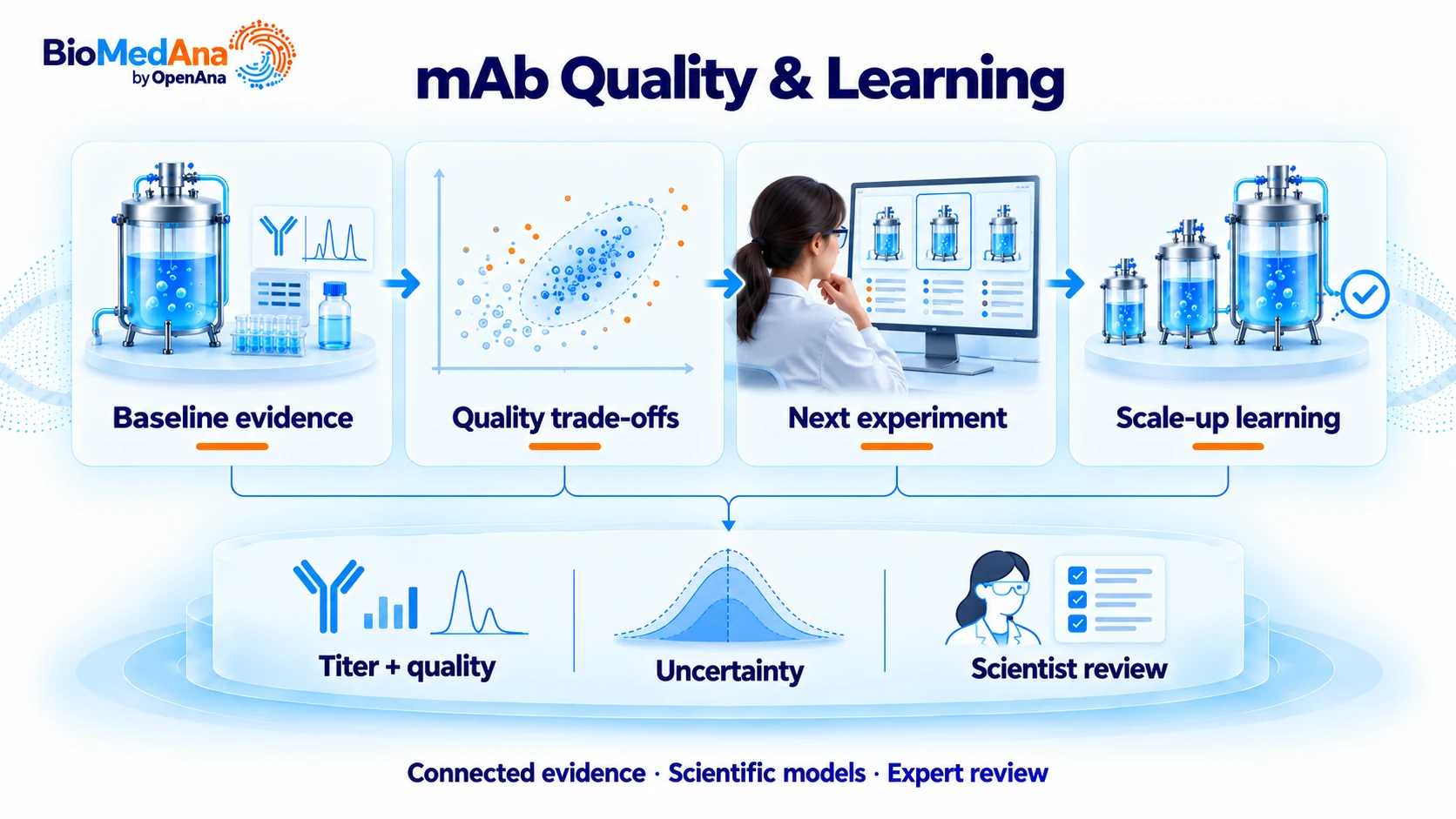
THE ENTERPRISE OBJECTIVE
A defined question.
A shared evidence basis.
Help a development team decide which perfusion measurements and experiments are needed before making credible process-performance predictions.
Start with the receiving decision
A hypothetical antibody team has a substantial fed-batch history and is considering a perfusion process. The records can inform biological hypotheses, but the receiving mode introduces continuous material exchange, retention and bleed behavior. The immediate deliverable is a defensible learning plan rather than a confident forecast of perfusion output.
The decision owner
Process development and MSAT own the scientific interpretation, with engineering, analytical and quality colleagues reviewing evidence relevant to their responsibilities.
Why the decision matters
The investment question is which learning can be reused and which experiments must be funded before committing to the new mode. A large fed-batch dataset can still leave retention, product passage and sustained high-density behavior unobserved. The value of the first modeling stage is to make those evidence gaps specific enough to guide an experiment budget and a decision sequence.
Which knowledge can transfer from the fed-batch evidence, and which assumptions require direct perfusion experiments?
Prepare comparable culture histories with feeds, viable-cell density, metabolites, volume, titer and assay context. Identify where the history contains informative perturbations and where inputs always change together. For the perfusion study, specify medium exchange, bleed, retention performance and product passage measurements in addition to the existing panel.
The evidence boundary
Keep observations, derived quantities and model outputs distinguishable. Missing evidence remains an explicit gap in the review record, with an owner and a proposed way to resolve it.
HOW BIOMEDANA FITS
From source context
to a reviewable decision.
- 01
Establish the transferable evidence
Bio Hub organizes the fed-batch cohort and distinguishes measured observations from estimates and unobserved mechanisms.
- 02
Scope the mode extension
Define a dedicated Twin modeling engagement for perfusion balances and retention behavior. Existing fed-batch support does not imply perfusion readiness.
- 03
Choose informative experiments
Prioritize studies that challenge uncertain rate behavior and material exchange assumptions, within the development team’s approved experimental boundaries.
- 04
Review before forecasting
Compare predictions with new perfusion observations and decide whether to recalibrate, extend the experiment set or restrict the intended use.
Challenge the explanation before using the estimate
A hybrid structure can combine material balances with a learned representation of selected biological rates. Transfer requires explicitly representing the new inlet, outlet, retention and product-removal terms. Decide which parameters remain provisional and which may change with the operating environment. A learned rate function is especially uncertain outside the conditions represented in its training data.
Evaluation for this decision
Evaluate the fed-batch component on independent runs before extending the structure. Use initial perfusion experiments to test the additional terms and challenge transferred assumptions. Assess transient behavior, viable biomass, metabolites and product measurements separately; a match to one response cannot validate the others. Reserve further runs for evaluation after calibration.
Make the model assumptions inspectable
Define the process boundary before transferring any learned behavior. A fed-batch endpoint does not represent the same product inventory as material collected continuously from a perfusion process. The review needs a consistent accounting basis for vessel inventory, collected product, bleed losses and sampling. Compare productivity only after the time basis, volume basis and material boundary are stated.
Make the next action explicit
| Review finding | Next action |
|---|---|
| The extended balances can be challenged experimentally | Select a bounded perfusion learning study and retain independent experiments for later evaluation. |
| Retention or product passage is assumed rather than measured | Prioritize measurements that distinguish outlet behavior from changes in biological rates. |
| The requested forecast exceeds the observed mode or region | Keep the simulation at hypothesis-generation scope and gather direct perfusion evidence before forecasting performance. |
How to evaluate value
Measure the uncertainty resolved by each experiment, held-out perfusion behavior and remaining unsupported outputs. Compare resource requirements only after establishing a process-specific evidence basis.
What your team reviews.
A cross-mode learning plan with transferable assumptions, required balance extensions, new measurements, experimental priorities and separate calibration and evaluation gates.
Scope and interpretation
Perfusion requires a separate model extension and direct evidence. This scenario does not claim an existing production-ready perfusion predictor, cross-mode validation or achieved productivity improvement.
This scenario describes a proposed enterprise workflow. Deployment-specific integration, review and model behavior require verification. Business and process impact are evaluated against an agreed baseline and measured outcomes.
Explore the modality ↗The evidence needed to make this comparison useful
Build the evidence set around the receiving question. The following review map identifies what each source contributes and the uncertainty it is intended to resolve.
| Evidence layer | What to retain | Question it helps answer |
|---|---|---|
| Biological history | Comparable growth, viability, metabolism and product observations. | Which rate relationships are informed within the existing operating region? |
| Exchange and retention | Inlet and outlet flows, bleed history and measured retention behavior. | Can the new cell and material balances be evaluated? |
| Product accounting | Vessel concentration, permeate or harvest concentration, collected volumes and losses. | Is the proposed performance metric defined consistently? |
| Independent quality evidence | Product-specific assays with sampling location and method context. | What must be measured separately from a process-performance prediction? |
Distinguishing a biological limitation from a retention assumption
Consider an illustrative team that transfers a fed-batch model into a proposed perfusion study. Its simulation assumes effective cell retention and a chosen product-passage behavior. The predicted biomass and product collection look attractive, but those assumptions were never observed in the historical runs. The immediate scientific question is which new measurements would most strongly challenge them.
The first experiment should connect the vessel state with the material leaving it. If measured biomass differs from the expected trajectory, the team examines both biological rates and cell losses before recalibrating growth. If product collection differs, it examines the product balance, passage assumptions and sample locations before concluding that cell-specific production has changed. Adjusting a biological term to absorb an incorrect outlet balance would weaken the next prediction.
The team then considers the range of conditions actually observed. A learned fed-batch relationship may be informative near its original region and uncertain at a sustained density or nutrient state absent from that history. Rather than requesting an unrestricted search for the best perfusion condition, reviewers choose a bounded set of questions that distinguish the dominant uncertainties and can be tested within the development plan.
After new observations are reviewed, some components may be retained, some recalibrated and others replaced. The decision to move from hypothesis generation to performance forecasting is an explicit gate. The team preserves which experiments were used to make that change and which remain independent evidence. This scenario describes how to learn across modes; it does not report successful transfer or an achieved intensification result.
A staged path from the first review to repeatable use
Four delivery stages
- 01
Fed-batch evidence audit
Check endpoint definitions, independent model behavior and the region covered by the historical cohort. Identify assumptions that were never challenged by that process mode.
- 02
Explicit balance extension
Scope the inlet, outlet, bleed, retention and product terms required for perfusion. Document the expected measurements and unresolved terms before fitting them.
- 03
Targeted learning studies
Select experiments that distinguish biology from exchange and retention effects. Keep operating decisions and experimental authorization with the development team.
- 04
Independent mode evaluation
Challenge the updated model with additional perfusion evidence. Restrict its use to the supported questions and conditions, then define the next uncertainty to resolve.
What travels with the decision
The cross-mode dossier should identify each transferred relationship, its original evidence region and its current status: retained hypothesis, recalibrated component or newly evaluated term. Include a material-accounting diagram or table, measurement locations, assay context and the boundary of the claimed output. An MSAT reviewer should be able to see why a promising simulation is or is not ready to influence the next development milestone.
Questions to settle before starting
Can a fed-batch model predict perfusion without new experiments?
It can generate hypotheses under explicit assumptions. Credible performance forecasting requires a suitable structure and evidence for the new mode. Fed-batch fit alone does not evaluate retention, continuous removal or sustained conditions.
What is the role of the machine-learning component?
It represents selected relationships that are not fully specified by the mechanistic structure. Its inputs, outputs and training region need to be stated, and the overall model still needs independent evaluation for the intended use.
Should the first objective be maximum productivity?
Begin with a measurable learning question and a consistent material basis. A productivity comparison is useful only when its assumptions, product accounting, resource basis and independent quality evidence can be reviewed.
Scientific background and further reading
These references provide background for the scientific methods and review considerations discussed here. The scenario, delivery plan and decision examples are proposed BioMedAna workflows; the publications do not establish BioMedAna deployment or performance.
START WITH YOUR PROCESS QUESTION
Turn the evidence
into a reviewable next step.
Bring your program context, available evidence and the decision your team needs to make.