02 / Microbial fermentation
Separating fermentation productivity loss from recovery loss
An enterprise investigation reconciling assay basis, production-phase accounting and recovery performance across a fermentation network.
Proposed enterprise workflow · Source-linked analysis · Expert review
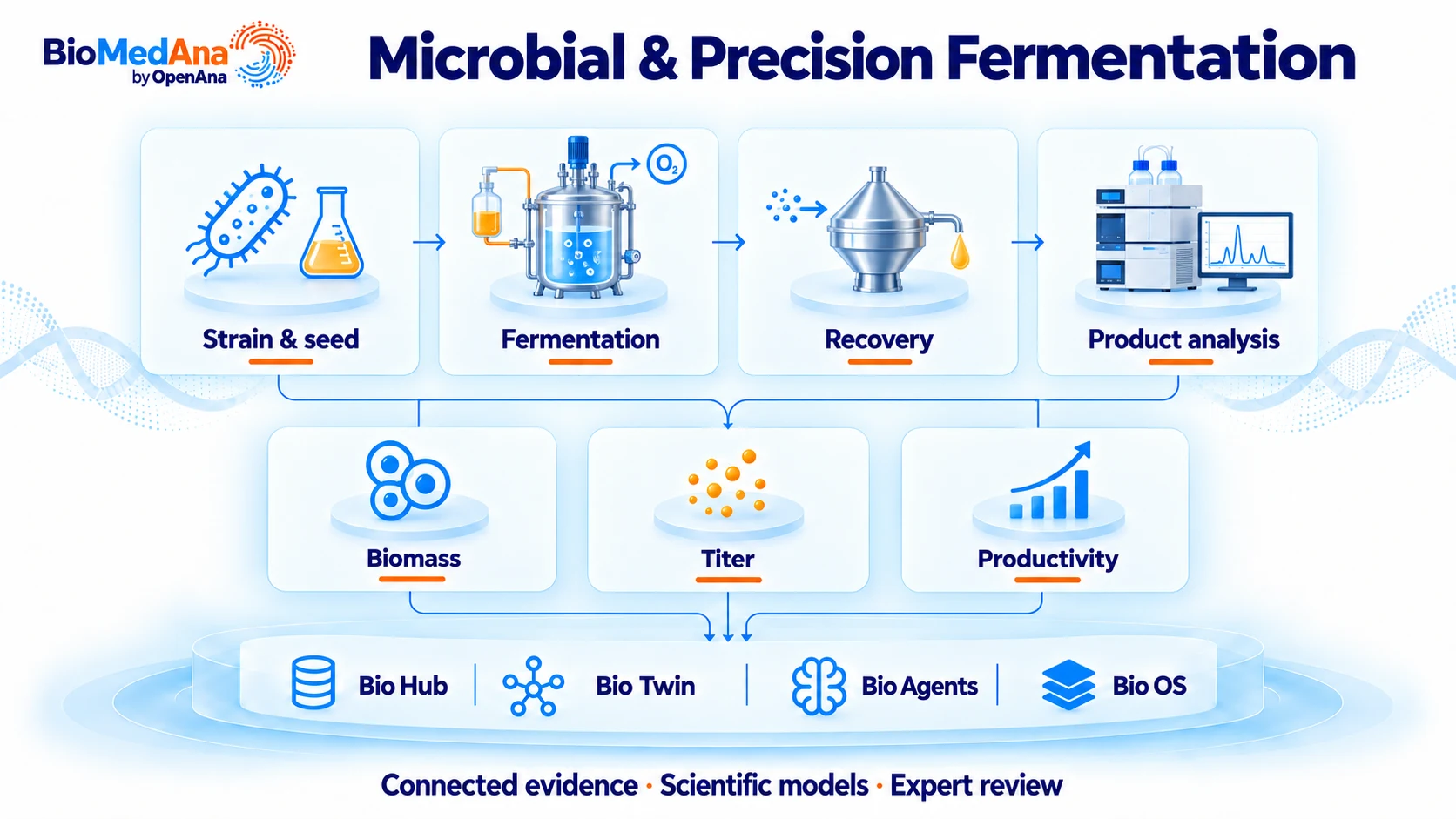
THE ENTERPRISE OBJECTIVE
A defined question.
A shared evidence basis.
Connect strain-to-batch lineage with phase-resolved process and assay evidence, distinguish a true productivity loss from a change in measurement basis, and prioritize experiments that resolve the largest uncertainty. The same method must remain usable as campaigns, strains and equipment change.
Across sites, programs and functions
The use case spans development, pilot and manufacturing evidence without collapsing them into one leaderboard. The program team organizes each campaign by strain/construct version, bank lineage, recipe version, equipment and scale. High-frequency online measurements remain linked to the batch, while offline assays and recovery records retain their own sampling and analytical basis. Evidence is assembled in an authorized program project from approved source exports. Separate programs retain separate project scope; portfolio reuse refers to methods, not an assumed automatic cross-project or cross-company data view.
Continuity as new campaigns arrive
New campaign files are assessed against their reviewed source layout and expected run identities before commitment. Missing offline measurements are visible as coverage gaps. A batch with complete records and a failed product result remains analyzable; it is not confused with a failed import.
Reconstruct the incident before ranking performance
Initial signal
A portfolio report shows lower volumetric productivity in transferred campaigns. The first operating response would be to revisit the feed strategy, but the scientists first ask whether the output and time bases are actually comparable.
What makes it enterprise work
One site reports vessel concentration, another reports diluted assay concentration, and recovery teams report product mass after concentration or isolation. Campaign durations and production-phase start definitions also differ. The comparison therefore starts by reconciling how performance is defined.
The decisive comparison
The team reconciles dilution and volume basis, separates production time from total elapsed time and follows strain/recipe versions. It then examines the residual performance difference alongside feed events, substrate measurements and oxygen-related process evidence.
| Evidence domain | Decision it supports |
|---|---|
| Biological lineage | Prevents a biological change being mistaken for a scale effect. |
| Feed and process execution | Connects the recipe to actual execution. |
| Online and offline response | Supports phase-specific investigation. |
| Recovery and quality | Separates fermentation output from recovery performance. |
The comparison is scoped by business and scientific context. Data volume is not used as a proxy for comparability, relevance or evidence quality.
HOW BIOMEDANA FITS
From source context
to a reviewable decision.
- 01
Build lineage-aware campaign groups
Select the strain/construct and recipe versions in scope. Keep bank and seed context attached to run records. Segment by scale and equipment before comparing development and manufacturing behavior.
- 02
Define and calculate the response consistently
Review units, dilution corrections, working volume and phase boundaries. Use the formula workflow only after the required inputs and calculation basis are available; otherwise retain a reviewed calculation. Keep raw assays visible alongside derived responses.
- 03
Investigate phase-specific performance
Use Analyze/Workbench to compare production-phase metrics and inspect product/substrate trajectories with feed-event context. Keep strain, recipe and equipment cohorts separate. A low dissolved-oxygen reading alone does not establish the mechanism of a productivity loss.
- 04
Separate fermentation and recovery workstreams
Follow incoming and recovered product mass on a consistent basis. Save the phase comparison and recovery accounting in a report draft, assigning each open question to fermentation, analytical or recovery reviewers.
Define the mass, time and recovery basis
Specify the productivity calculation
A phase concentration difference is not a product-mass balance when volume changes. Account for starting/ending product mass and product removed or introduced. Define the volume-time denominator for volumetric productivity and preserve the measured inputs. This is net accounting, not a direct measure of gross biosynthesis.
Separate substrate added from substrate consumed
Substrate yield needs a consumption basis, not just feed addition. Review starting substrate, additions, residual substrate, sampling and volume changes over the same interval. Show an unavailable metric if those inputs cannot support the calculation.
Keep fermentation and recovery denominators separate
Compare fermentation output at a declared boundary. Calculate stage recovery from product entering and leaving that stage on the same assay and mass basis. Diluted concentrations or different isolation stages cannot establish a loss by themselves.
Localize the oxygen-related hypothesis
Inspect available oxygen-transfer measurements, oxygen-demand evidence, operating conditions and phase-specific execution. Nominal vessel size and dissolved oxygen alone do not establish transfer limitation. Use any forecast only within the model's evaluated response and horizon.
| Evidence layer | Meaning in the decision |
|---|---|
| Observed | What source measurements and recorded events establish. |
| Interpreted | The explanation consistent with those observations. |
| Predicted | A result under declared model assumptions. |
| Confirmed | The predeclared criterion is met in follow-up evidence; causal interpretation depends on study design. |
A focused conclusion and a confirmation plan
Interpret the evidence through explicit decision paths, then confirm the hypothesis with the agreed study.
| Evidence pattern | Interpretation | Next decision |
|---|---|---|
| If part of the reported gap changes after dilution and time-basis reconciliation. | The initial portfolio comparison mixed different response definitions. | Replace the mixed metric with clearly defined comparable measures. |
| If a residual net-productivity pattern appears in one matched production-phase cohort. | A localized execution hypothesis remains after accounting reconciliation. | Review feed/substrate and measured oxygen-transfer evidence. |
| If stage-matched product-mass accounting identifies a separate recovery shortfall in the scenario. | A recovery workstream is warranted on the matched assay basis. | Investigate the stage separately from fermentation productivity. |
The decision output separates assay/denominator reconciliation, residual fermentation performance and stage-specific recovery. Each receives an owner and response basis. A fermentation follow-up targets the residual process hypothesis, while recovery teams investigate their own stage-specific mass accounting.
| Confirmation element | What the next study establishes |
|---|---|
| Confirmation question | Does the phase-specific performance pattern recur with matched response definitions? |
| Control variables | Strain/bank, recipe version, analytical basis and declared operating context. |
| Responses | Net product mass, phase productivity on the defined denominator, substrate consumption and stage recovery. |
| Decision boundary | Interpret process and recovery outcomes separately; retain inconclusive runs and missing inputs. |
| Enterprise reuse | Carry agreed definitions and lineage rules into future campaigns and partner transfers. |
What your team reviews.
Campaign accounting pack: raw and corrected assay basis; phase boundaries; product/substrate calculations with input coverage; matched trend comparisons; and separate fermentation/recovery action lists.
Scope and interpretation
Keep assay, production-phase and recovery accounting distinct. A single process signal does not establish the cause of productivity loss.
This scenario describes a proposed enterprise workflow. Deployment-specific integration, review and model behavior require verification. Business and process impact are evaluated against an agreed baseline and measured outcomes.
Explore the modality ↗Make the method repeatable across the enterprise
Biological and process ownership
Assign owners for strain/construct history, bank references and recipe-version context.
Data stewardship
Review units, assay basis, dilution factors and source-to-derived-variable mappings.
Cross-functional scientific review
Fermentation, operations and recovery teams review the same investigation with responsibilities attached to each open hypothesis.
Enterprise operating controls
Specify access scope, retention, source delivery and review ownership for each internal or partner environment; verify implementation before broader rollout.
Rollout gates and evidence requirements
- 01
Campaign reconciliation
Agree the response definitions and recreate an existing campaign comparison.
- 02
Prospective confirmation
Evaluate the targeted process hypothesis on new measured campaign evidence.
- 03
Cross-functional investigation
Separate fermentation performance, accounting issues and recovery behavior.
- 04
Network adoption
Reuse the method across compatible strains and recipes, with explicit exceptions.
Operating-model requirements are deployment-specific. Validate role/access behavior, reviewer workflows, retention, model governance and source delivery for the intended environment; this scenario does not assert certification or production readiness.
Measure investigation effort and accountable process output
The enterprise value is a shared scientific basis for deciding what to fix, where to fix it and which evidence is still needed across fermentation and recovery operations.
| Value dimension | How to evaluate it |
|---|---|
| Data preparation | Time to produce a comparable campaign dataset with reviewed units and lineage. |
| Investigation precision | Open hypotheses resolved by evidence, not merely assigned to a general scale-up category. |
| Transfer execution | Completeness of receiving-team evidence and recurrence of previously identified gaps. |
| Measured output | Prospective product and recovery outcomes on the agreed basis, with attribution limits stated. |
A credible benefit assessment
Choose a baseline period and comparable investigation or campaign scope. Record how elapsed time, review effort or process response is measured. Separate improvement in data preparation from improvement in scientific interpretation, and separate both from any measured manufacturing result. Include adverse, inconclusive and unchanged outcomes.
What leadership receives
A defined investigation scope; a common evidence basis for the participating teams; a documented conclusion with remaining uncertainty; and a confirmation plan with owners. Portfolio expansion follows demonstrated reuse and the required deployment checks, rather than an assumption that one successful analysis establishes every use case.
START WITH YOUR PROCESS QUESTION
Turn the evidence
into a reviewable next step.
Bring your program context, available evidence and the decision your team needs to make.