05 / Cell therapies
Separating starting-material variability from cell-process performance
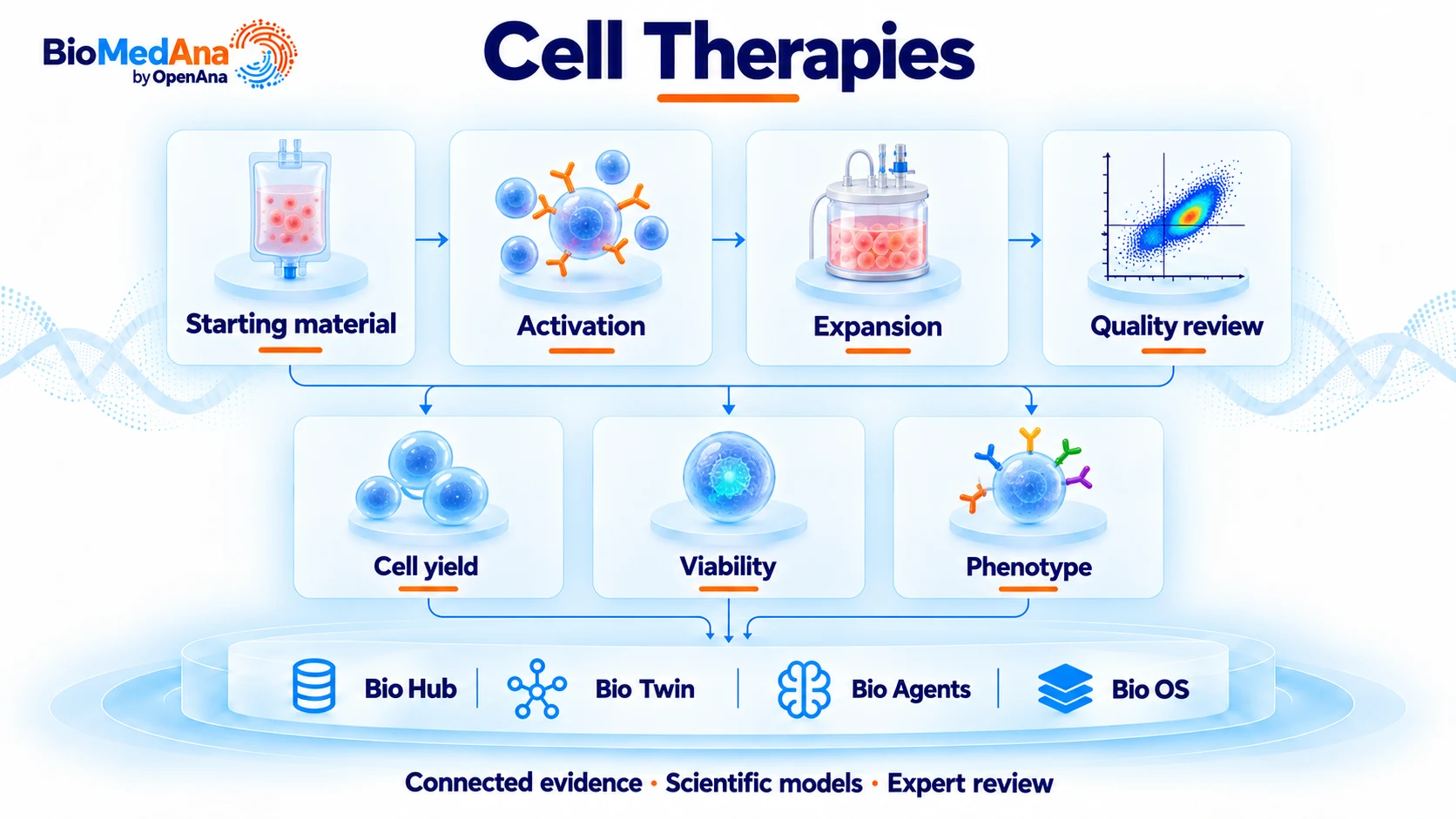
An autologous cell-therapy development use case connecting material attributes, stage performance, viable yield and product-specific potency.
Proposed enterprise workflow · Source-linked analysis · Expert review
THE ENTERPRISE OBJECTIVE
A defined question.
A shared evidence basis.
Separate starting-material effects, process-stage effects and measurement differences, then define a donor-aware confirmation study with distinct yield, phenotype and functional responses.
Across sites, programs and functions
The use case concerns an autologous program with evidence reviewed inside an authorized project. Pseudonymous source and manufacturing identifiers preserve the allowed linkage between starting material, process stages and samples. Direct patient identifiers are not needed for this development analysis. Each product/process version remains separately scoped, and partner evidence is delivered through agreed exports rather than assumed automatic clinical-system or cross-company integration.
Continuity as new campaigns arrive
New process runs retain the same stage and sampling definitions where scientifically appropriate. Repeated samples from one donor or manufacturing run remain linked, so they cannot be counted as independent evidence. Identity, custody and clinical record systems remain authoritative for their own workflows.
Reconstruct the incident before ranking performance
Initial signal
A development comparison asks why one group of manufacturing runs has lower viable output or a different phenotype. Before changing expansion conditions, the team examines starting-material composition, process version and the measurement basis at each site.
Enterprise complexity
Site and donor/source differences may overlap. Multiple samples from a single run can dominate a pooled analysis, and different gating or counting methods can create an apparent shift. A comparison across different products or process versions would add another ambiguity.
Decisive comparison
Match or stratify on the relevant available starting-material and process attributes, preserve donor/run relationships and compare the same stage endpoints. If the available populations do not overlap, document the limitation and design a suitable development study.
| Evidence domain | Decision it supports |
|---|---|
| Starting-material context | Defines the baseline without exposing unnecessary personal data. |
| Process-stage history | Locates changes across the living process. |
| Cell number and phenotype | Separates growth from a change in cell composition. |
| Product-specific function | Keeps viable yield distinct from potency and disposition. |
The comparison is scoped by business and scientific context. Data volume is not used as a proxy for comparability, relevance or evidence quality.
HOW BIOMEDANA FITS
From source context
to a reviewable decision.
- 01
Define an authorized development cohort
Use project and Run Registry context for product/process version, site, pseudonymous source and manufacturing run. Keep donor/run relationships explicit and exclude direct identifiers that the investigation does not need.
- 02
Reconcile stage and assay definitions
Use Imports and Mapping Studio for source identities, units and sample links. Analytical reviewers confirm count methods, viability measures, gating definitions, sample timing and functional assay basis before comparing sites.
- 03
Compare the responses separately
Use Analyze/Workbench to inspect viable yield, phenotype and measured functional results on their declared bases. Show individual run variation and starting-material strata. Treat stage samples as repeated observations, not additional donors or independent batches.
- 04
Prepare a donor-aware confirmation plan
Save the cohort, exclusions, comparisons and open hypotheses in a report. Consider paired or blocked development experiments where feasible, with prespecified endpoints. Clinical dose, product release and patient treatment remain with the responsible procedures and teams.
Respect the population, assay and donor structure
Viable yield requires a clear population
Document whether a recorded count is total, viable or already viability-corrected. Do not apply viability twice. A target-population percentage also needs a defined gating denominator before it can support a target-cell count.
Cell number is not product-specific potency
Growth, viability, phenotype and functional response describe different attributes. Potency interpretation depends on the intended product and its assay strategy; there is no universal potency score that can replace that evidence.
Donor/run dependence changes the comparison
Repeated timepoints from the same material do not create independent donors. Preserve that dependence in plots and study design. A site effect cannot be isolated where site, starting material and process version have no useful overlap.
Prospective learning needs a declared boundary
Use a study plan that separates starting-material strata from the factor under test. Keep process-development predictions distinct from measured responses, and do not turn a modeled yield or phenotype into a clinical or release recommendation.
| Evidence layer | Meaning in the decision |
|---|---|
| Observed | What source measurements and recorded events establish. |
| Interpreted | The explanation consistent with those observations. |
| Predicted | A result under declared model assumptions. |
| Confirmed | The predeclared criterion is met in follow-up evidence; causal interpretation depends on study design. |
A focused conclusion and a confirmation plan
Interpret the evidence through explicit decision paths, then confirm the hypothesis with the agreed study.
| Evidence pattern | Interpretation | Next decision |
|---|---|---|
| If the apparent site contrast changes after source and assay alignment. | The pooled comparison mixed starting-material or measurement differences. | Retain the usable strata and list gaps. |
| If a stage-specific difference remains within a comparable cohort. | A process hypothesis merits a targeted development study. | Test the stage factor using donor-aware design. |
| If viable yield improves without support from the functional response. | Cell output alone does not establish product improvement. | Review phenotype and product-specific potency evidence separately. |
The decision output separates differences attributable to comparison basis from the stage-specific hypotheses still worth testing. Process and analytical reviewers share a cohort definition and distinct yield, phenotype and functional endpoints. The next experiment evaluates process robustness without making a clinical efficacy or automatic release claim.
| Confirmation element | What the next study establishes |
|---|---|
| Confirmation question | Does the stage/process factor change the declared response within relevant source strata? |
| Control variables | Product/process version, starting-material context, sample stage and analytical basis. |
| Responses | Viable yield, defined target-population composition and product-specific functional assay. |
| Decision boundary | Preserve donor/run dependence; release and clinical decisions follow their established procedures. |
| Enterprise reuse | Reuse the allowed cohort and stage definitions within compatible product programs. |
What your team reviews.
Cell-process investigation pack: pseudonymous cohort; source strata; donor/run relationships; stage count/gating basis; distinct yield/phenotype/function comparisons; and a donor-aware confirmation plan.
Scope and interpretation
This is an autologous development scenario using pseudonymous evidence. Yield, phenotype and function remain separate; release and clinical decisions stay with responsible teams.
This scenario describes a proposed enterprise workflow. Deployment-specific integration, review and model behavior require verification. Business and process impact are evaluated against an agreed baseline and measured outcomes.
Explore the modality ↗Make the method repeatable across the enterprise
Program and privacy ownership
Approve the minimum pseudonymous data needed, access scope, permitted source linkage and retention requirements.
Process-development ownership
Own stage definitions, starting-material strata and the donor-aware experimental design.
Analytical and quality review
Own count/gating definitions, assay suitability and the interpretation of product-specific function.
Manufacturing and deployment ownership
Define source delivery and reviewer workflows; retain authoritative identity, custody, disposition and clinical systems.
Rollout gates and evidence requirements
- 01
Reconcile a development cohort
Confirm allowed identifiers, stage links and assay definitions.
- 02
Run the confirmation study
Evaluate the declared process factor and separate endpoints on new evidence.
- 03
Review independence and overlap
Agree usable comparisons and preserve repeated-measure relationships.
- 04
Extend within program scope
Reuse the method where source populations and process definitions support it.
Operating-model requirements are deployment-specific. Validate role/access behavior, reviewer workflows, retention, model governance and source delivery for the intended environment; this scenario does not assert certification or production readiness.
Measure process understanding without conflating clinical outcomes
The enterprise value is a defensible separation of starting-material variability and process performance while keeping product function and permitted data use explicit.
| Value dimension | How to evaluate it |
|---|---|
| Investigation precision | Questions resolved as source, assay or process issues instead of a generic site label. |
| Review readiness | Coverage of the allowed lineage, stage and assay evidence required for the investigation. |
| Study efficiency | Development experiments that answer the prespecified donor-aware question. |
| Measured robustness | New run outcomes on defined yield/phenotype/function endpoints, with uncertainty and attribution. |
A credible benefit assessment
Choose a baseline period and comparable investigation or campaign scope. Record how elapsed time, review effort or process response is measured. Separate improvement in data preparation from improvement in scientific interpretation, and separate both from any measured manufacturing result. Include adverse, inconclusive and unchanged outcomes.
What leadership receives
A defined investigation scope; a common evidence basis for the participating teams; a documented conclusion with remaining uncertainty; and a confirmation plan with owners. Portfolio expansion follows demonstrated reuse and the required deployment checks, rather than an assumption that one successful analysis establishes every use case.
START WITH YOUR PROCESS QUESTION
Turn the evidence
into a reviewable next step.
Bring your program context, available evidence and the decision your team needs to make.