03 / Chemical & pharmaceutical APIs
Investigating an API impurity shift after CDMO transfer
A route-step investigation separating analytical-method effects, reaction execution and impurity behavior through isolation.
Proposed enterprise workflow · Source-linked analysis · Expert review
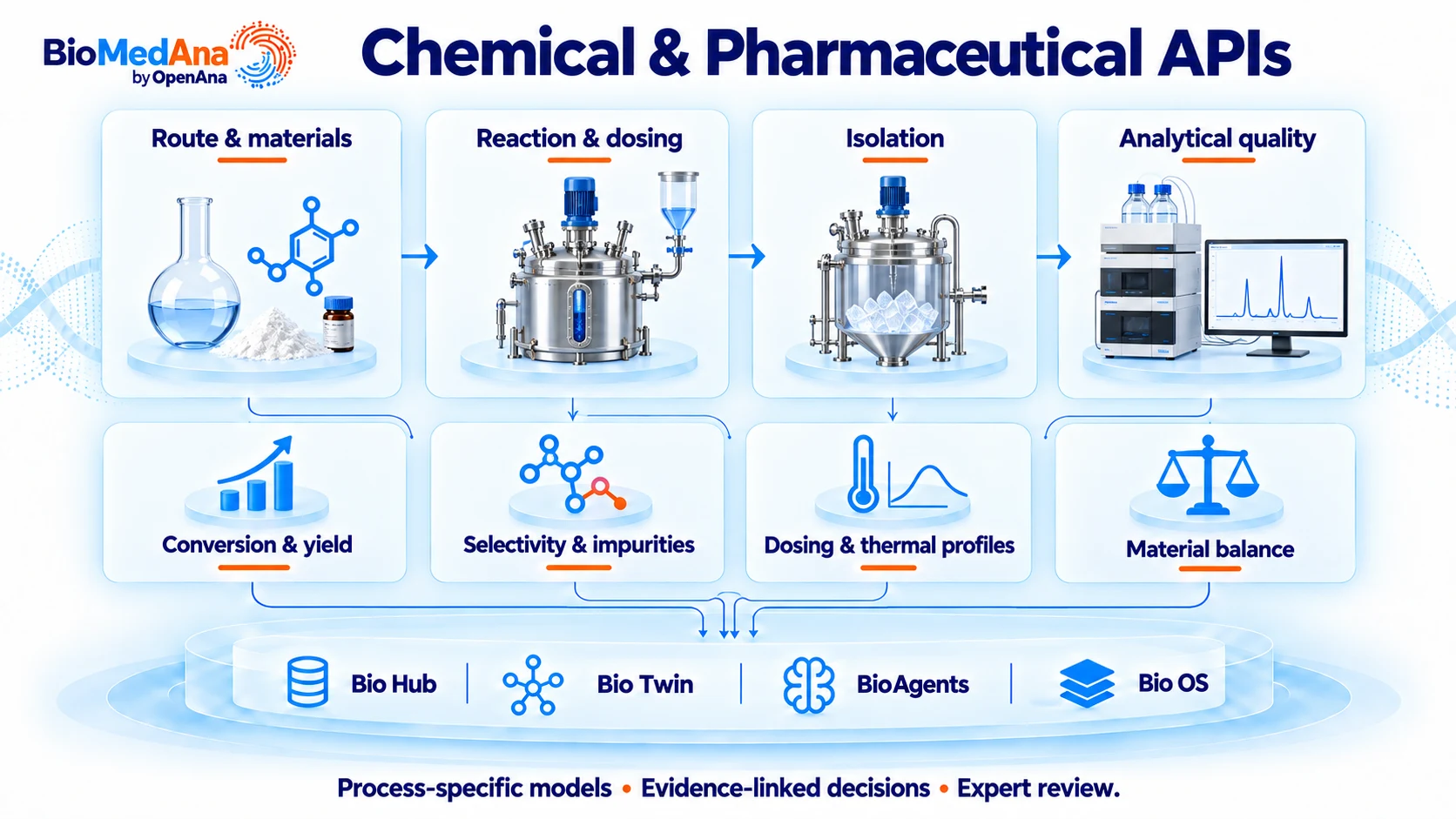
THE ENTERPRISE OBJECTIVE
A defined question.
A shared evidence basis.
Determine which evidence explains the impurity pattern, distinguish reaction selectivity from downstream recovery, and give the program a controlled path from historical investigation to experimental confirmation. Reuse the investigation method across routes without treating their chemistry or specifications as interchangeable.
Across sites, programs and functions
The use case follows a route step across development and transfer campaigns. The program team segments by product, route version, step, reagent lot, equipment and analytical method. Source data may originate in multiple operational systems, but this case assumes governed source-file delivery; it does not presume a live connector or plant-control integration. Evidence is assembled in an authorized program project from approved source exports. Separate programs retain separate project scope; portfolio reuse refers to methods, not an assumed automatic cross-project or cross-company data view.
Continuity as new campaigns arrive
Incoming campaign evidence is reconciled against reviewed field mappings and expected identities. Method changes and new impurity labels receive explicit scientific review. A trend based on one analytical method is not silently extended across a changed method, and the original source context remains available for investigation.
Reconstruct the incident before ranking performance
Initial signal
A receiving partner reports an impurity pattern that is less prominent in the sending organization's reference campaigns. Nominal endpoint conversion appears comparable, so the program opens an investigation into the reaction and isolation history.
What makes it enterprise work
The route has changed over development, reagent suppliers vary by campaign and analytical methods have evolved. Dosing is recorded differently across sites, while material from the reaction and isolated product are sampled at different stages.
The decisive comparison
The team narrows the comparison to the same route-step version and comparable assay basis. It follows the actual addition and hold sequence rather than comparing only nominal recipe temperature. The impurity pattern is then examined separately before and after isolation.
| Evidence domain | Decision it supports |
|---|---|
| Route and material context | Avoids pooling chemically different histories. |
| Reaction execution | Distinguishes the recipe from the actual run. |
| Analytical evidence | Makes sample timing and method comparability explicit. |
| Work-up and isolation | Separates selectivity from recovery and purification effects. |
The comparison is scoped by business and scientific context. Data volume is not used as a proxy for comparability, relevance or evidence quality.
HOW BIOMEDANA FITS
From source context
to a reviewable decision.
- 01
Define the route-step cohort
Select the product and route version, then attach the relevant reaction step, materials and campaign context. Keep development screens separate from manufacturing comparability evidence.
- 02
Establish analytical and execution comparability
Use Imports and Mapping Studio for source identity and units. Analytical reviewers establish impurity identity, sample stage, method suitability and any bridging/reanalysis requirement. Column mapping cannot make two methods scientifically comparable.
- 03
Trace the impurity through reaction and isolation
Use the Chemical API workspace and Analyze/Workbench on matched route-step evidence. Compare actual addition/hold history with sampled product and impurity results, then follow isolation on an appropriate assay or mass basis. Do not treat chromatographic area percent as molar selectivity.
- 04
Save the investigation and frame a bounded test
Save the route/method cohort, sampled impurity sequence, execution hypothesis and isolation question in a project report. Where Twin use is suitable, declare its input and evaluation basis before comparing scenarios; the follow-up experiment evaluates measured outcomes.
Separate analytical comparability from impurity behavior
Establish method and impurity identity
An impurity name or retention time alone does not prove that two sites measured the same species on the same basis. Analytical review establishes method suitability, identity evidence and any bridging or reanalysis required. Keep non-comparable measurements separate.
Preserve the analytical calculation basis
Chromatographic area percent, concentration, conversion, molar selectivity and isolated yield are different quantities. Use the relevant calibration/response basis and stoichiometry before deriving them. A label or a field mapping is not sufficient.
Distinguish formation from carry-through
Review stage-matched samples before and after work-up. A concentration change may reflect dilution or concentration rather than impurity formation or removal. Use the appropriate assay and material balance before interpreting impurity fate or isolation loss.
Test an execution hypothesis
Actual ramps, additions and hold times frame the candidate explanation. Material lot, route version and method changes may confound it. A bounded model scenario can propose a test only within its stated domain; measured follow-up evidence evaluates the outcome.
| Evidence layer | Meaning in the decision |
|---|---|
| Observed | What source measurements and recorded events establish. |
| Interpreted | The explanation consistent with those observations. |
| Predicted | A result under declared model assumptions. |
| Confirmed | The predeclared criterion is met in follow-up evidence; causal interpretation depends on study design. |
A focused conclusion and a confirmation plan
Interpret the evidence through explicit decision paths, then confirm the hypothesis with the agreed study.
| Evidence pattern | Interpretation | Next decision |
|---|---|---|
| If a subset of the apparent partner difference is not comparable on the available analytical basis. | Method/route differences must be resolved before pooling. | Retain matched measurements; request bridging or reanalysis. |
| If within the matched subset, the impurity pattern aligns with an addition/hold sequence. | Execution history is a candidate explanation with possible confounders. | Design a controlled study of the specific sequence. |
| If the pattern differs between reaction and isolated-product samples on the reviewed basis. | Formation and isolation carry-through remain separate questions. | Evaluate stage-matched assay and material-accounting evidence. |
The decision output is a route-step and method-qualified comparison with non-comparable measurements separated. Sending and receiving teams agree the execution hypothesis and confirmation criteria, analytical reviewers own bridging or reanalysis, and isolation behavior remains a separately scoped question.
| Confirmation element | What the next study establishes |
|---|---|
| Confirmation question | Does the candidate addition/hold sequence change the impurity response under comparable conditions? |
| Control variables | Route version, material basis, analytical method, concentration and work-up. |
| Responses | Measured conversion, product/impurity profile, isolated yield and relevant balance evidence. |
| Decision boundary | A predicted gain remains a proposal until a controlled experiment confirms the intended outcome. |
| Enterprise reuse | Reuse the evidence structure across partner transfers, retaining route-specific chemistry and limits. |
What your team reviews.
Impurity investigation pack: route-step/material cohort; assay and impurity-identity basis; sample/operation sequence; reaction versus isolation evidence; confounders; and the controlled confirmation plan.
Scope and interpretation
Analytical-method mapping does not establish scientific comparability. Keep reaction behavior, isolation and impurity identity distinct.
This scenario describes a proposed enterprise workflow. Deployment-specific integration, review and model behavior require verification. Business and process impact are evaluated against an agreed baseline and measured outcomes.
Explore the modality ↗Make the method repeatable across the enterprise
Route and process ownership
Process chemistry owns route-step definitions, reaction assumptions and the technical scope of a scenario.
Analytical ownership
Analytical teams own method comparability, sample basis and interpretation of impurity measurements.
Partner and quality review
Sending and receiving reviewers agree the evidence basis and confirmation criteria. Reports support the decision process without replacing established disposition procedures.
Deployment ownership
Define source delivery, partner-access requirements, retention and any connector or model integration as a scoped implementation workstream.
Rollout gates and evidence requirements
- 01
Historical route review
Reconcile the route-step, materials and analytical comparison basis.
- 02
Controlled confirmation
Test the declared hypothesis and evaluate measured outcomes against agreed criteria.
- 03
Partner investigation
Review the same source-linked evidence with sending and receiving teams.
- 04
Route portfolio reuse
Apply the method to other compatible steps while retaining chemistry-specific definitions.
Operating-model requirements are deployment-specific. Validate role/access behavior, reviewer workflows, retention, model governance and source delivery for the intended environment; this scenario does not assert certification or production readiness.
Measure investigation turnaround and partner alignment
The enterprise value is a consistent investigation and transfer method that connects chemistry, operations and quality across organizational boundaries.
| Value dimension | How to evaluate it |
|---|---|
| Investigation turnaround | Elapsed time to reconcile the route-step evidence and deliver a reviewed technical conclusion. |
| Partner alignment | Disputed data definitions resolved and open evidence requests tracked to closure. |
| Experiment effectiveness | Studies that answer the declared hypothesis, including negative or inconclusive outcomes. |
| Measured process impact | Confirmed yield or impurity change after implementation, with baseline and contributing changes documented. |
A credible benefit assessment
Choose a baseline period and comparable investigation or campaign scope. Record how elapsed time, review effort or process response is measured. Separate improvement in data preparation from improvement in scientific interpretation, and separate both from any measured manufacturing result. Include adverse, inconclusive and unchanged outcomes.
What leadership receives
A defined investigation scope; a common evidence basis for the participating teams; a documented conclusion with remaining uncertainty; and a confirmation plan with owners. Portfolio expansion follows demonstrated reuse and the required deployment checks, rather than an assumption that one successful analysis establishes every use case.
START WITH YOUR PROCESS QUESTION
Turn the evidence
into a reviewable next step.
Bring your program context, available evidence and the decision your team needs to make.