06 / Gene therapies / AAV
Reconciling vector yield, recovery and potency across AAV campaigns
A vector-process use case connecting production, fraction recovery, capsid attributes, genome evidence and functional assessment.
Proposed enterprise workflow · Source-linked analysis · Expert review
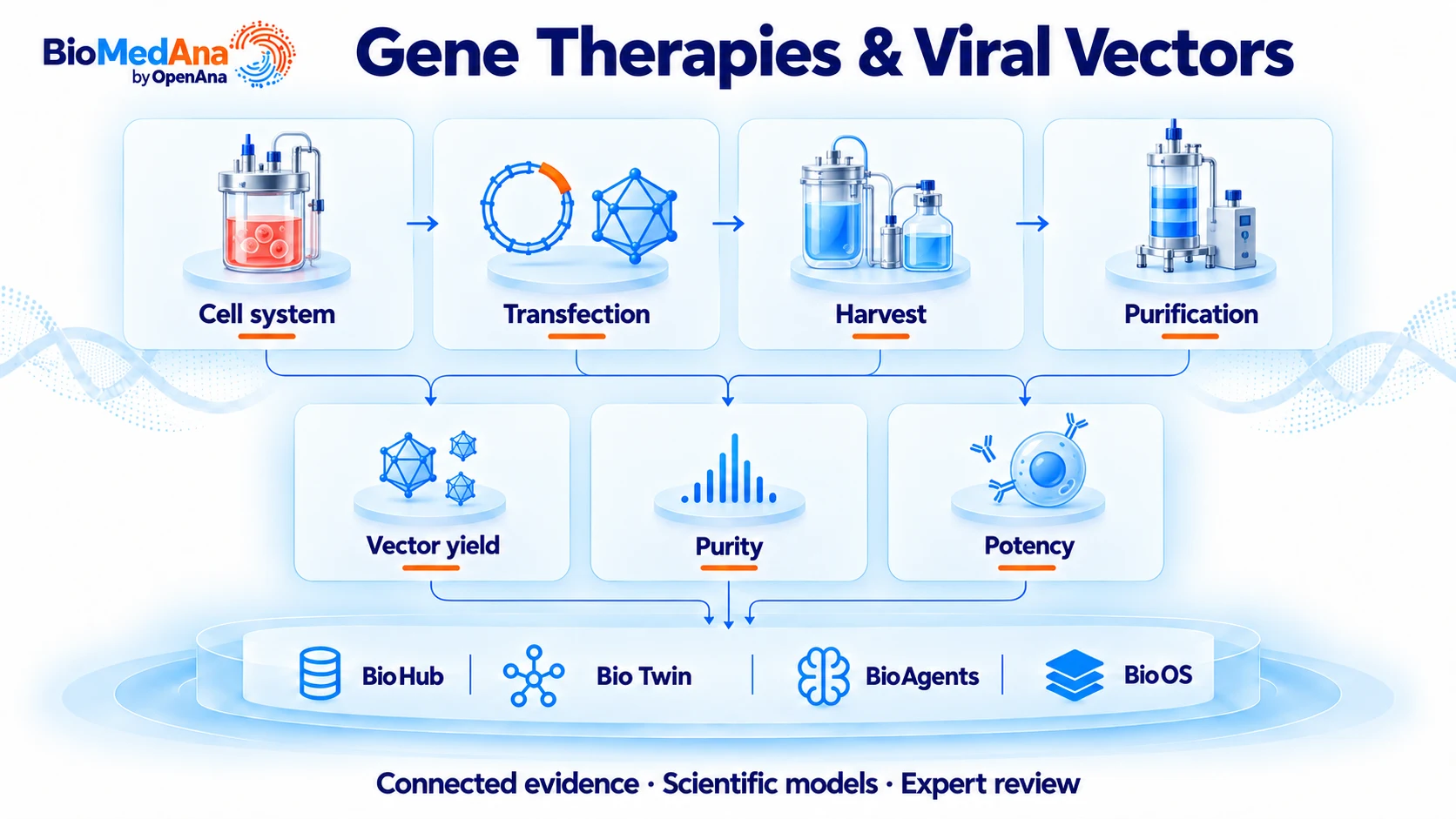
THE ENTERPRISE OBJECTIVE
A defined question.
A shared evidence basis.
Establish which vector quantities can be compared, distinguish concentration from total recovery and connect quality evidence to a specific production or purification question.
Across sites, programs and functions
An authorized AAV program project brings together approved source exports across production and purification campaigns. Serotype/capsid, vector construct, cell system, process version and assay basis define the comparison. The method may be reused across a vector portfolio, but unlike constructs and analytical populations are not pooled. The use case is AAV-specific; it does not imply that the same assays or process model apply to every viral-vector platform.
Continuity as new campaigns arrive
Incoming campaigns preserve the relation between run, harvest stream, purification fraction, pool and analytical sample. Changed assay targets, standards or methods require review before historical values are combined. Evidence from partners follows agreed project permissions and source delivery; no automatic cross-company access is assumed.
Reconstruct the incident before ranking performance
Initial signal
A program review sees favorable vector-genome concentration in selected campaigns but inconsistent total recovery and final quality evidence. The investigation asks whether the difference begins in production, harvest partitioning or purification pooling.
Enterprise complexity
Sites may report genome titer, capsid titer and functional response on different assay bases. Concentration changes during processing, and a fraction can be analytically rich yet contribute little total recovered material. Pool boundaries also determine what reaches the final sample.
Decisive comparison
Restrict to the relevant construct/capsid and reviewed assay basis. Connect volume to each titer sample, follow streams and fractions, then compare final genome, capsid and functional evidence as separate responses.
| Evidence domain | Decision it supports |
|---|---|
| Production context | Defines an appropriate vector cohort. |
| Stream and pool accounting | Separates titer from total recovered quantity. |
| Genome and capsid assays | Keeps distinct vector measures from being interchanged. |
| Quality and function | Prevents titer or capsid occupancy becoming a potency surrogate by assumption. |
The comparison is scoped by business and scientific context. Data volume is not used as a proxy for comparability, relevance or evidence quality.
HOW BIOMEDANA FITS
From source context
to a reviewable decision.
- 01
Define the vector and analytical cohort
Use project context and Run Registry to select construct, capsid, cell system and process version. Retain assay targets, standards and sample-stage metadata, with non-comparable campaigns explicitly separated.
- 02
Reconcile streams, fractions and measurements
Use Imports and Mapping Studio for run/sample links and units. Review harvest partitioning, fraction/pool membership and volume basis. Establish comparable assay results before calculating total quantity or stage recovery.
- 03
Compare recovery and quality together
Use the AAV workspace and Analyze/Workbench where the required data are available. Evaluate concentration, total recovered genome quantity and separate capsid/quality responses. A pool choice is reviewed against the declared quality objectives, not titer alone.
- 04
Prepare a bounded process decision
Save the stage accounting, pool evidence, assay basis and gaps in a report. Select a production or purification hypothesis for confirmation. Any model exploration requires a supported AAV implementation and intended-response evaluation; otherwise remain with measured analysis.
Separate genome quantity, capsid attributes and function
Titer and total quantity answer different questions
A volume change can increase concentration without increasing recovered vector. Total genome quantity requires the relevant genome-titer and stream volume on a compatible basis. Avoid counting the same stream twice or treating an analytical aliquot as the full pool.
Genome, capsid and function are distinct
Genome titer, capsid quantity, occupancy measures and functional assays reflect different properties. A higher full-capsid fraction is not automatically greater potency, and a genome/capsid ratio is not a universal full/empty measurement without a supported method interpretation.
Assay basis and integrity matter
Genome target, reference standard, sample treatment and method can affect comparison. A detected target region alone does not establish intact packaged genome. Retain the relevant integrity and impurity evidence rather than inferring it from one assay result.
Pool decisions require multiple responses
Evaluate recovery alongside the product-specific quality and functional evidence. A narrow pool may improve one attribute while reducing total recovery. Confirm that trade-off experimentally on comparable material; do not imply clinical efficacy from an analytical ranking.
| Evidence layer | Meaning in the decision |
|---|---|
| Observed | What source measurements and recorded events establish. |
| Interpreted | The explanation consistent with those observations. |
| Predicted | A result under declared model assumptions. |
| Confirmed | The predeclared criterion is met in follow-up evidence; causal interpretation depends on study design. |
A focused conclusion and a confirmation plan
Interpret the evidence through explicit decision paths, then confirm the hypothesis with the agreed study.
| Evidence pattern | Interpretation | Next decision |
|---|---|---|
| If concentration rises while volume-adjusted recovery falls. | The favorable titer does not establish a higher process output. | Review stream accounting and stage loss. |
| If a pool enriches a capsid attribute but reduces recovered quantity. | The choice involves a quality/recovery trade-off. | Evaluate the declared quality and functional objectives together. |
| If apparent campaign differences change after assay reconciliation. | Part of the comparison was method-dependent. | Retain compatible values and resolve analytical gaps. |
The decision output distinguishes upstream production, harvest/stream accounting and purification pooling. Reviewers see total quantity and separate quality/function responses on an agreed assay basis. The next study tests a defined process or pool decision rather than declaring a higher-titer campaign universally better.
| Confirmation element | What the next study establishes |
|---|---|
| Confirmation question | Does the selected production/pool change meet the intended recovery and quality objectives? |
| Control variables | Vector construct/capsid, source material, process version, assay and sample basis. |
| Responses | Stage genome recovery, relevant capsid attributes, integrity/impurity evidence and functional assay. |
| Decision boundary | Evaluate the declared product-specific response set; titer alone does not establish potency. |
| Enterprise reuse | Reuse the stream/assay data contract within compatible vector programs and transfers. |
What your team reviews.
AAV process investigation pack: construct/assay cohort; stream and pool map; titer/total-quantity accounting; distinct capsid/genome/function evidence; and a multi-response confirmation plan.
Scope and interpretation
An AAV-focused scenario: concentration, recovered quantity, capsid attributes, genome evidence and function are distinct. Titer alone does not establish potency.
This scenario describes a proposed enterprise workflow. Deployment-specific integration, review and model behavior require verification. Business and process impact are evaluated against an agreed baseline and measured outcomes.
Explore the modality ↗Make the method repeatable across the enterprise
Vector-program ownership
Own construct/capsid identity, cell system and process-version scope.
Process and purification ownership
Own harvest partitioning, fraction membership, volumes and pooling assumptions.
Analytical review
Own genome/capsid/function assay suitability, standards and interpretation of occupancy and integrity evidence.
Quality and deployment ownership
Define evidence review and partner delivery; verify access, supported modality behavior and model eligibility for the deployment.
Rollout gates and evidence requirements
- 01
Reconcile a vector campaign
Link production, streams, fractions, pools and assay samples.
- 02
Confirm the pool/process choice
Evaluate the intended multi-response trade-off on new evidence.
- 03
Review the measurement basis
Agree comparable titers, quantities and separate quality/function measures.
- 04
Reuse within vector scope
Extend the method with explicit construct, capsid and assay exceptions.
Operating-model requirements are deployment-specific. Validate role/access behavior, reviewer workflows, retention, model governance and source delivery for the intended environment; this scenario does not assert certification or production readiness.
Measure recovered vector evidence and decision readiness
The enterprise value is a shared view of what the AAV process actually recovered and how that material was characterized, without collapsing unlike measurements into one performance score.
| Value dimension | How to evaluate it |
|---|---|
| Accounting clarity | Coverage of linked streams, volumes, pool membership and compatible assays. |
| Decision turnaround | Time to a reviewed production/purification question and confirmation plan. |
| Transfer readiness | Open assay or stream-definition gaps agreed with the receiving organization. |
| Measured process response | Prospective recovery and quality/function outcomes against the declared objectives. |
A credible benefit assessment
Choose a baseline period and comparable investigation or campaign scope. Record how elapsed time, review effort or process response is measured. Separate improvement in data preparation from improvement in scientific interpretation, and separate both from any measured manufacturing result. Include adverse, inconclusive and unchanged outcomes.
What leadership receives
A defined investigation scope; a common evidence basis for the participating teams; a documented conclusion with remaining uncertainty; and a confirmation plan with owners. Portfolio expansion follows demonstrated reuse and the required deployment checks, rather than an assumption that one successful analysis establishes every use case.
START WITH YOUR PROCESS QUESTION
Turn the evidence
into a reviewable next step.
Bring your program context, available evidence and the decision your team needs to make.