BIOMEDANA TWIN / TECHNOLOGY TRANSFER
Make the receiving-site transfer decision explicit
Editorial date
Connect sending-site history, receiving-asset differences and bounded model comparisons to focus the next transfer study.
Engagement basis: Project-data comparison and process-model evaluation
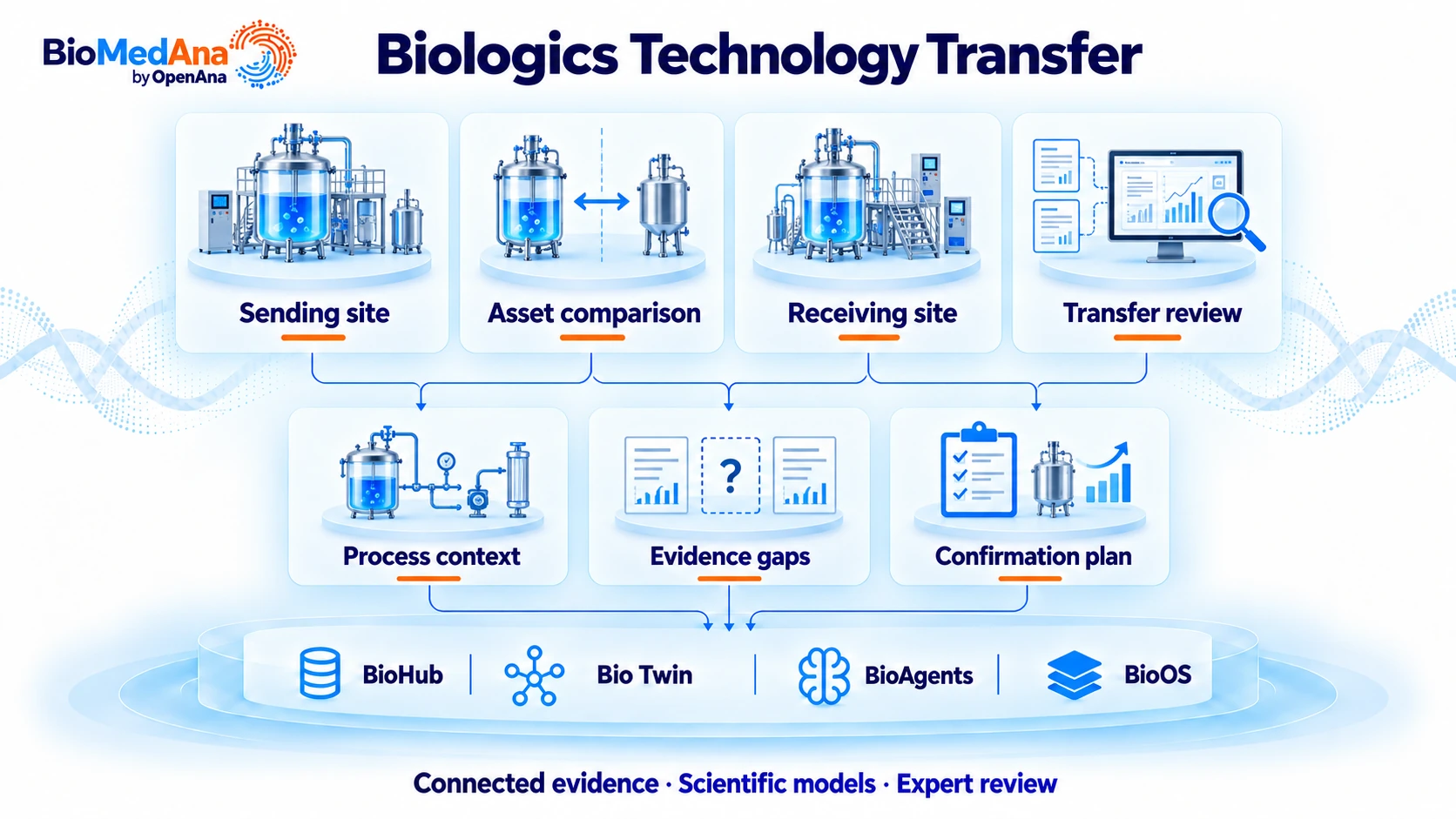
The transfer package is complete. The receiving team still cannot explain the risk.
A biologics process is moving between sites or into a CDMO network. The sending team has a development history and a familiar operating rationale. The receiving team has different assets, different local records and questions about how those differences affect the next transfer milestone. Both teams can point to a complete document package while still lacking a shared comparison basis.
The business problem is not simply slow document search. Unresolved differences can lead to repeated clarification cycles, an engineering campaign that tests the wrong question, or a late change to the transfer plan. Client confidentiality and program separation also matter: a CDMO needs reusable methods without mixing evidence across unrelated customer programs.
The scenario opens when the receiving team challenges an apparently straightforward equivalence claim. Are they seeing an asset effect, a different analytical basis, a changed process version or a genuine gap in the available history? BioMedAna helps structure that investigation before a model result is used to defend a preferred answer.
Which receiving-site differences matter enough to investigate before the next transfer milestone?
Identify the receiving-site differences that matter to the next transfer gate, resolve what can be resolved from existing evidence and assign the remaining confirmation work. Both sites should be able to reconstruct and challenge the same rationale.
Who owns the decision
Sending and receiving MSAT, process engineering and Quality
Work backward from the receiving-site question.
The receiving decision is stated first: which difference must be understood before the next transfer activity can proceed? The evidence team then assembles the relevant sending-site runs, receiving-site equipment basis and analytical-method crosswalk in an authorized project. Unmatched records stay visible instead of disappearing from a favorable comparison.
The team checks whether a difference can be evaluated through available engineering calculations or a suitable process model. Some differences concern measurement comparability or missing source context, and cannot be resolved by a more sophisticated prediction. Other differences require new equipment evidence or a separately scoped model extension.
The scenario comparison is then challenged for confounding. Site, process version and analytical method may have changed together. A statistical association cannot assign responsibility to one of them without additional evidence. The comparison pack distinguishes a supported finding, a plausible explanation and a question that still requires a study.
Start with a baseline your team can challenge.
| Evidence | What the team brings | How it informs the decision |
|---|---|---|
| Sending-site basis | Process versions, representative runs, equipment and quality-method context. | Define the reference process and its demonstrated range. |
| Receiving-site basis | Equipment specifications, available engineering data, proposed process conditions and method crosswalk. | Expose differences and missing evidence before scenario comparison. |
| Transfer evidence | Risk register, engineering results, deviations and agreed transfer criteria. | Keep the model comparison connected to the receiving decision. |
WHAT BIOMEDANA DOES / WHAT YOUR TEAM DECIDES
Connect the evidence.
Compare the scenarios.
- 01
Define comparable cohorts
Bio Hub retains site, product, process-version and assay context. Record why each run belongs in the comparison and which records remain unmatched.
- 02
Map asset and process differences
Compare relevant vessel and unit-operation inputs. Identify which differences can be represented by available calculations and which require additional equipment or process evidence.
- 03
Challenge the receiving scenario
Use a suitable Twin process model for bounded what-if comparisons. Keep site effects and other confounders visible; a modeled similarity is a hypothesis for review.
- 04
Hand over an actionable gap plan
Prepare a source-linked comparison pack with the differences, their scientific rationale and the additional studies required. MSAT and Quality own the next transfer gate.
Compare the alternatives on the same basis.
| Alternative | What is compared | What would change the answer |
|---|---|---|
| Transfer the nominal process basis | Use the sending-site process as the reference, with all material differences listed. | Identify which equipment and method differences prevent interpretation before calling the sites comparable. |
| Evaluate a receiving-site alternative | Represent the supported asset/process differences in a bounded scenario. | Review whether the model can answer this specific transfer question and what independent receiving-site evidence is required. |
| Resolve the evidence gap | Defer the process ranking when assay reconciliation or missing equipment context dominates the conclusion. | Assign the necessary measurement, crosswalk or study to a named receiving or sending owner. |
A decision pack with an owned next step.
A transfer readiness pack: cohort definitions, source and model versions, equipment-difference matrix, scenario comparisons, unresolved risks and a confirmation plan with owners.
| Review finding | Evidence interpretation | Next action |
|---|---|---|
| Comparable basis | Records, methods and process versions support the intended comparison. | Review the receiving scenario against the agreed transfer question. |
| Evidence gap | A method or equipment difference prevents interpretation. | Resolve the gap before ranking site performance. |
| Next study | A plausible process difference remains after reconciliation. | Define the study needed to challenge the explanation. |
Explain the finding before choosing the action.
An actionable review distinguishes different kinds of progress. Resolving a method mismatch can remove a misleading comparison. Identifying a supported engineering difference can focus a receiving-site study. Demonstrating that the current model cannot represent a material difference can prevent an unsupported forecast from entering the transfer rationale.
The transfer packet records the cohort, source cut, asset assumptions, model version, scenario results and evidence gaps together. Sending and receiving MSAT teams can challenge the same basis, rather than circulate independent plots whose exclusions or calculation versions have drifted.
BioMedAna supports preparation and scientific comparison; the receiving organization owns the transfer decision and the applicable qualification pathway. A faster comparison process is evaluated separately from successful process transfer, formal comparability or PPQ. The latter require their own product- and site-specific evidence.
Show what changed, who owns it and how it is measured.
Record the baseline before introducing the workflow. Compare the complete effort and the quality of the resulting decision, including review, reconciliation and follow-up work. The measures below define an evaluation plan; they are not claimed customer results.
| Value question | Baseline to record | Evidence of progress | Owner |
|---|---|---|---|
| Evidence reconciliation | Clarification cycles and time spent matching source records and analytical context. | Time to a comparison basis accepted by both teams. | Sending/receiving MSAT |
| Critical transfer gaps | Open issues that could change the next transfer activity. | Gap closure with an owner, evidence reference and disposition. | Transfer lead |
| Model contribution | Which receiving-site question a model is expected to answer. | Whether the comparison survives independent challenge and receiving-site evidence. | Scientific/model owner |
| Program execution | Planned transfer gates and dependencies. | How the clarified study plan changes readiness or sequencing; record realized effects separately. | Program sponsor |
Start with one decision. Retain the evidence as the work expands.
A staged delivery and review path
- 01
Choose one transfer gate
Start with a specific product, process version, site pair and receiving decision. Define confidentiality and access boundaries.
- 02
Build the shared evidence basis
Reconcile run identities, analytical methods, equipment data and exclusions. Agree the records that make up the comparison.
- 03
Review the scenario and its limits
Challenge asset assumptions, confounding and model applicability. Produce a prioritized gap and confirmation plan.
- 04
Close the loop at the receiving site
Attach new study evidence to the retained comparison basis. Review whether the transfer rationale changed and route the next decision through established owners.
The first engagement has an explicit boundary and receiving owner. New campaigns, source layouts, equipment evidence or model versions return through the appropriate review before the prior analysis is reused. Any broader use needs its own evidence and authorization.
Define success before relying on the model.
Measure evidence-reconciliation effort, closure of critical transfer gaps and time to a reviewed study plan. Track later process results separately from investigation-preparation improvements.
Implementation and scientific boundary
A process-model comparison does not establish formal product comparability, replace PPQ or authorize a process change. Transfer criteria and qualification remain product- and site-specific.
This use case defines a proposed workflow, its evidence and its decision path. It does not report measured customer outcomes. Acceptance criteria, model suitability and operating authority are agreed for the intended deployment.
START WITH YOUR DECISION
Make the next study
specific to your process.
Bring the available evidence, the model question and the people who will act on the result.