INDUSTRY INSIGHTS · AI-enabled biologics discovery
AstraZeneca is moving AI deeper into biologics. Who owns the handoff?
AstraZeneca’s October 15, 2026 perspective puts AI inside biologics design. Our founder lens: the next bottleneck is carrying experimental context into development.
AstraZeneca perspective published:
What happened on October 15
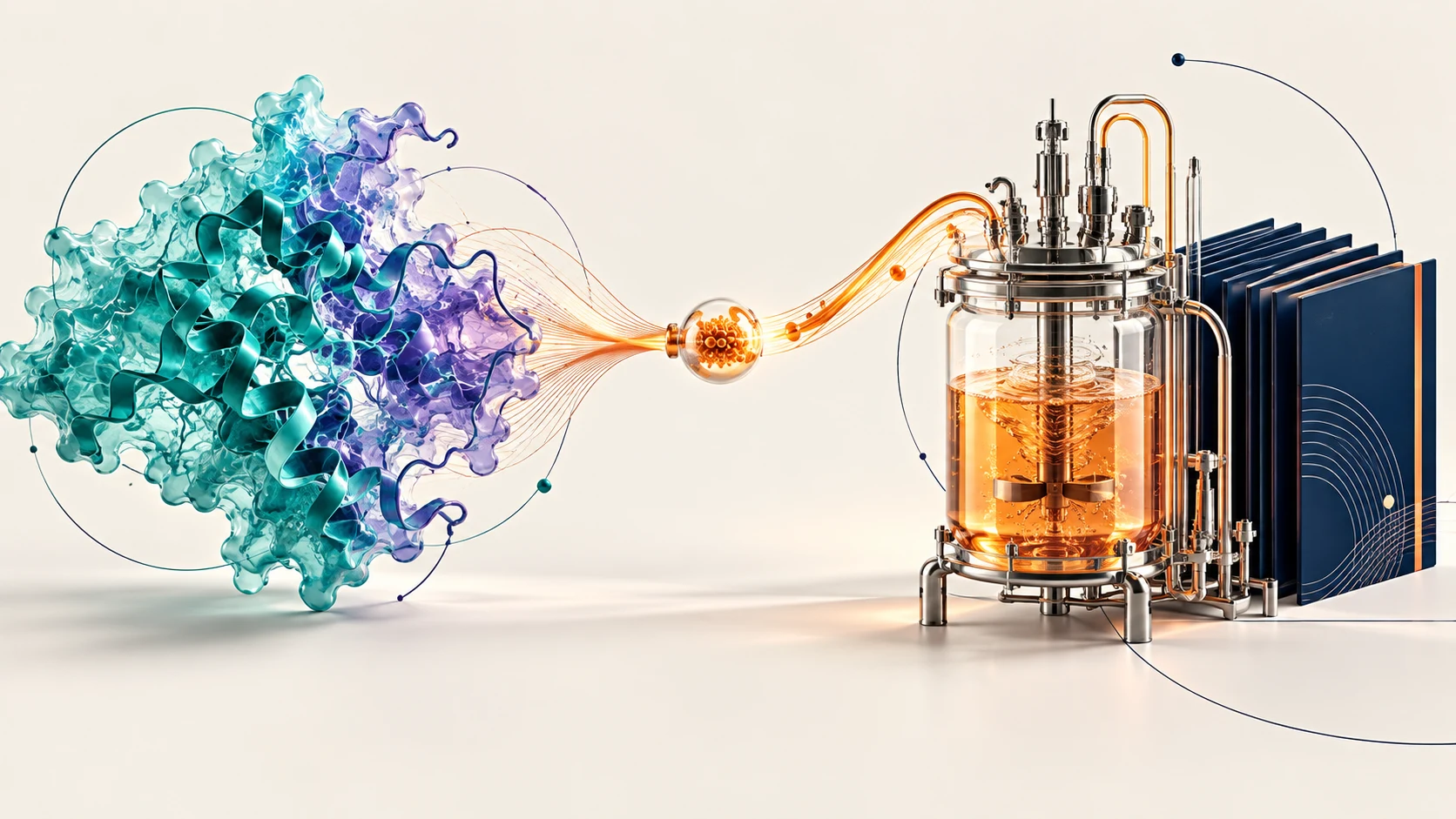
On October 15, 2026, AstraZeneca published its perspective on AI-enabled biologics design. The company describes bringing AI and automation into discovery to help scientists evaluate and refine molecules earlier, including attention to properties relevant to manufacturing. This is a description of its approach, rather than an independently controlled comparison of development outcomes.
The useful signal for founders is organizational: AI is being discussed as part of how discovery work happens. A model on its own is less interesting than the decisions, experiments and handoffs around it. That is where we would look for both the opportunity and the next source of friction.
Our take: discovery speed changes where work accumulates
Imagine a small biologics company that can now propose many more plausible candidates in a design cycle. Its assay capacity, analytical team and process-development budget have not expanded at the same rate. Faster proposal generation makes selection more important. It can also increase the amount of context that must travel with each candidate.
Our view is that this creates a practical opening for founders: make the transition between a computational hypothesis and a development decision easier to inspect. A team should be able to ask why one molecule was selected, which experiments support it, which properties remain unknown and which result would change the ranking. Those answers should survive a personnel change or an external handoff.
The next team needs the reasoning behind the candidate, as well as the candidate itself.THE BIOMEDANA LENS
A hypothetical antibody program shows the problem
Consider two candidates with encouraging binding results. Candidate A appears stronger in the initial assay, while candidate B has a less compelling headline result but fewer unresolved process questions. The decision is not simply which has the better score. It is which uncertainty the team can afford to resolve next, given the intended product and the available runway.
Now imagine that discovery shares only a ranked spreadsheet with process development. Missing assay conditions, inconsistent candidate names or an unclear history of sequence changes can turn the next experiment into a reconstruction exercise. A clean handoff would retain the sequence version, material identity, assay method, conditions, result and rationale behind the selection.
This is an illustrative scenario, not a reported AstraZeneca program. Its purpose is to show why a faster design engine still needs a disciplined path to experimental learning.
What a founder should build into the workflow
Start with one decision that matters to the program. For example: which candidate should receive the next round of characterization? Define the required evidence before asking a system to summarize or rank it. That reduces the chance that an attractive output quietly becomes the acceptance criterion.
- Give each candidate and sequence version a stable identity that follows materials and experiments.
- Separate predicted properties, measured results and reviewer interpretation.
- Preserve assay conditions and processing steps behind each result.
- Record unresolved properties alongside favorable findings.
- Keep the selection rationale and the next experiment together so later teams understand the decision.
The tradeoff: more context can become more administration
There is a real implementation risk here. Requiring scientists to fill out a large new record for every design can slow the work the system is supposed to improve. We would begin with the evidence already produced by the experiment and capture only the additional context needed to make the next decision reviewable.
Integration should follow that same discipline. A founder does not need to connect every system before proving value. One program, one selection decision and one repeatable evidence trail can expose the missing links. Expand after the team demonstrates that the record helps another scientist make a supported decision with less reconstruction.
How we would judge whether it works
Count the time from an experimental result becoming available to a reviewed next action. Track how often a decision is delayed because its supporting context cannot be found, and how often a team repeats work to resolve an identity or version question. Compare these with a baseline from the same kind of decision.
We would also test disagreement. Give a reviewer a candidate with favorable results and an unresolved weakness. Can they identify the weakness, trace the source and choose an appropriate follow-up? A workflow that only makes a preferred answer faster is less useful than one that helps a team recognize when it should pause.
For BioMedAna, the product implication is to connect evidence, models and reviewed actions across development. The current headline is AI entering more of discovery. The founder opportunity is making the learning survive the journey out of it.
Where the handoff can quietly break
The most obvious failure is a missing file. A subtler failure is a complete set of files that no longer tells a consistent story. A candidate name may refer to one sequence in a design system and a later revision in an assay report. A reviewer may remember why a low result was excluded, while the exported table preserves only the exclusion. The records exist; the meaning has become dependent on a person.
We would examine this by asking a scientist who was not involved in the experiment to reconstruct the decision. Give them the retained record and a defined question: why did candidate A advance? Every explanation that requires an informal conversation reveals a piece of context the workflow may need to preserve. This is a useful product discovery exercise because it starts from an actual gap in work.
The solution should remain proportionate. Capturing every conversation would create noise and discourage use. The goal is to retain the claims that affected the decision, their evidence, their owner and the uncertainty left open. That is a smaller and more useful target than recording everything a team did.
What we would pass on to another builder
Choose a handoff with a real receiving team. Agree with that team on what it needs to accept the work, then build backward from the questions it asks. A polished discovery interface can conceal how much reconstruction happens after export. The receiving scientist is an essential user of the product.
Keep disagreement visible. When one person favors a candidate and another wants an additional assay, that difference may reveal a missing criterion or a different tolerance for uncertainty. A workflow should make it possible to record the disagreement and the experiment chosen to resolve it. Flattening that discussion into a single confidence score can remove the most useful part of the review.
Finally, close the loop after the handoff. Ask which assumptions held, which were revised and which evidence was difficult to reuse. Feed that learning into the next record. The founder advantage comes from making each transfer easier, with a process the team can repeat as programs and partners change.
A decision record that can travel with the molecule
Here is how we would turn the handoff into a usable scientific record. Each row answers a different question; none should be substituted for another.
| What travels | Question it answers | What is lost without it |
|---|---|---|
| Candidate and sequence version | Which exact design was tested? | Results can be attached to the wrong molecular version. |
| Prediction and assumptions | Why did the team expect this candidate to work? | A favorable result can be interpreted without knowing the original hypothesis. |
| Material and assay context | What was actually measured, and under which conditions? | Differences in execution can be mistaken for differences in design. |
| Decision and unresolved questions | Why advance it, and what must be tested next? | The receiving team repeats the selection discussion. |
The questions behind the headline
Does faster AI design mean faster biologics development?
It can improve part of the workflow, but overall progress also depends on experiments, characterization, process work and review. We would measure the whole decision cycle before making an end-to-end speed claim.
What should a small team implement first?
Pick one recurring candidate-selection handoff. Keep the design version, supporting experiments, selection rationale and unresolved questions together, then test whether the receiving team can use that record.
Is this an account of AstraZeneca’s internal results?
No. The news hook comes from AstraZeneca’s dated perspective. The handoff examples, decision record and implementation advice are BioMedAna’s original analysis.
Follow the evidence
Original BioMedAna editorial analysis. The linked sources support the reported developments; examples, frameworks and product implications reflect our perspective.
Explore the underlying concepts
CONTINUE READING
More from the BioMedAna lens.
 Biologics development & CMC
Six months to IND readiness? Read the decisions behind the timeline.
Read perspective ↗ AI & experimental validation
Lonza and Onava put expression data inside the AI loop. That is the signal.
Read perspective ↗ AI adoption & protein engineering