GOVERNANCE & COMPLIANCE
Why Agentic AI in GxP Fails Without Deterministic Guardrails
Agentic AI in GxP can fail when an uncertain interpretation becomes an action without an independently enforced check. Deterministic guardrails address that execution risk by applying explicit rules to tool access, inputs, workflow transitions and approvals.
BioMedAna's recommended approach is to let agents assemble evidence and propose next steps while controlled software and accountable reviewers govern consequential actions. Reliable deployment also depends on intended-use validation, source quality and change control; guardrails alone cannot establish compliance.
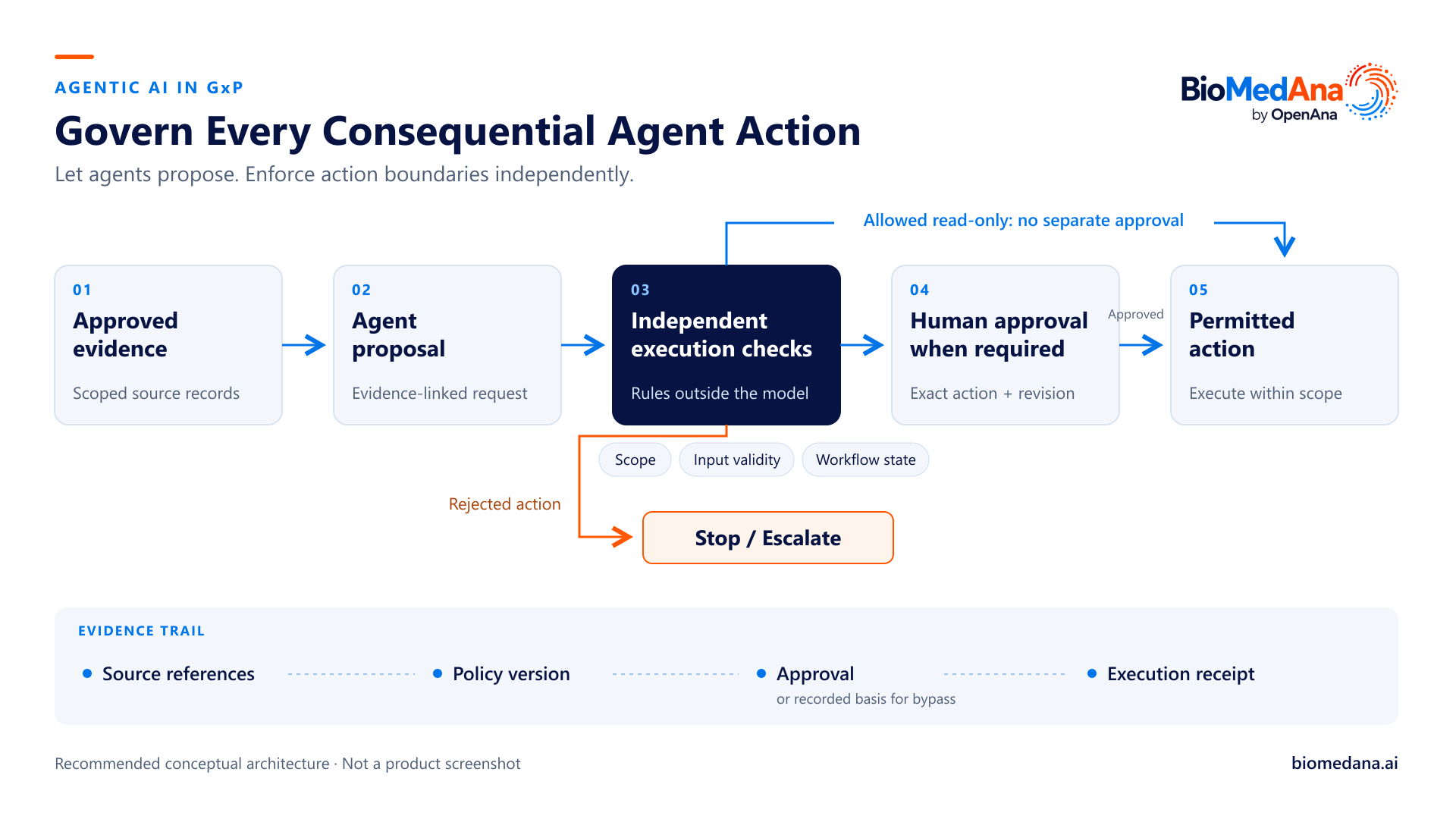
Where agentic AI in GxP encounters a control problem
Consider an agent preparing a batch-investigation brief. Retrieving an approved assay result, proposing a root-cause hypothesis and changing a quality record are different activities. A useful architecture gives each a distinct permission boundary.
Without that separation, a plausible interpretation can travel farther than the evidence supports. An agent might associate a process excursion with an equipment event, treat that association as an established cause, and attempt to update a downstream record. The control failure occurs when the workflow permits that transition without the required evidence and authority.
This article uses “fails” to describe such foreseeable failure paths — not to claim that every unguarded agent has failed in production. Its primary context is pharmaceutical manufacturing and associated quality evidence; specific obligations depend on the system's intended use and applicable jurisdiction.
For applicable closed electronic-record systems, 21 CFR 11.10 addresses validation, authorized access, audit trails, permitted sequencing and authority checks. It does not prescribe an architecture named “deterministic AI guardrails.” Translating these control objectives into agent execution boundaries is an engineering recommendation.
What are deterministic guardrails for agentic AI?
Deterministic guardrails are explicit software checks that govern whether a proposed action may execute. Given the same evaluated inputs, policy version and relevant system state, they apply the same decision rule. Examples include tool allowlists, role checks, required-field validation and approval requirements. They constrain execution independently of the model's narrative; they do not guarantee that an allowed action is scientifically appropriate.
BioMedAna recommends placing these checks between the agent and the systems it can affect. An agent may request a tool call, but a separate enforcement layer evaluates the caller, target record, proposed operation and applicable workflow state.
The model must not be able to grant itself permissions, replace the policy or create its own approval. Otherwise, the apparent boundary remains part of the agent's discretionary behavior.
| Proposed activity | Recommended execution control | Evidence to retain |
|---|---|---|
| Retrieve batch data | Check program, site, record and user scope | Record identifiers, source versions and access result |
| Compare process values | Validate units, required inputs and approved calculation method | Inputs, method version and calculation output |
| Prepare an investigation brief | Require source references and explicit unresolved questions | Draft revision and linked evidence |
| Write an approved summary | Bind permission to the exact reviewed payload and destination | Reviewer identity, approval and write receipt |
| Retry an interrupted write | Reconcile the prior outcome and prevent duplicate execution | Operation identifier and reconciliation result |
These are proposed controls for a bounded workflow, not claims that every BioMedAna deployment includes this exact implementation.
Why are prompts alone insufficient in GxP workflows?
A prompt describes desired behavior but does not itself remove a tool permission, reject an invalid payload or establish an authenticated approval. In BioMedAna's recommended design, prompts guide evidence gathering and interpretation, while independent controls enforce action boundaries. A model-generated statement that approval exists must never substitute for checking the actual approval record and its scope.
For example, “do not modify controlled records” is useful guidance. A read-only service account makes that limit enforceable. Likewise, asking an agent to use the approved procedure is weaker than a source-selection rule that verifies procedure identity, revision and applicability before the workflow proceeds.
An additional AI reviewer may help identify missing evidence. It should not be the sole mechanism deciding whether another agent has authority to execute a restricted action.
A hypothetical monoclonal-antibody batch investigation
Assume an MSAT team is investigating a titer shift. The agent has access to selected batch trends, assay results, equipment events and approved procedures. This scenario is illustrative; it is not a customer result.
The agent finds that a feed-pump maintenance event preceded the affected run. It proposes under-delivery as one explanation. At this stage, the useful output is a hypothesis with source references and competing explanations — not an established root-cause verdict.
A bounded workflow would proceed as follows:
- Check the evidence scope. Confirm that the records belong to the selected batch, equipment and time window. Flag missing calibration or delivery data.
- Check the analysis. Run defined calculations through controlled tools, with explicit units and input requirements. Reject incomplete inputs instead of filling them with plausible estimates.
- Prepare the review brief. Separate observations, calculations, hypotheses and unresolved questions. Identify the evidence needed to distinguish pump performance from other explanations.
- Route the decision. Give the designated MSAT and Quality reviewers the exact brief and source context. Keep batch disposition outside this pilot's allowed actions.
If the maintenance record is inaccessible, the agent should expose the gap and stop the affected analysis. If a reviewer requests a different batch comparison, that change should trigger a new scope check rather than silently extending access.
The intended benefit is a clearer, more reviewable investigation trail. Whether the workflow reduces preparation time or reviewer workload must be measured in the pilot; those outcomes should not be assumed.
Which agent actions need human approval?
Approval requirements should follow the action's consequences, intended use and governing procedure. For an initial evidence-assembly pilot, BioMedAna recommends human authorization before consequential writes, controlled-record changes or externally used outputs. Batch disposition should remain outside the agent's authority in this example. Routine permitted retrieval can proceed within its defined scope without treating every read as a new approval event.
Approval must identify what was reviewed: the content revision, destination and requested action. If the agent changes the payload afterward, the earlier approval should not automatically authorize the new version.
The approval gate also needs an accountable owner and a usable review package. Requiring a click without presenting the supporting evidence does little to improve the quality of the decision.
How should teams validate an agent workflow?
Start with a defined intended use, named users, permitted actions and foreseeable failure paths. Test the integrated workflow — including retrieval, tools, permissions, approval gates and recovery — not only the model's answers. Establish acceptance criteria before testing, retain the results and resolve unacceptable failures. Validation depth should reflect the workflow's risk and applicable quality-system requirements.
FDA's 2023 manufacturing discussion paper raises questions about AI model validation, data management and lifecycle maintenance. It is explicitly a discussion paper, not draft or final guidance, and should not be presented as an agent-specific compliance checklist.
BioMedAna recommends testing ordinary cases alongside deliberate boundary challenges:
- A valid request referring to the wrong site or batch.
- Conflicting procedure revisions or a missing source record.
- A numerically valid result expressed in the wrong units.
- A write request without approval, or with approval for a different revision.
- An interrupted operation whose completion is uncertain.
- A retrieved document containing instructions to bypass the workflow's permissions.
For each case, specify the expected outcome: continue, reject, request missing evidence or escalate. Evaluate false blocks as well as missed blocks. An excessively restrictive control can make the workflow unusable and encourage workarounds.
What evidence belongs in an agent audit trail?
A useful operational evidence record links the request, user identity, source versions, proposed action, policy decision, reviewer decision and execution result. For applicable electronic records, regulatory audit-trail requirements must also be addressed. BioMedAna recommends distinguishing the regulated record history from supporting AI operational logs, with defined access, retention and review rules for each.
Capture observable evidence: tool inputs and outputs, denied operations, document references and approval receipts. Do not rely on a generated narrative about what the agent supposedly did. Logs should support reconstruction of the relevant event without indiscriminately copying sensitive data into another repository.
The practical question for a reviewer is: can I determine which information supported this output, which controls were applied, and who authorized the resulting action?
Explore BioMedAna OS: See how a governed platform layer enforces scope, approval and auditability independently of the underlying model.
Explore BioMedAna OS ↗How should model and tool changes be controlled?
Assess changes against the workflow's intended use and previously demonstrated behavior. A new model, prompt, tool schema, retrieval configuration or source mapping can affect results even when the user interface looks unchanged. BioMedAna recommends versioning these components, evaluating their impact, repeating affected tests and authorizing deployment through the relevant change process before expanding use.
In tech transfer, the same field name may represent a different measurement or operating context at the receiving site. In PPQ or routine manufacturing, an apparently minor change to input mapping can alter the interpretation of process evidence. The workflow boundary therefore needs both software rules and current SME knowledge.
A hybrid model can provide a useful quantitative check only within its established scope. Passing a numerical range check does not prove biological plausibility, establish causality or demonstrate that a model is suitable for a new scale or modality.
Build a bounded workflow before expanding autonomy
BioMedAna's view is that the most useful first deployment starts with a narrow scientific question, identifiable evidence and an accountable decision owner. Define what the agent may retrieve, what it may calculate, what it may propose and what it may never change.
BioMedAna Agents describes evidence-linked outputs, scoped tools and expert review, with customer-specific intended use and validation evaluated for each engagement. This positioning supports a supervised workflow; it does not establish that any particular implementation is already validated.
Deterministic controls make action boundaries testable. Source governance makes the evidence interpretable. Scientific and Quality review establish whether the proposed conclusion is fit for the decision. A useful agent workflow needs all three.
BRING US ONE EVIDENCE-HEAVY WORKFLOW
Discuss a bounded BioMedAna Agents pilot.
Bring one evidence-heavy workflow and its Quality owner to explore scoped tools, deterministic checks and traceable approval with our team.
Frequently asked questions
What are deterministic guardrails for agentic AI?
Deterministic guardrails are explicit software checks that govern whether a proposed action may execute. Given the same evaluated inputs, policy version and relevant system state, they apply the same decision rule — tool allowlists, role checks, required-field validation and approval requirements. They constrain execution independently of the model's narrative; they do not guarantee that an allowed action is scientifically appropriate.
Why are prompts alone insufficient in GxP workflows?
A prompt describes desired behavior but does not itself remove a tool permission, reject an invalid payload or establish an authenticated approval. Prompts should guide evidence gathering and interpretation, while independent controls enforce action boundaries. A model-generated statement that approval exists must never substitute for checking the actual approval record and its scope.
Which agent actions need human approval?
Approval requirements should follow the action's consequences, intended use and governing procedure. Human authorization is recommended before consequential writes, controlled-record changes or externally used outputs. Routine permitted retrieval can proceed within its defined scope without treating every read as a new approval event.
How should teams validate an agent workflow?
Start with a defined intended use, named users, permitted actions and foreseeable failure paths. Test the integrated workflow — including retrieval, tools, permissions, approval gates and recovery — not only the model's answers. Establish acceptance criteria before testing, retain the results and resolve unacceptable failures.
What evidence belongs in an agent audit trail?
A useful operational evidence record links the request, user identity, source versions, proposed action, policy decision, reviewer decision and execution result. Regulated electronic records and supporting AI operational logs should be distinguished, with defined access, retention and review rules for each.
How should model and tool changes be controlled?
Assess changes against the workflow's intended use and previously demonstrated behavior. Version the model, prompt, tool schema, retrieval configuration and source mapping, evaluate their impact, repeat affected tests and authorize deployment through the relevant change process before expanding use.
Sources
Verified October 5, 2026. Regulatory assertions are limited to the cited provisions; architecture recommendations are explicitly BioMedAna's point of view.
- eCFR, 21 CFR 11.10: validation, access, audit trails, sequence and authority controls. The retrieved page reports currency through October 2, 2026.
- FDA, Artificial Intelligence in Drug Manufacturing: 2023 discussion paper; disclaimer and lifecycle questions. Not binding guidance or an agent-specific standard.
- BioMedAna Agents: primary company description of supervised workflows and engagement-specific evaluation. Not independent performance evidence.
- BioMedAna OS, Hub and Trust & Compliance: verified destinations for contextual internal links.